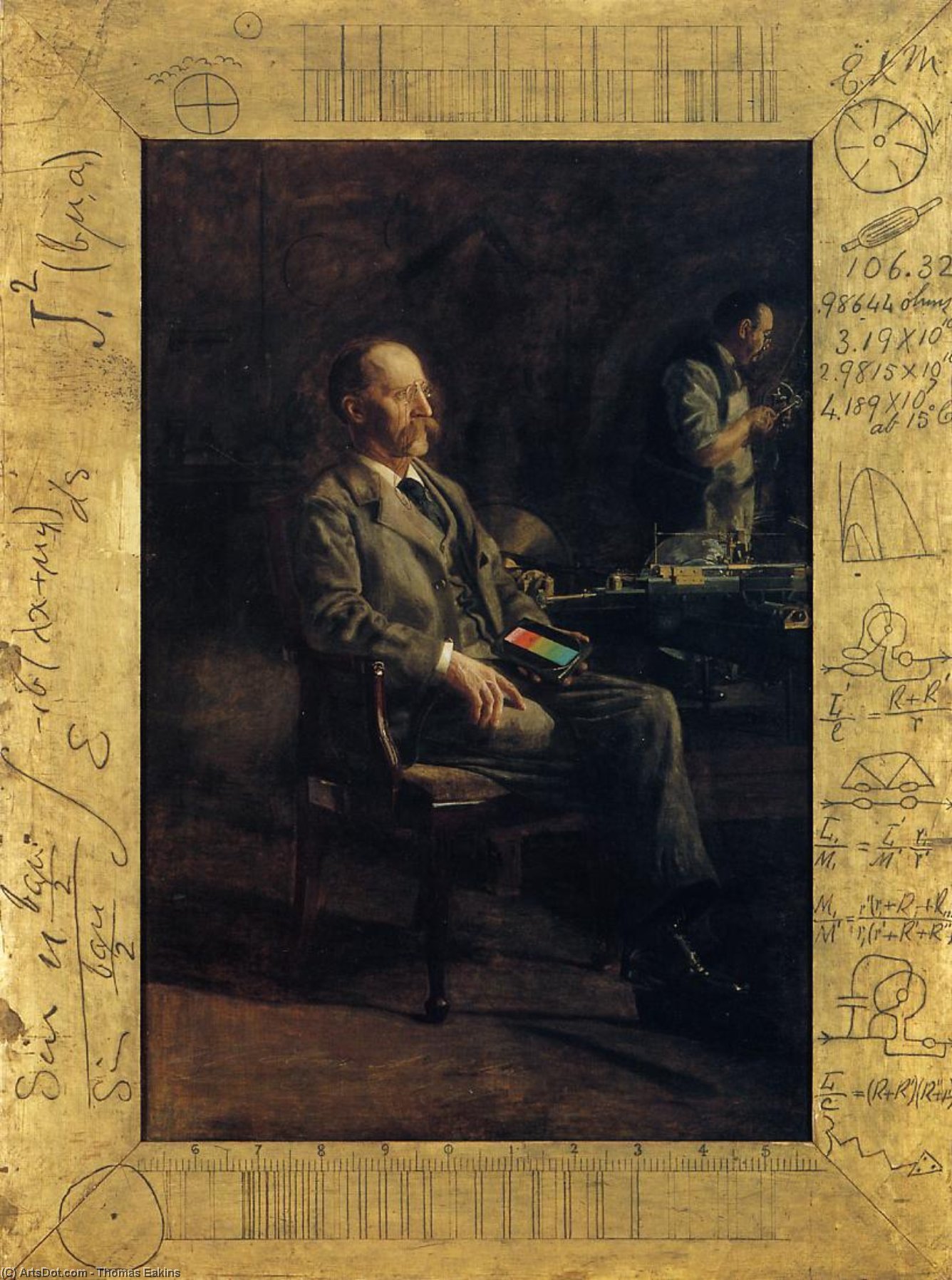
Explore Thomas Eakins's masterful portrait of Professor Henry A. Rowland—a stunning example of American realism capturing detail and psychological insight into the subject’s demeanor.
Otkrijte Tomasa Ekinsa (1844-1916), ključnog američkog slikara realizma poznatog po snažnim portretima, dinamičnim scenama veslanja i anatomskoj preciznosti. Istražite njegovo nasleđe sada! Slike kao što su "Max Schmitt u pojedinačnom skulu" i "Klinički čas dr Grose" predstavljaju njegov realizam.
Istražite američku umetnost od Koplija do Poloka u Addison galeriji u Andoveru, MA! Besplatan ulaz i raznovrsne kolekcije, uključujući fotografiju i modele brodova.
A Study in Observation: Thomas Eakins’s Portrait of Professor Henry A. Rowland
Thomas Cowperthwait Eakins (1844–1916) stands as an unparalleled figure in American art—a painter whose unwavering commitment to realism propelled him to the forefront of his era, leaving behind a legacy marked by unflinching portraits, dynamic rowing scenes and anatomical precision. He wasn’t merely attempting to depict reality; he sought to dissect it, understand its intricate workings, both physical and psychological, before reconstructing it on canvas with an honesty that often provoked debate and challenged conventional artistic norms. Eakins's Philadelphia—a city far removed from the idealized landscapes of Romanticism—became his crucible, shaping his artistic vision through encounters with surgeons, rowers, and ordinary citizens – subjects he rendered with a meticulous attention to detail that distinguished him from many of his contemporaries.
Early Influences and Artistic Formation
Eakins’s formative years instilled in him not only intellectual curiosity but also a profound respect for scientific inquiry. His exposure to the anatomical studies conducted by Dr. Samuel Drennan, a surgeon at Pennsylvania Hospital where he apprenticed, profoundly impacted his artistic approach. This dedication to observation—to painstakingly documenting the human form with unparalleled accuracy—became the cornerstone of Eakins’s distinctive style. Unlike Impressionists preoccupied with capturing fleeting moments of light and color, Eakins prioritized anatomical correctness and psychological nuance, striving to convey not just what he *saw*, but also what he *felt*. He meticulously studied cadavers alongside his fellow artists, absorbing knowledge of musculature and skeletal structure—a practice considered unorthodox by many of his peers.
The Portrait’s Composition and Technique: A Masterclass in Realism
“Portrait of Professor Henry A. Rowland,” completed in 1897, exemplifies Eakins's mastery of realism. The painting depicts Rowland, a prominent physicist and professor at Drexel Institute of Art and Science, seated at a desk cluttered with papers—a deliberate choice that speaks volumes about the intellectual climate of the time. Eakins employed a pyramidal composition, anchoring Rowland’s figure centrally while subtly directing the viewer's gaze upwards towards his face. The artist utilized oil paints on canvas with remarkable layering and blending techniques, achieving an astonishing level of tonal gradation that captures the subtle nuances of light and shadow—a hallmark of Eakins’s meticulous craftsmanship. Note the careful rendering of Rowland’s skin texture, conveying a palpable sense of presence and intellect.
Symbolism Beyond Appearance: Exploring Inner Landscape
Beyond its formal elements, “Portrait of Professor Henry A. Rowland” resonates with symbolic significance. The desk laden with scientific instruments—a telescope and charts—represents Rowland's dedication to intellectual pursuits and his unwavering belief in empirical observation. These objects serve as visual metaphors for the pursuit of knowledge and understanding—themes central to Eakins’s artistic worldview. Furthermore, Rowland’s posture exudes confidence and composure, reflecting a man who commands respect through intellect and conviction. The artist subtly conveys this inner strength through careful positioning and facial expression, inviting contemplation on the complexities of human character.
Emotional Impact: Capturing Essence Through Detail
Ultimately, Eakins succeeds in conveying an emotional resonance that transcends mere visual representation. “Portrait of Professor Henry A. Rowland” isn’t simply a likeness; it's an embodiment of intellect, dignity, and quiet contemplation—qualities that Eakins skillfully captures through painstaking detail. The painting compels viewers to consider not just what they see on the surface but also what lies beneath—the inner landscape shaped by experience and driven by curiosity. Like many of Eakins’s portraits, it lingers in the memory long after viewing, prompting reflection on the enduring power of observation and artistic truthfulness. It remains a testament to Eakins's ability to transform a simple depiction into an emotionally evocative masterpiece—a cornerstone of American realist painting.