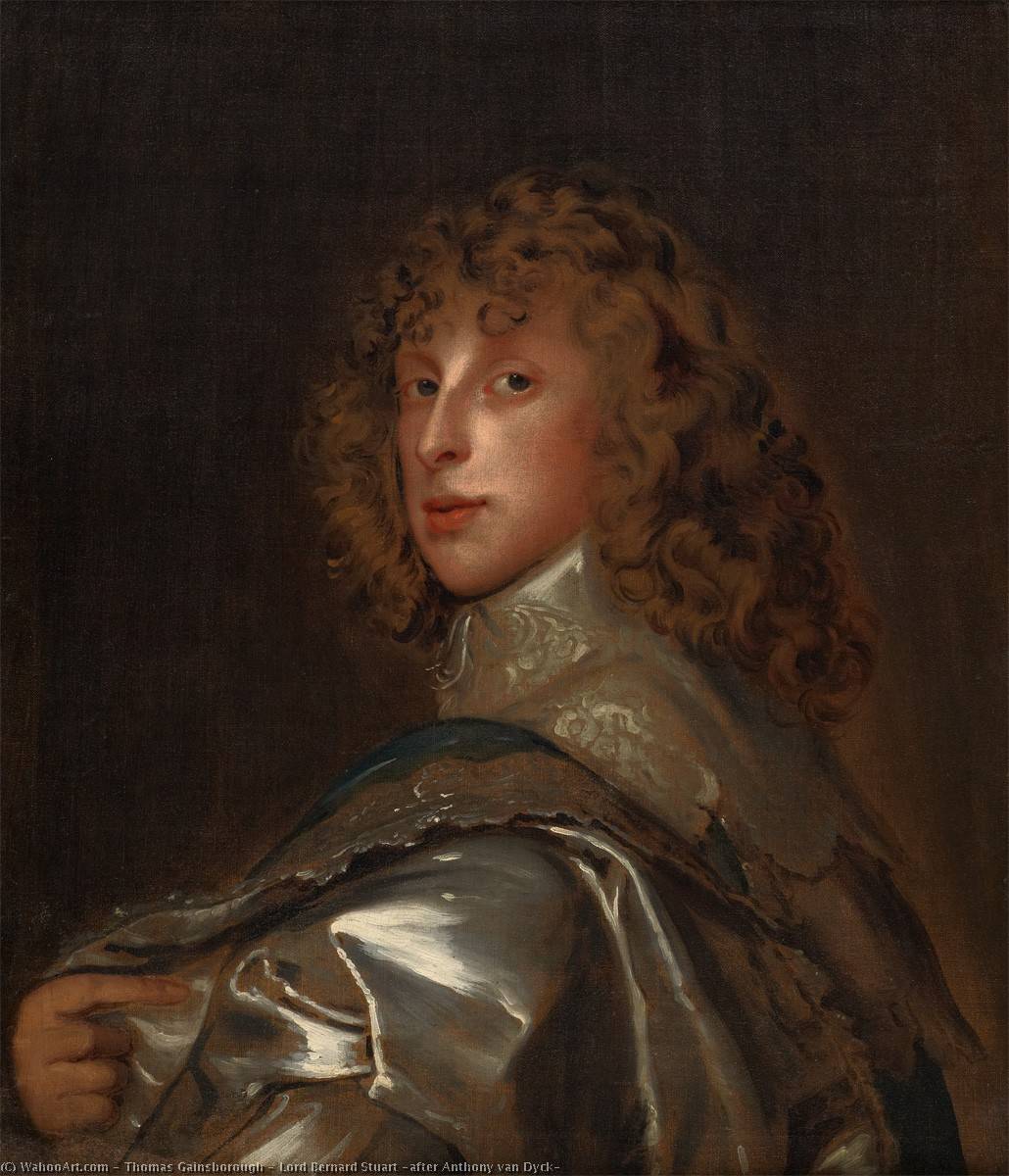
This captivating portrait showcases Lord Bernard Stuart (after Anthony van Dyck), executed by Thomas Gainsborough in 1760. Featuring a blonde-haired gentleman adorned in opulent attire, the painting captures a dignified gaze and subtle expression against a richly textured backdrop.
A Legacy Reimagined: The Radiance of Lord Bernard Stuart
In the grand tapestry of British art history, few moments capture the intersection of lineage and light as poignantly as Thomas Gainsborough’s “Lord Bernard Stuart.” Completed around 1760, this masterful oil on canvas is far more than a mere portrait; it is a profound dialogue between two eras of greatness. While the work serves as a tribute to the nobility of the subject, it also acts as a sophisticated homage to the legendary Anthony van Dyck. By revisiting Van Dyck’s celebrated likeness of Charles Stuart—Lord Bernard’s father—Gainsborough does not simply copy a predecessor; he breathes new, Georgian life into a Baroque foundation, creating a piece that resonates with both historical weight and fresh, atmospheric vitality.
The portrait presents Lord Bernard Stuart seated with an air of effortless grace, his presence anchored by a richly draped chair that speaks to his high social standing. Gainsborough’s brushwork masterfully navigates the complexities of texture, from the crispness of a white shirt to the shimmering luster of a silver coat. Through the delicate application of sfumato, the artist softens the edges of the figure, allowing him to emerge seamlessly from a subtly textured background. This backdrop, reminiscent of the rolling, pastoral hills of Suffolk, provides a sense of depth that prevents the portrait from feeling static, instead imbuing the scene with a living, breathing environment.
The Alchemy of Light and Shadow
To behold this work is to witness a masterclass in chiaroscuro. Gainsborough employs a dramatic interplay between light and shadow to sculpt the form of the nobleman, lending a three-dimensional physicality to the subject. This technique does more than define shape; it creates an emotional atmosphere of solemn dignity. The muted palette—dominated by sophisticated browns, creams, and silvers—reflects the understated elegance favored by the 18th-century aristocracy, ensuring that the focus remains on the psychological nuance of the sitter’s expression.
There is a deliberate, captivating connection forged between the subject and the observer. By positioning Stuart’s gaze directly toward the viewer, Gainsborough invites us into a silent communion. Whether one perceives a hint of a smile or a moment of deep contemplation, the painting demands engagement. For the discerning collector or interior designer, this piece offers a unique opportunity to introduce a sense of timeless authority and intellectual depth into a space. It is an artwork that does not merely decorate a wall but commands the room, serving as a window into an era where nobility was defined by both character and the exquisite mastery of light.