A Vision of Georgian Grace
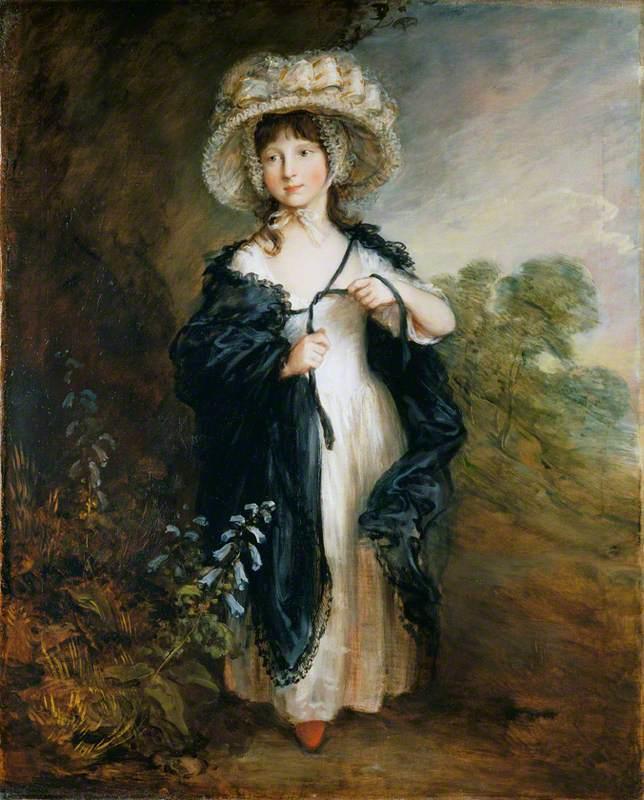
In the quietude of Thomas Gainsborough’s 1782 masterpiece, Miss Haverfield, we encounter more than just a portrait; we step into a refined era of English elegance and contemplative beauty. The painting presents a young woman, likely in her early teens, whose presence radiates a delicate, ethereal charm. Rather than confronting the viewer with a bold or theatrical gaze, she looks softly to the side, her eyes averted in a gesture that embodies the 18th-century ideals of modesty and inward reflection. This subtle avoidance of direct eye contact invites the observer into her private world of thought, creating an intimate connection that feels both timeless and profoundly personal. Her pale, luminous complexion and dark, flowing hair serve as focal points of light against the more somber tones of her attire, capturing a moment of youthful innocence caught in the amber of history.
The sartorial details of the piece speak eloquently to the status and sophistication of the subject. Dressed in a crisp white gown accented by intricate lace at the neckline and sleeves, Miss Haverfield embodies the polished refinement of the late Georgian period. A dark, elegant cloak drapes gracefully over her shoulders, providing a striking visual contrast that adds significant depth and weight to the composition. This interplay between the bright, airy textures of the lace and the heavy, enveloping darkness of the cloak creates a rhythmic movement across the canvas, guiding the eye through the delicate folds of fabric and the soft contours of her form.
Mastery of Light and the Rococo Spirit
Technically, Miss Haverfield is a testament to Gainsborough’s unparalleled ability to manipulate light and texture. While his style draws inspiration from the great Venetian masters, he infused his work with a uniquely British sensibility—one that favors a certain atmospheric lightness over rigid formality. His brushwork in this piece is a masterful balance of precision and fluidity; while the fine details of the lace and the subject's features are rendered with exquisite care, there is an underlying looseness to the strokes that lends the painting a sense of vitality and breath. This technique allows the light to appear as if it is truly dancing upon the surfaces of the silk and skin, creating a lifelike luminosity that has captivated collectors for centuries.
The background of the portrait further enhances this atmospheric quality. Eschewing a sterile or overly ornate studio setting, Gainsborough places his subject within a soft, muted landscape. The gentle suggestion of trees and foliage in the distance provides a naturalistic sanctuary for the sitter, grounding her aristocratic elegance in the tranquil beauty of the English countryside. This integration of portraiture and landscape—a hallmark of Gainsborough’s genius—creates a harmonious whole where the human spirit and the natural world exist in perfect, quiet equilibrium.
An Enduring Legacy for the Modern Collector
For the discerning art lover or interior designer, a reproduction of Miss Haverfield offers much more than mere decoration; it provides an infusion of historical soul and classical poise into a contemporary space. The painting’s palette—dominated by sophisticated muted greens, deep browns, and luminous whites—is remarkably versatile, capable of complementing both traditional period rooms and sleek, modern minimalist interiors. It serves as a conversation piece that evokes the romanticism of the 18th century while maintaining a serene aesthetic that promotes tranquility.
Owning a high-quality reproduction of this work allows one to preserve the legacy of Thomas Gainsborough’s "quiet grace." Whether placed in a sunlit library or as a focal point in a grand hallway, the portrait brings with it an aura of intellectual depth and aesthetic refinement. It is an invitation to pause, to reflect, and to find beauty in the subtle nuances of light, texture, and human emotion that Gainsborough so masterfully captured over two hundred years ago.