Tomas Gejnzboro (1727-1788) – britanski slikar poznat po portretima i pejzažima! Otkrijte eleganciju, lakoću poteza i uticaj na Konstebla. Osnivač Kraljevske akademije!
А Тапатреи оф Тиме: Експлореинг Енглесхс Херитхе
Степ ин то а релм где северити шепи фром ведерд стеонс анд вибрант тапетрис уфолд кросс ландсејпс степд ин легенд. Енглеска Херитџу исант мерели прецесион колекцион оф биллидингс; итс а профунд јурни тох те нарратив оф енглеск сефс, мителицли пресервед анд пассионатли пресентед. Фром инпозинг рампартс оф Довер Кастла, гардинг те чаннел ф
A Portrait of Power and Enlightenment
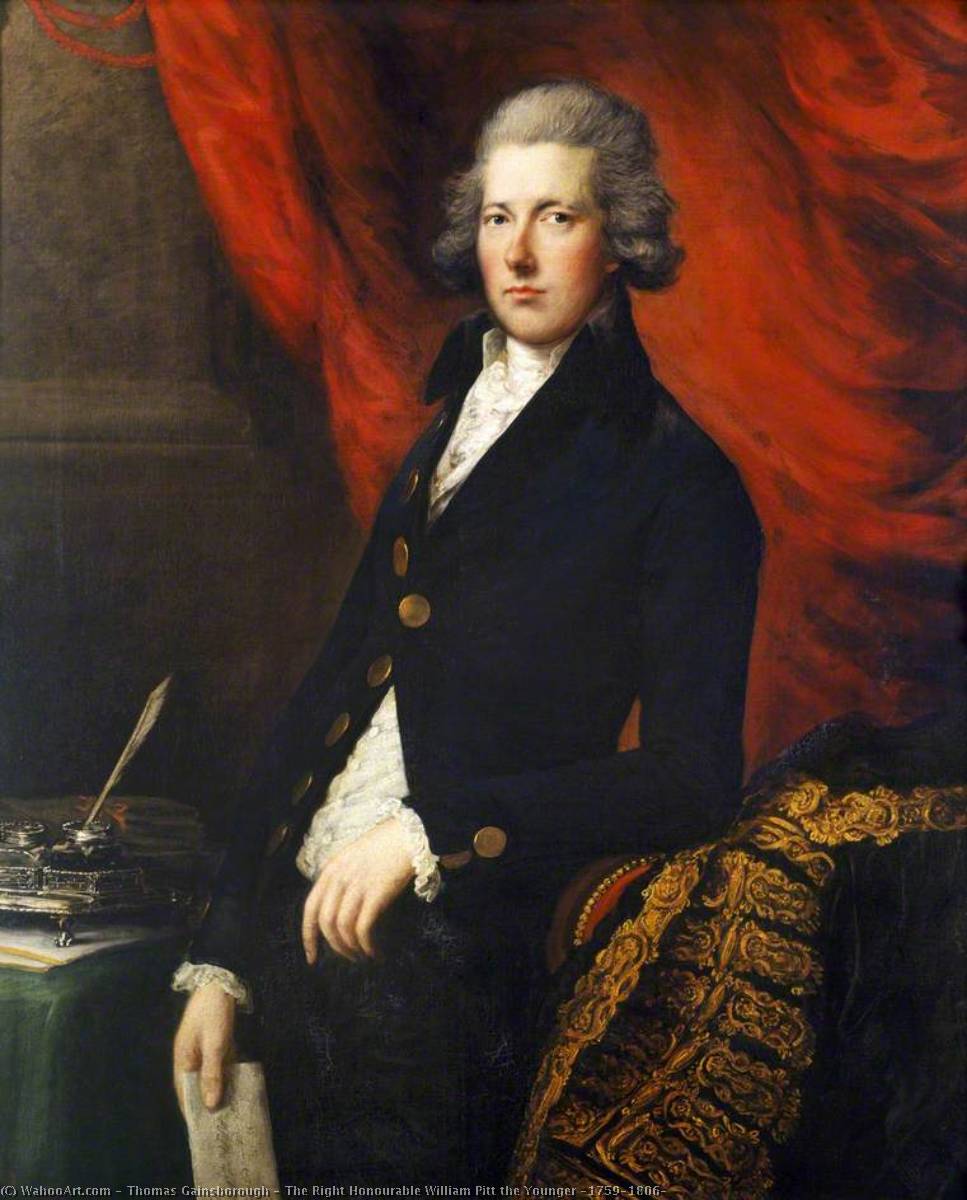
To gaze upon this portrait of The Right Honourable William Pitt the Younger is to encounter not merely a likeness, but an embodiment of late eighteenth-century British political gravity. Painted around 1790, this work captures the formidable presence of one of history's most consequential statesmen. Thomas Gainsborough, the master painter whose brushstrokes seemed capable of capturing the very spirit of Georgian England, has rendered Pitt in a moment of thoughtful repose. The sitter is depicted seated, his gaze directed just off-camera, suggesting a mind perpetually engaged with matters beyond the immediate view of the viewer. His attire—the crisp white shirt contrasting sharply with the black jacket and tie—speaks to the disciplined elegance expected of men of his stature during this era of burgeoning industrial and political might.
The Artistry of Gainsborough's Hand
Gainsborough’s technique here is a masterful display of portraiture, blending formal representation with an almost spontaneous vitality. While the subject matter is inherently weighty—the weight of governance and public life—the execution retains a certain airy grace characteristic of the artist. Observe the handling of the fabric; it possesses a luminous quality that suggests both expense and meticulous care. The background elements are thoughtfully composed to support, rather than distract from, the central figure. The visible books, placed near the left and right flanks, serve as subtle signifiers of intellect and erudition, anchoring Pitt within an environment conducive to deep thought and scholarly pursuit. These details transform a simple portrait into a narrative tableau.
Symbolism and Setting: A Study in Intellect
The inclusion of these carefully placed props—the books and the substantial chair—is key to understanding the painting's symbolic language. They do not merely decorate; they contextualize. The books speak to Pitt’s profound engagement with law, history, and philosophy, suggesting that his political acumen was rooted in deep study. The composition itself balances formality with a sense of private contemplation. It invites the viewer to consider the man behind the title—the intellect wrestling with the demands of empire. This duality between public duty and private thought is what gives the portrait its enduring emotional resonance.
Bringing History Home: Decorating with Legacy
For the discerning collector or interior designer, this reproduction offers an unparalleled opportunity to infuse a space with historical gravitas and artistic pedigree. Imagine this piece gracing a library, a formal study, or a drawing-room where conversation is expected to be as rich as the art itself. The scale of 127 x 102 cm ensures it commands attention without overwhelming a sophisticated setting. Owning a reproduction allows one to connect tangibly with the golden age of British portraiture, bringing home not just paint on canvas, but a palpable echo of Enlightenment ambition and enduring political drama.