A Symphony of Light and Shadow
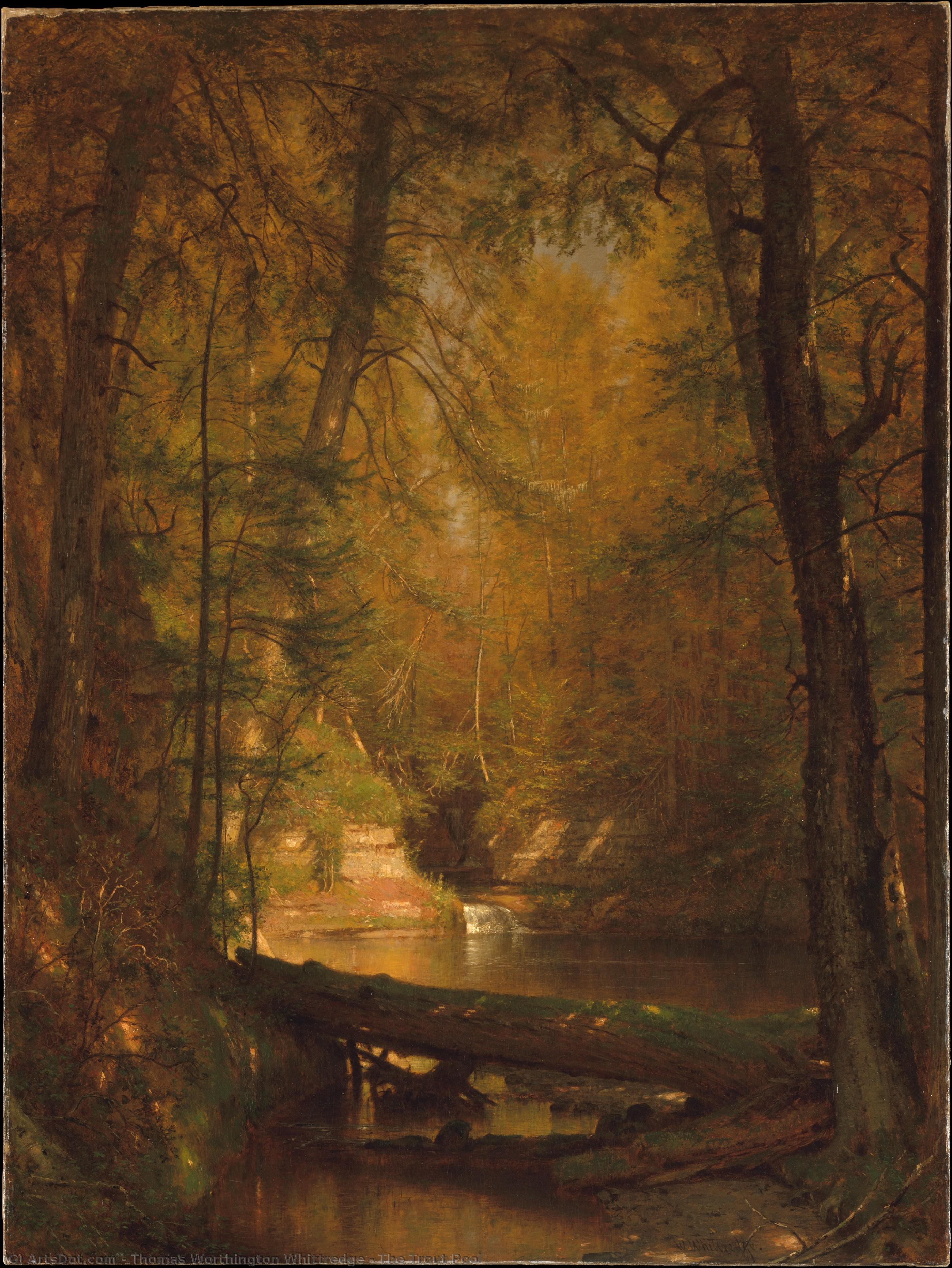
In the quiet depths of the American wilderness, where the sunlight struggles to pierce through a dense canopy of ancient trees, lies the soul of Thomas Worthington Whittredge’s “The Trout Pool.” This masterpiece serves as more than a mere depiction of a woodland stream; it is a profound meditation on the interplay between the seen and the unseen. As a pivotal figure within the Hudson River School, Whittred enough to capture not just the topography of the Hudson Valley, but its very spirit. The painting invites the viewer into a secluded sanctuary, where a tranquil waterway winds through a lush landscape, bordered by towering sentinels of timber that cast long, dramatic shadows across the forest floor.
The technique employed in this oil on canvas is nothing short of masterful. Whittredge, having refined his skills at the prestigious Düsseldorf Academy, brought a meticulous attention to detail that allowed him to render the textures of mossy rocks, feathery ferns, and the shimmering surface of the water with breathtaking realism. Yet, he transcends mere botanical accuracy through his use of luminism—a technique characterized by the soft, atmospheric glow that seems to emanate from within the painting itself. By juxtaposing deep, velvety shadows with radiant bursts of light in the middle ground, Whittredge creates a theatrical tension that breathes life into the stillness, making the forest feel as though it is caught in a single, eternal moment of transition.
The Pastoral Ideal and Emotional Resonance
Beyond its technical brilliance, “The Trout Pool” embodies the 19th-century American pursuit of the pastoral ideal. During an era of rapid industrialization, artists of the Hudson River School sought to preserve a sense of spiritual connection to the untouched wild. In this work, the subtle inclusion of human figures—small, quiet presences near the water’s edge—suggests a harmonious coexistence between man and nature. They are not conquerors of the landscape, but humble observers, much like the viewer themselves, lost in the serene majesty of the scene. This sense of scale evokes a feeling of sublime awe, reminding us of the grandeur that exists in the quietest corners of our world.
For the discerning collector or interior designer, this painting offers an unparalleled opportunity to introduce a sense of tranquility and timeless elegance into a space. The composition’s balance of organic forms and light-filled voids provides a natural focal point that can anchor a room, offering a window into a peaceful, primordial era. Whether placed in a sunlit gallery or a sophisticated study, the reproduction of this work carries with it the weight of history and the soothing rhythm of nature’s own heartbeat. It is an investment in atmosphere, bringing the enduring beauty of the American landscape into the modern home.