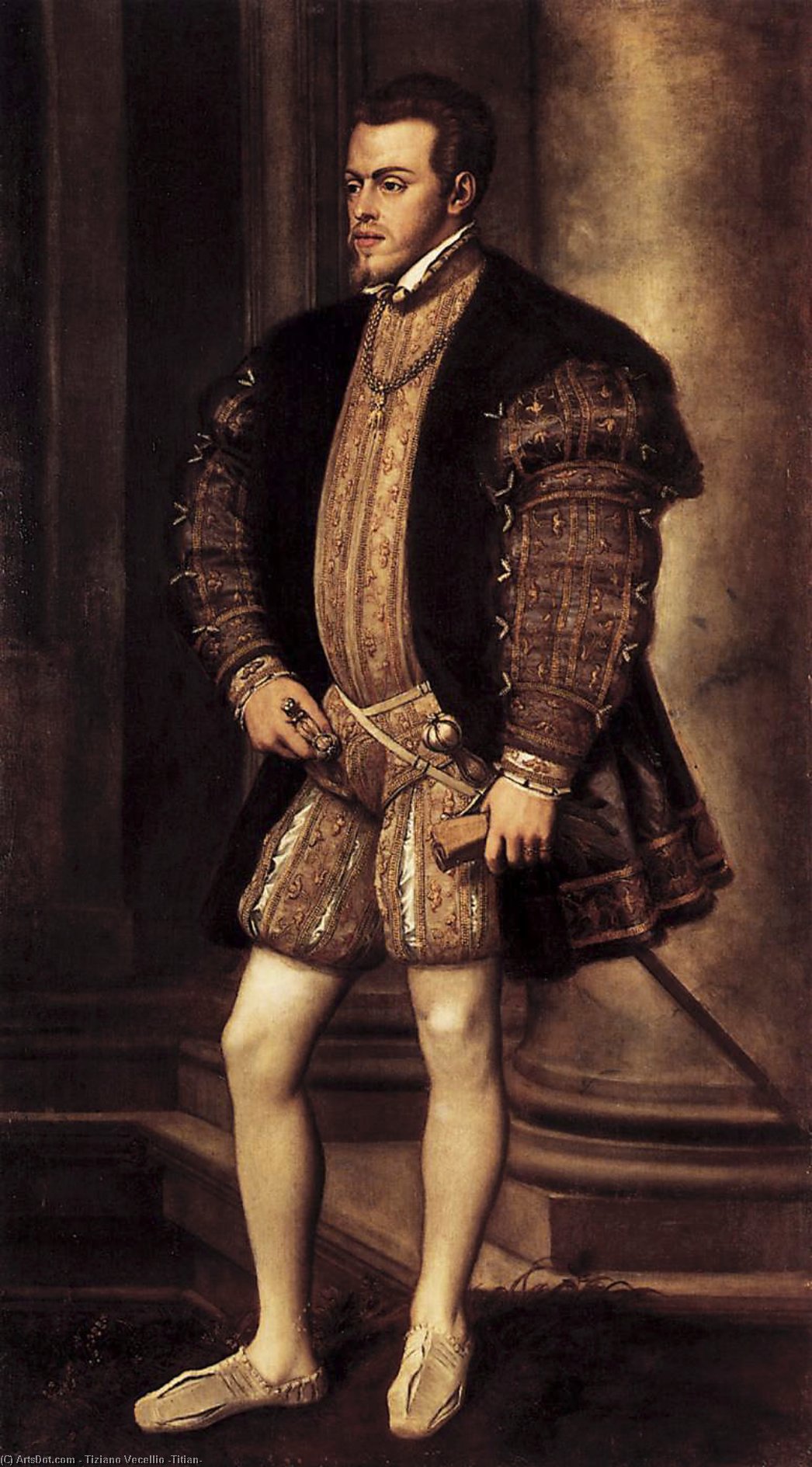
The
Portrait of Philip II, painted by the renowned artist
Tiziano Vecellio (Titian) in 1554, is a testament to the artistic genius of the Renaissance era. This magnificent oil on canvas painting measures 185 x 103 cm and is currently housed at the
Galleria Palatina in Italy.
Artistic Elements and Style
Titian's attempt to incorporate Mannerist elements into his chromatic language is evident in this work. The figure of Philip II exudes a powerful plasticity, with a theatrical pose that reflects the dominant taste of 16th-century Venice. The strength of the timbres of the tones and the luminous matching of colors create a sense of depth and dimensionality. The painting showcases Titian's sensitivity to color, as seen in the 'impasto' of the paint, which seems to rise from the canvas. The grey of the skin is matched with the ivory color of the flesh, while the browns, greens, and darkened tones create a sense of movement and energy. This enthusiasm for research and experimentation with color is characteristic of Titian's style.
Historical Context
Philip II became King of Naples and Sicily in 1554 and King of Spain from 1556-98. The painting is based on an earlier model created by Titian, capturing the sovereign's thoughtful and stern character. Philip II is portrayed standing in a three-quarter pose, dressed in royal garments with the Roman Catholic Order of the Golden Fleece chain around his neck.
Relevance to Art History
The
Portrait of Philip II is significant not only for its artistic merit but also for its historical importance. It reflects the cultural and political climate of 16th-century Venice, where artists like Titian were influenced by Mannerist elements and the problems of form and composition.
Reproduction and Appreciation
For art enthusiasts who wish to appreciate this masterpiece in their own homes,
ArtsDot.com offers high-quality, handmade oil painting reproductions of the
Portrait of Philip II. These reproductions are crafted with meticulous attention to detail and color accuracy, ensuring that the essence of Titian's original work is preserved. In conclusion, the
Portrait of Philip II by Tiziano Vecellio (Titian) is a masterpiece that embodies the artistic excellence of the Renaissance. Its historical significance, artistic elements, and cultural relevance make it a valuable addition to any art collection or appreciation.