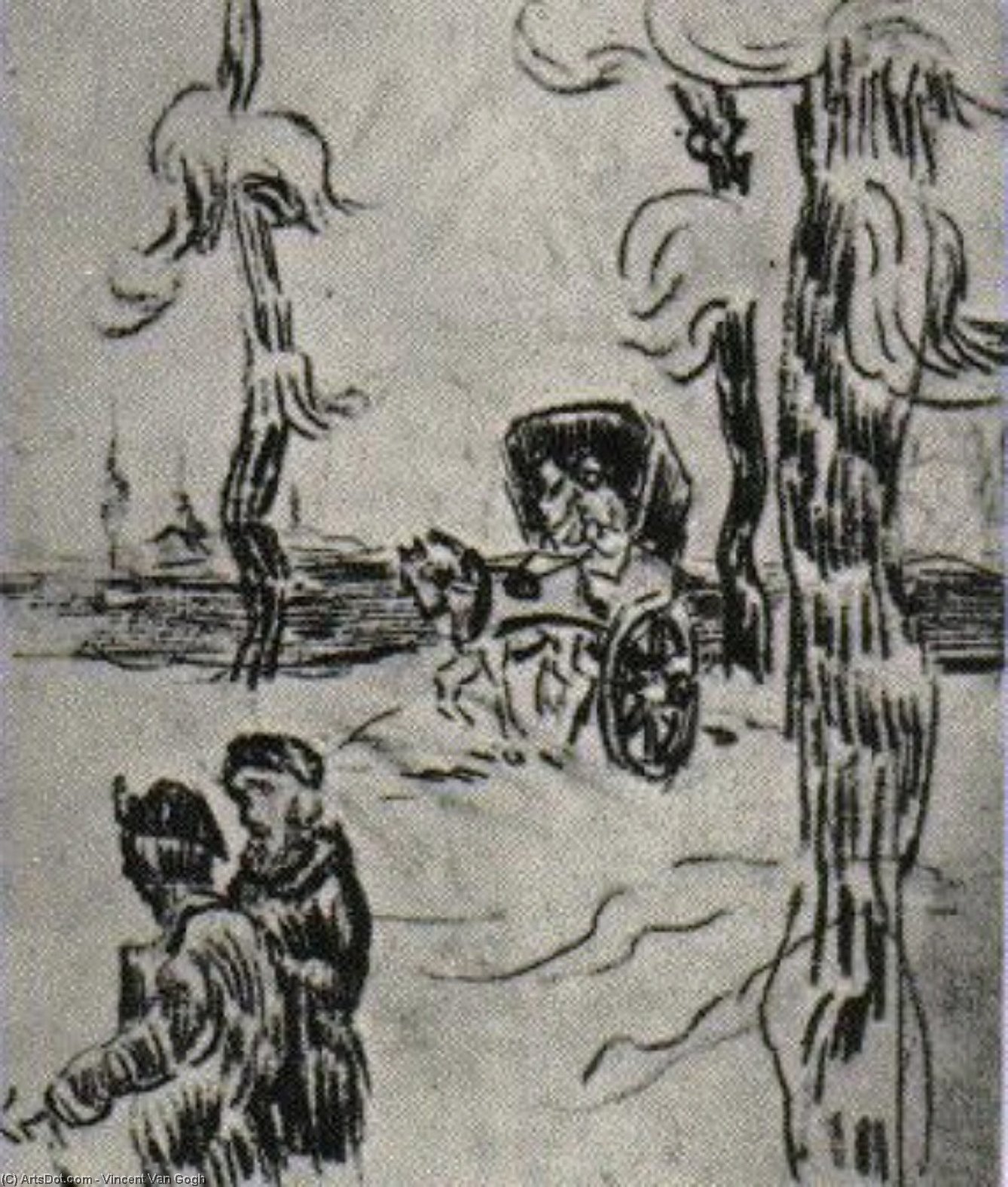
Carriage and Two Figures on a Road – A Study in Movement and Emotion
Vincent van Gogh’s “Carriage and Two Figures on a Road,” completed in 1890 during his prolific Parisian period, stands as a testament to the artist's unwavering commitment to capturing fleeting moments of observation with unparalleled expressive power. More than just a depiction of rural life—a recurring theme in Van Gogh’s oeuvre—this sketch delves into the psychological landscape of its subject matter, reflecting both the immediacy of experience and the profound contemplation inherent in his artistic vision.
- Subject Matter: The artwork portrays a simple yet evocative scene: a horse-drawn carriage traversing a road alongside two individuals. This unassuming composition belies a deeper significance, capturing a moment of human connection amidst the natural world—a motif that resonates throughout Van Gogh’s oeuvre.
- Style & Technique: “Carriage and Two Figures on a Road” firmly establishes itself within the Post-Impressionist movement, prioritizing emotional intensity over photographic realism. Van Gogh employs rapid sketching with graphite or charcoal, utilizing hatching and crosshatching to achieve tonal variations and textural richness. These techniques aren’t merely descriptive; they actively convey feeling—the restless energy of the horse pulling the carriage, the subtle interaction between the figures—creating a palpable sense of movement.
- Composition & Perspective: The flattened perspective contributes to the artwork's immediacy, immersing the viewer in the scene as if witnessing it firsthand. Lines converge subtly towards the center, guiding the eye and emphasizing the importance of the carriage and its occupants. Trees punctuate the background, providing vertical counterpoint and reinforcing the sense of depth.
- Color Palette & Line Work: Stripped down to a monochrome palette of black, white, and shades of gray, the drawing underscores Van Gogh’s focus on tonal relationships rather than color hues. The energetic, short lines—often broken—are characteristic of his distinctive style, injecting dynamism into every contour and creating a textured surface that mimics the roughness of bark or fabric.
- Symbolism & Emotional Impact: Beyond its visual representation, “Carriage and Two Figures on a Road” speaks to themes of solitude, contemplation, and perhaps even unspoken communication. The simplicity of the composition amplifies the emotional resonance of the drawing—a reflection of Van Gogh’s own turbulent inner life and his desire to convey profound feelings through restrained artistic expression.
This artwork exemplifies Van Gogh's masterful ability to transform ordinary subjects into vehicles for emotional exploration. Its enduring appeal lies in its ability to capture the essence of human experience—a quiet moment of observation imbued with an undeniable sense of vitality and psychological depth. Reproductions from ArtsDot offer a chance to appreciate this iconic piece within your own home, bringing Van Gogh’s expressive vision to life.