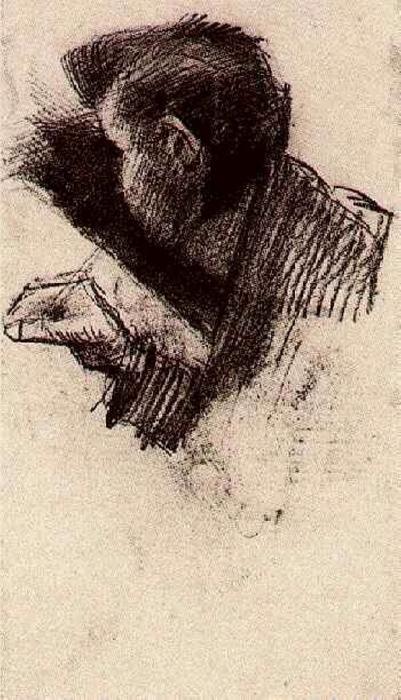
Captured in striking black and white, Vincent van Gogh’s *Man, Drawing or Writing* embodies Expressionist emotion through a contemplative posture—a man absorbed in his craft against a simple backdrop. Painted in 1886, this iconic piece invites you to experience the artist's profound vision.
Van Gog, holandski postimpresionista, poznat po delima poput 'Zvezdane noći' i 'Suncokreta'. Njegova ekspresivna tehnika i intenzivne boje revolucionarisale su umetnost i uticale na moderne pokrete.
A Portrait of Quiet Intensity: Exploring Van Gogh’s “Man, Drawing or Writing”
Vincent van Gogh's "Man, Drawing or Writing," painted in 1886 during his prolific Parisian period, transcends mere representation; it embodies a profound exploration of human emotion and artistic contemplation. Captured in stark black and white photography, this image allows us to appreciate the painting’s inherent beauty and invites deeper consideration of its significance within Van Gogh's oeuvre and the broader context of Impressionism.
The Subject Matter: A Moment Frozen in Time
The central figure—a man seated at a table—is rendered with remarkable sensitivity. His head is bowed, suggesting deep concentration as he engages in either writing or sketching. The posture conveys vulnerability yet determination, hinting at an inner world brimming with ideas and creative impulses. Van Gogh’s masterful observation of human anatomy contributes to the painting's realism, grounding it in a tangible presence despite its stylized execution. Notice how the artist captures subtle nuances of expression—a furrowed brow, a slight downturn of the lips—that speak volumes about the man’s mental state.
Style and Technique: Impressionistic Echoes Amidst Bold Strokes
While firmly rooted in Impressionism – influenced by artists like Claude Monet and Edgar Degas – “Man, Drawing or Writing” distinguishes itself through Van Gogh's characteristic expressive brushwork. Unlike Monet’s pursuit of fleeting light effects, Van Gogh prioritizes conveying emotion rather than optical accuracy. Thick impasto strokes dominate the canvas, creating a textured surface that pulsates with energy. These bold marks aren’t merely decorative; they actively contribute to the painting’s emotional impact, mirroring the artist's turbulent inner life and reflecting his preoccupation with capturing psychological states. The deliberate lack of color amplifies this effect, forcing viewers to focus on form and gesture—elements crucial to Van Gogh’s artistic vision.
Historical Context: Parisian Experimentation and Artistic Dialogue
Painted during Van Gogh’s time in Paris, “Man, Drawing or Writing” represents a pivotal moment in his artistic evolution. Having moved away from the landscapes of Provence – where he initially sought solace after experiencing mental instability – Paris offered him access to a vibrant intellectual and artistic milieu. This exposure fueled his experimentation with new techniques and styles, pushing him beyond the conventions of academic painting. Simultaneously, Van Gogh engaged in dialogue with fellow Impressionists, absorbing their influence while forging his own distinctive path. The photograph itself serves as a testament to the photographic advancements of the era, capturing the essence of the artwork without relying on color palettes that wouldn’t have been available at the time.
Symbolism and Emotional Resonance: Beyond Representation
The simple act of drawing or writing—a commonplace activity—becomes imbued with symbolic significance within this painting. It represents not just a task but also an endeavor to capture and communicate inner thoughts, feelings, and perceptions. The man’s bowed head symbolizes introspection and contemplation, inviting viewers to consider the complexities of human consciousness. Furthermore, the muted palette contributes to the painting's melancholic atmosphere—a reflection of Van Gogh’s own struggles with mental illness and his yearning for connection. Ultimately, “Man, Drawing or Writing” resonates deeply because it speaks to universal themes of creativity, vulnerability, and the pursuit of meaning in a world often characterized by uncertainty.