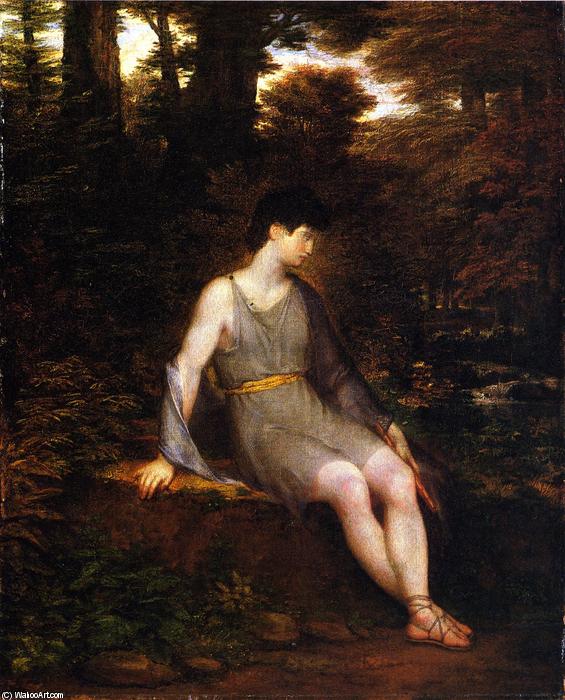
Explore Washington Allston's "Italian Shepherd Boy," an evocative landscape painting capturing serene beauty and literary themes—a cornerstone of American Romanticism.
Istražite romantične pejzaže Vašingtona Olstona (1779-1843), pionira američkog pejzažnog slikarstva. Poznat po dramatičnoj svetlosti, atmosferskim bojama i književnim temama. Otkrijte njegov uticaj na Emersona i još mnogo toga!
Откријте сјајан свет уметности у ДИА! Истражите светиште репродукција познатих дела Дијега Ривере и других маестрија, одражавајући богато наслеђе Дејтроита и културну разноликости.
Откријте сјајан свет уметности у ДИА! Истражите светиште репродукција познатих дела Дијега Ривере и других маестрија, одражавајући богато наслеђе Дејтроита и културну разноликости.
ДИА, Детройтски институт умет
Italian Shepherd Boy - A Romantic Vision of Rural Tranquility
The painting “Italian Shepherd Boy,” attributed to Washington Allston (1779-1843), stands as a cornerstone of American Romanticism, capturing a moment of serene contemplation amidst the lush landscapes of Italy. Executed in 1819, this oil on canvas exemplifies Allston’s signature style—characterized by dramatic lighting effects and an unwavering focus on conveying emotional depth through color and composition. It's more than just a depiction; it’s an immersive experience designed to transport the viewer into a realm of idealized beauty and profound introspection.
Subject Matter and Composition
At its core, the artwork portrays a young shepherd boy seated upon a weathered rock in a verdant forest clearing. His posture exudes stillness and quiet observation—he gazes upwards with unwavering attention toward the sky, suggesting an engagement with something larger than himself. The inclusion of several figures in the background – presumably other shepherds – adds to the scene’s narrative dimension, hinting at a community bound by tradition and connected to the rhythms of nature. Allston skillfully utilizes pyramidal composition, anchoring the central figure while subtly directing the eye across the expansive vista beyond. This technique reinforces the painting's sense of grandeur and invites contemplation on themes of solitude and connection.
Technique and Artistic Style
Allston’s masterful brushwork is immediately apparent upon close inspection. He employed a layering technique—building up translucent glazes over underpaintings—to achieve remarkable luminosity and atmospheric depth. The artist meticulously rendered the textures of bark, foliage, and stone, demonstrating an acute sensitivity to detail. Crucially, Allston utilized color with deliberate intention, favoring muted greens and blues that evoke the tranquility of the Italian countryside. These hues are punctuated by warmer tones – primarily yellows—that illuminate the boy’s face and hands, conveying a sense of warmth and inner peace. The artist's use of chiaroscuro—the interplay between light and shadow—further enhances the dramatic impact of the scene, emphasizing the contours of the landscape and creating an illusion of three-dimensionality.
Historical Context and Romantic Ideals
“Italian Shepherd Boy” emerged during a period of significant artistic ferment in Europe and America – the Romantic era. Influenced by poets like Wordsworth and Coleridge, Romantic artists sought to express emotion and imagination as paramount values, rejecting Enlightenment rationalism in favor of subjective experience. Allston’s painting embodies these ideals perfectly, reflecting a fascination with untamed nature and an appreciation for the sublime—that awe-inspiring feeling of encountering something beyond human comprehension. The shepherd boy symbolizes innocence, contemplation, and harmony with the natural world – concepts central to Romantic thought.
Symbolism and Emotional Resonance
Beyond its formal qualities, “Italian Shepherd Boy” resonates deeply on an emotional level. The upward gaze of the boy speaks to aspirations for spiritual enlightenment and a yearning for transcendence. The rock upon which he sits represents stability amidst change—a grounding force that allows him to maintain perspective. The forest setting itself symbolizes refuge from urban pressures and embodies the restorative power of solitude. Allston’s deliberate use of color and light contributes to this emotional impact, creating an atmosphere of serenity and inviting viewers to contemplate profound questions about existence and beauty. Ultimately, “Italian Shepherd Boy” remains a testament to Allston's ability to capture not just what he saw but also what he felt—a timeless masterpiece that continues to inspire admiration for its artistic excellence and its enduring contemplation on the human condition.