Откријте Василија Кандиског – револуционарно дело апстрактне уметности! Динамичне форме, ярке боје и духовна резонанца у једном мајсторија платног. Овај руски сликар оставио је трајан утицај на светску уметност.
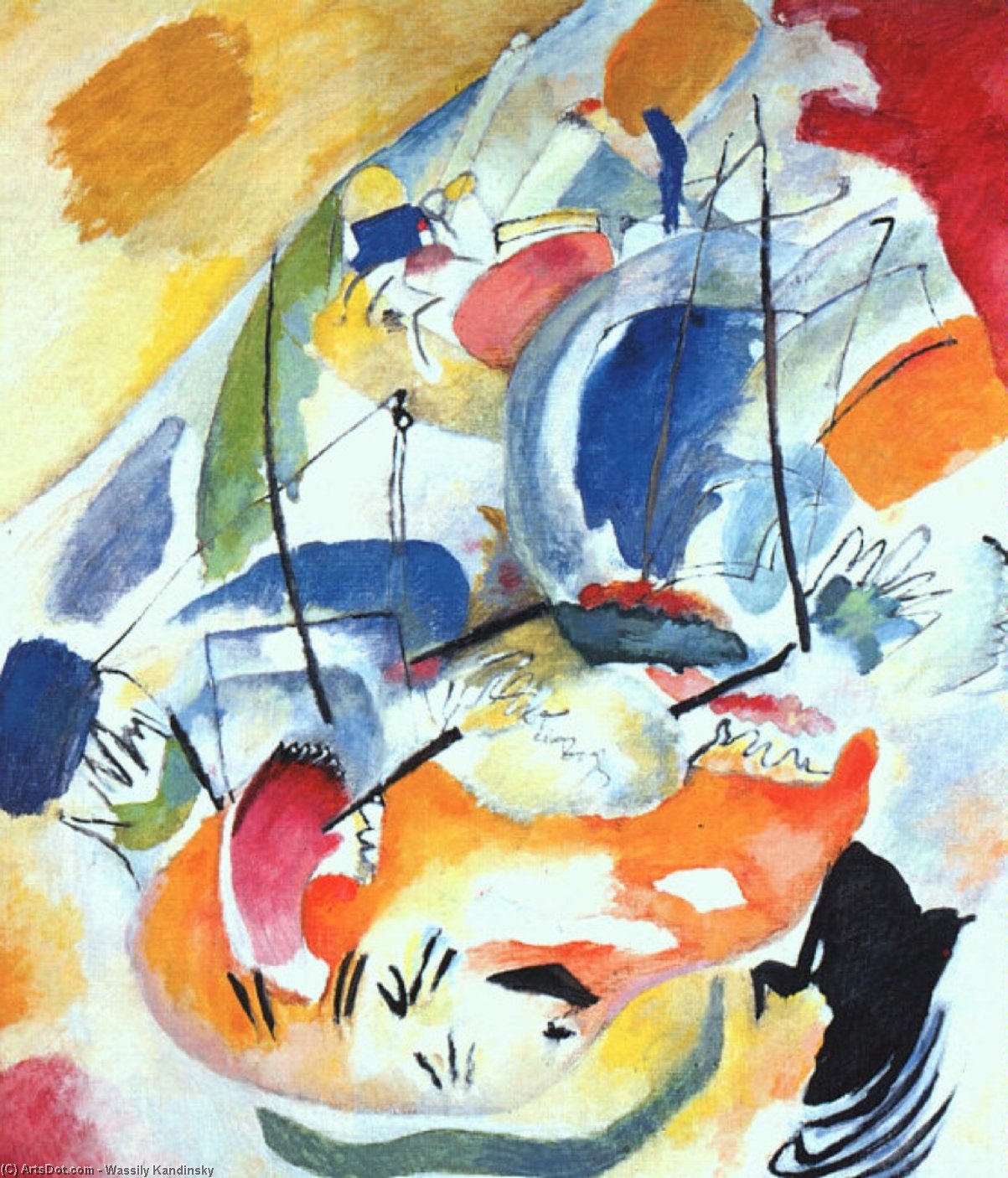
Improvisation 31 (Sea Battle): A Symphony of Conflict and Color
Wassily Kandinsky’s *Improvisation 31 (Sea Battle)*, completed in 1913, stands as a cornerstone of abstract expressionism and a testament to the artist's revolutionary vision. Born in Moscow in 1866, Kandinsky embarked on an artistic odyssey fueled by encounters with Impressionism – specifically Monet’s “Haystacks” – and profoundly moved by Wagner’s opera "Lohengrin," marking a pivotal shift toward prioritizing inner experience over mere representation. This transformative moment propelled him to Munich, where he honed his craft at the Bauhaus Academy of Fine Arts under Franz von Stuck, yet even within formal training, Kandinsky's spirit relentlessly pursued artistic freedom beyond conventional constraints.
The Expressionist Spirit and Its Visual Language
Kandinsky’s work aligns closely with the Expressionist movement, which championed subjective interpretation and emotional resonance. *Improvisation 31 (Sea Battle)* embodies this ethos through vibrant hues and dynamic geometric forms—a deliberate rejection of academic realism. The painting's composition depicts two sailing ships engaged in combat, rendered as slender black lines representing masts against a turbulent seascape dominated by swirling waves and a crumbling cityscape. This visual vocabulary isn’t merely descriptive; it aims to convey a palpable sense of turmoil and confrontation, mirroring Kandinsky’s belief that art could transcend the material world and tap into deeper spiritual currents.
Inspired by Revelation and Beyond War
The artist's subject matter draws inspiration from apocalyptic imagery found in the Book of Revelation, reflecting anxieties surrounding the impending First World War. However, Kandinsky vehemently denied any direct connection to the conflict, asserting that *Improvisation 31 (Sea Battle)* stemmed from a broader spiritual struggle—a quest for artistic truth independent of external pressures. He sought to capture not just what he saw but what he felt, translating inner emotions into visual symbols.
A Masterpiece of Abstract Composition
Measuring 140 x 119 cm, *Improvisation 31 (Sea Battle)* is executed in oil on canvas—a technique Kandinsky favored to achieve maximum expressive potential. The painting’s central triangle, formed by ascending diagonals, symbolizes upward movement and aspiration amidst the chaos of battle. Color plays a crucial role, pulsating with energy and conveying emotional intensity. Shades of crimson and ochre dominate, representing passion and vitality, while darker hues underscore the gravity of the situation. Kandinsky's meticulous attention to detail—the subtle variations in texture and tone—further enhances the painting’s impact.
Provenance and Legacy
Purchased by Joseph Müller in 1913 and subsequently acquired by the National Gallery of Art in Washington, D.C., *Improvisation 31 (Sea Battle)* has graced numerous exhibitions, cementing Kandinsky's place as a pioneer of abstract art. Its enduring fascination speaks to its ability to evoke profound contemplation and inspire artistic creativity—a legacy that continues to resonate with audiences today.