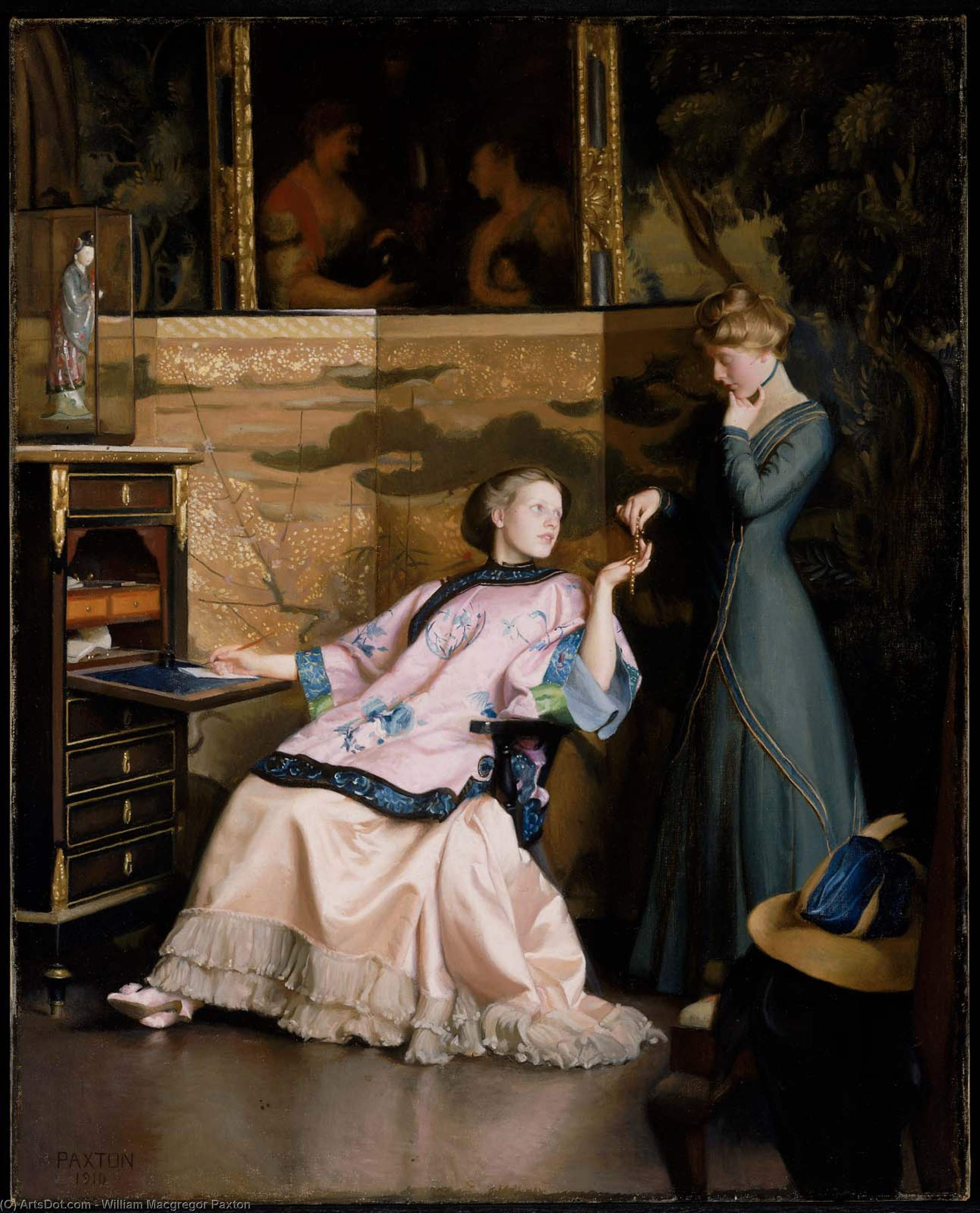
Explore William McGregor Paxton's evocative portrait 'The New Necklace,' capturing two women in a cozy fireplace setting—a masterful example of the Boston School style.
Explore William McGregor Paxton (1869-1941), a Boston School luminary! Discover captivating portraits & intimate interior scenes of women, reflecting American Impressionism. See his works at Butler Institute & beyond.
Otkrijte svetsku umetnost u Muzeju lepih umetnosti (MFA) u Bostonu! Istražite remek-dela iz različitih kultura i epoha, od egipatskih artefakata do evropskih majstora. Ne propustite!
A Portrait of Domestic Tranquility: Exploring William McGregor Paxton’s “The New Necklace”
“The New Necklace,” painted in 1910 by William McGregor Paxton, stands as a quintessential example of the Boston School aesthetic—a movement that championed serene interiors and psychologically nuanced portraits. More than just a depiction of two women seated before a fireplace, this artwork delves into themes of companionship, instruction, and subtle emotional resonance, reflecting the values prevalent in American society at the turn of the century.
Paxton’s artistic approach was rooted in meticulous observation and careful rendering of light and shadow. He employed glazing techniques—applying thin layers of translucent paint over underlying colors—to achieve a luminous quality that captures the warmth emanating from the hearth. The muted palette, dominated by creams, browns, and ochres, contributes to the painting's calming atmosphere, mirroring the idealized domestic life envisioned during this period. Notice how Paxton skillfully utilizes chiaroscuro – dramatic contrasts between light and dark – to sculpt the figures’ forms and emphasize their expressions. This technique wasn’t merely stylistic; it served to convey a deeper understanding of human psychology, portraying not just appearances but also inner states.
The composition itself is thoughtfully balanced. The seated woman dominates the frame, radiating confidence and authority as she gestures towards her companion—likely offering guidance or sharing an intimate moment. Her gaze directs our attention outwards, suggesting contemplation and connection with the surrounding environment. Simultaneously, the standing woman embodies receptiveness and vulnerability, absorbing the instruction imparted by her counterpart. This dynamic interplay between figures underscores the importance of interpersonal relationships within the domestic sphere – a core concern for artists of the Boston School who sought to depict idealized human experience.
Beyond its formal qualities, “The New Necklace” carries symbolic weight. The fireplace represents warmth, comfort, and familial hearth—values deeply cherished in American culture at the time. The vase placed beside the chair symbolizes beauty and refinement, aligning with the aspirations of upper-middle-class families during the Edwardian era. Even the books on the mantelpiece speak to intellectual curiosity and cultural enrichment – elements considered essential for fostering a well-rounded individual.
Ultimately, Paxton’s masterpiece evokes a profound sense of tranquility and intimacy. It invites viewers to consider not only what is seen but also what is felt—a testament to the artist's ability to capture the essence of human emotion through masterful technique and astute observation. “The New Necklace” remains an enduring symbol of American artistic idealism, continuing to inspire admiration for its understated elegance and psychological depth.