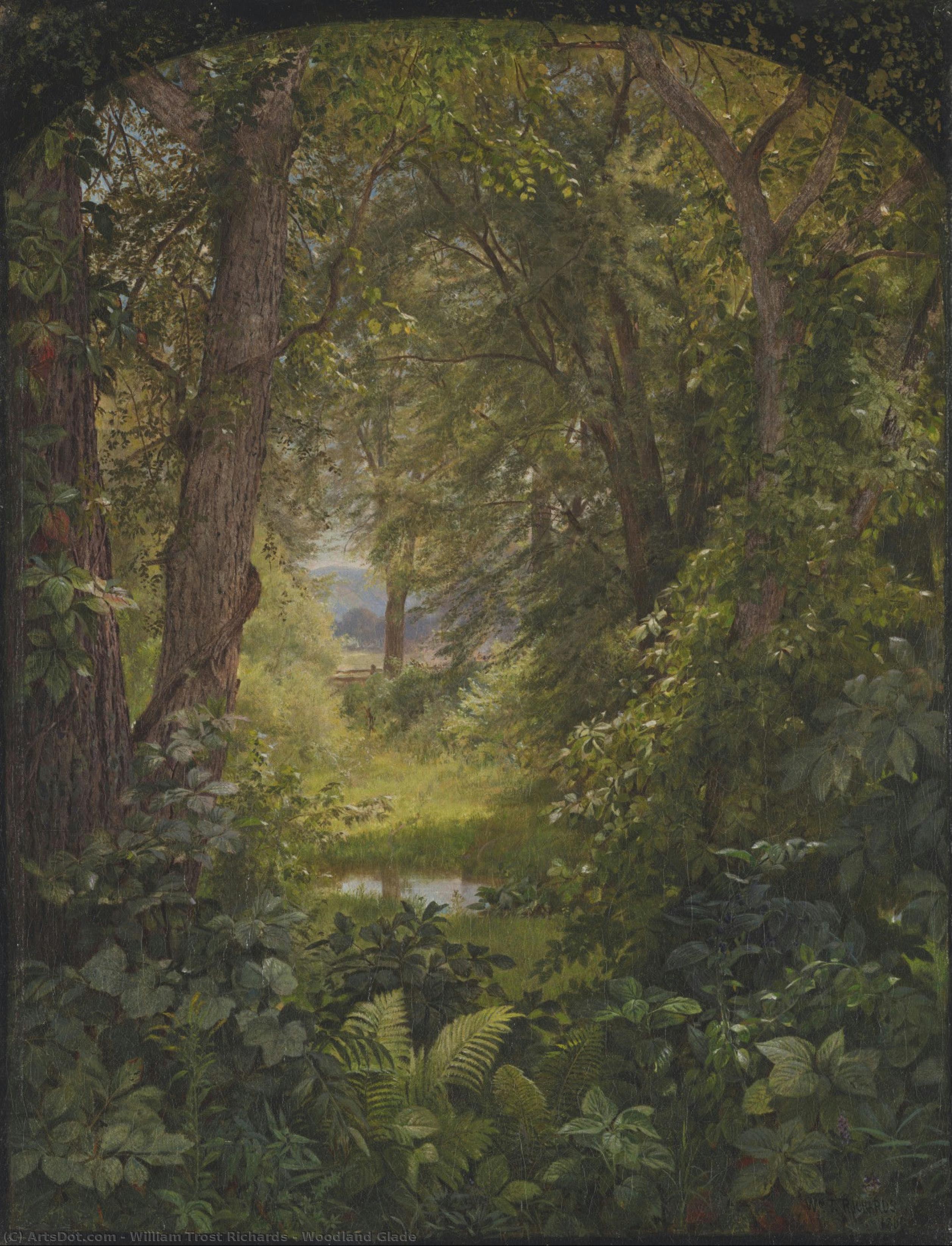
A Woodland Reverie: William Trost Richards’ “Woodland Glade”
William Trost Richards' "Woodland Glade," painted in 1860, isn’t merely a depiction of a forest; it’s an immersion into a carefully constructed world of light, texture, and profound stillness. Born in Philadelphia and deeply influenced by the burgeoning American landscape movement, Richards sought to capture not just what he saw, but the very *feeling* of nature – a sentiment powerfully resonant with the spiritual currents flowing through 19th-century art. This piece stands as a testament to his meticulous approach, a bridge between the romanticism of the Hudson River School and a burgeoning realism that prioritized observation and detail above all else.
The scene unfolds within a dense woodland, dominated by towering trees whose rough bark is rendered with astonishing accuracy – each ridge and furrow painstakingly depicted. Richards eschews dramatic vistas or sweeping skies; instead, he focuses on the intimate details of this enclosed space. A small stream, reflecting the diffused light like a shattered mirror, snakes through the lower foreground, drawing the eye into the heart of the scene. The composition is vertically oriented, creating a sense of depth and encouraging the viewer to lose themselves within the receding layers of foliage. The overall effect isn’t one of grand spectacle, but rather a quiet invitation to contemplate the beauty of the commonplace.
The Language of Light and Texture
Richards' mastery lies in his ability to evoke atmosphere through light and texture. The painting is bathed in a soft, diffused glow, suggesting an overcast day or perhaps the dappled shade beneath the canopy. This isn’t harsh sunlight; it’s a gentle illumination that softens edges and imbues the scene with a sense of mystery. He achieves this remarkable effect through his technique – a layering of thin glazes built up over time, creating a luminous surface that seems to shimmer with reflected light. The brushwork itself is incredibly detailed, almost photographic in its precision, yet it never feels cold or sterile. Instead, the texture of the bark, the delicate veins of leaves, and the dampness of the undergrowth are all palpably present.
Notice how he utilizes converging lines – the trunks of the trees, the stream’s flow – to create a believable three-dimensional space. This isn't simply about depicting what *is*; it’s about creating an illusion of depth and distance that draws the viewer into the heart of the woodland. The careful placement of highlights and shadows further enhances this effect, guiding our eye through the scene and reinforcing its sense of realism.
A Pre-Raphaelite Echo & American Roots
While firmly rooted in the Hudson River School tradition – a movement characterized by its focus on American landscapes – “Woodland Glade” also reveals subtle influences from the Pre-Raphaelites, particularly in its meticulous detail and emphasis on natural beauty. Richards’ dedication to capturing the nuances of light and texture aligns with the Pre-Raphaelite interest in scientific observation and the faithful representation of nature. However, unlike the often overtly symbolic imagery favored by the Pre-Raphaelites, Richards' work is grounded in a quiet reverence for the natural world itself.
The painting’s historical context is crucial to understanding its significance. The mid-19th century was a period of rapid industrialization and urbanization in America, leading many artists to seek solace and inspiration in the wilderness. Richards' work reflects this yearning for connection with nature – a desire to preserve the beauty of the American landscape before it was irrevocably altered by progress. His meticulous approach serves as a powerful reminder of the importance of observation and appreciation for the natural world.
A Moment of Serenity
Ultimately, “Woodland Glade” is more than just a landscape painting; it’s an invitation to pause, breathe deeply, and connect with the tranquility of nature. The absence of human figures – no paths, no signs of civilization – reinforces this sense of solitude and allows the viewer to fully immerse themselves in the scene. There's no overt narrative or symbolic meaning beyond the inherent peace associated with a forest setting. It’s a testament to Richards’ ability to capture not just a visual image, but an emotional experience—a feeling of quiet contemplation and profound connection to the natural world.