A Descent into the Subconscious: Exploring Beksiński’s Untitled (307)
Zdzisław Beksiński's *Untitled (307)* is a haunting and evocative work that exemplifies his signature style of dystopian surrealism. Created by a master of unsettling imagery, this painting draws the viewer into a world steeped in decay, isolation, and existential dread – themes central to Beksiński’s artistic vision.
Subject & Composition
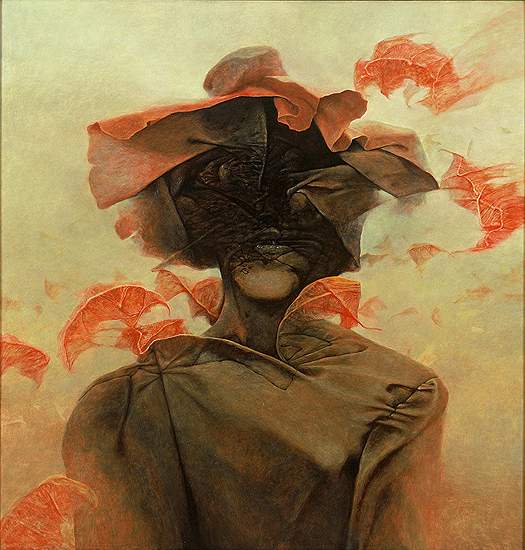
The artwork centers around a shrouded humanoid figure, draped in what appears to be coarse fabric—perhaps burlap or canvas—suggesting vulnerability and a connection to the earth. A large, crimson form, resembling a leaf or piece of cloth, obscures the face, creating an immediate sense of anonymity and loss of identity. Scattered around the figure are numerous red elements, like floating petals or fragments, providing a stark contrast against the muted yellowish-beige background. The composition is deliberately ambiguous; the figure’s surroundings are undefined, enhancing the feeling of being lost within a dreamlike—or nightmarish—space.
Style & Technique
Beksiński's style defies easy categorization, blending elements of surrealism, gothic art, and baroque drama. *Untitled (307)* showcases his masterful use of texture and tone to create a palpable atmosphere. The brushstrokes are subtle yet visible, contributing to the painting’s overall sense of unease. While he often worked in series and explored different mediums including photography and sculpture, Beksiński was primarily known for his oil paintings. His technique involved building up layers of paint to achieve depth and a uniquely unsettling aesthetic.
Historical Context & Artistic Vision
Born in Poland in 1929, Zdzisław Beksiński lived through a period marked by political upheaval and the trauma of World War II. While he resisted direct interpretations linking his work to specific events, it’s impossible to ignore how these experiences might have informed his bleak outlook. Beksiński deliberately avoided providing titles or explanations for his paintings, preferring viewers to project their own emotions and narratives onto them. This approach aligns with the core tenets of surrealism—exploring the realm of the subconscious without rational constraints.
Symbolism & Interpretation
- The Shrouded Figure: Represents humanity stripped bare, facing existential questions about mortality and purpose. The obscured face symbolizes a loss of identity or individuality.
- Red Elements (Leaves/Petals): Often interpreted as symbols of life, death, or decay. Their scattered arrangement suggests fragmentation and the ephemeral nature of existence.
- Muted Background: Creates a sense of isolation and emptiness, emphasizing the figure’s vulnerability within an indifferent universe.
- The overall lack of narrative: Encourages viewers to engage with the artwork on a deeply personal level, prompting introspection and contemplation.
Emotional Impact & Aesthetic Appeal
*Untitled (307)* is not a painting that offers easy comfort. It evokes feelings of melancholy, anxiety, and perhaps even fear. However, its haunting beauty and technical mastery are undeniable. The artwork’s power lies in its ability to tap into universal anxieties about the human condition. For interior designers, this piece would serve as a striking focal point, adding depth and intrigue to any space. Its muted palette allows it to complement a variety of décor styles, while its unsettling imagery sparks conversation and contemplation.
Beksiński’s work continues to resonate with audiences worldwide, solidifying his place as a unique and influential figure in 20th-century art. *Untitled (307)* is a testament to his enduring vision—a chilling yet captivating exploration of the darkness within us all.