

 Pregledaj u prostoru
 Kupi print
 Pošalji
 Podeli


 Преузми
 Slični predmeti
 Rendgenski snimak
 Slajdovi
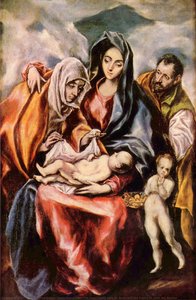
The Holy Family with St. Anne and the Young St. John the Baptist


Ел Греко (1541 – 1614)
El Greco, grčki slikar španske renesanse, poznat po dramatičnim kompozicijama, izduženim figurama i religijskim temama. Otkrijte 'Sahranu grofa Orgaza' i ostala remek-dela ovog vizionara!
A Vision of Faith and Foreboding: El Greco’s ‘The Holy Family’
El Greco’s “The Holy Family with St. Anne and the Young St. John the Baptist” isn't merely a depiction of a biblical scene; it’s an intensely felt experience, a window into the turbulent soul of one of art history’s most singular figures. Painted between 1594 and 1604 in Toledo, Spain, this oil on canvas masterpiece transcends simple religious iconography to become a profound meditation on family, faith, and the looming shadow of destiny. The painting immediately arrests the viewer with its dramatic use of color – a deliberately dark palette dominated by deep blues, browns, and ochres that evokes a sense of brooding atmosphere, almost as if a storm is brewing just beyond the canvas’s edge. This isn't the serene depiction of piety often found in Renaissance art; instead, El Greco plunges us into a world of heightened emotion and unsettling realism.
A Complex Composition: Spatial Intrigue and Symbolic Weight
Within this darkened space, five figures are tightly clustered, yet their arrangement is deliberately complex and unsettling. St. Anne, the mother of Mary, bends towards the infant Jesus, a pose echoing the iconic Pietà – a poignant reminder of Christ’s sacrifice and the promise of his future Passion. Joseph, standing slightly behind, offers a grounding presence, while simultaneously directing his gaze toward the young St. John the Baptist. It's this young prophet, pointing heavenward with an outstretched hand, who injects a crucial element of prophecy into the scene. He isn’t simply a child; he embodies a future filled with suffering and judgment, foreshadowing the events to come – a visual representation of divine justice and the path towards redemption. The spatial relationships are deliberately skewed, creating a sense of unease and drawing the viewer deeper into the painting's emotional core.
The Echoes of Byzantium and Mannerism
El Greco’s unique style is a fascinating synthesis of influences. Born in Crete under Venetian rule, he was steeped in the traditions of Byzantine art – characterized by its rich colors, elongated figures, and spiritual intensity. However, his time in Venice and Rome exposed him to the burgeoning styles of Mannerism, with its emphasis on stylized forms, dramatic lighting, and emotional expression. This blend is evident here: the meticulous detail reminiscent of Byzantine iconography coexists with the distorted proportions and heightened drama characteristic of Mannerism. He deliberately avoids direct eye contact between the figures, contributing to the painting’s dreamlike quality and intensifying the sense of mystery.
A Precursor to Modernity
El Greco's work wasn’t universally appreciated during his lifetime; many contemporaries found his style unsettling and unconventional. Yet, centuries later, he is recognized as a pivotal figure in art history – a precursor to Expressionism and Cubism. His use of distorted forms, intense color palettes, and emotionally charged compositions anticipated the artistic movements that would shape the 20th century. “The Holy Family” stands as a testament to his visionary genius, offering a glimpse into a world where faith, suffering, and prophecy intertwine in a powerfully evocative manner. It’s a painting that continues to resonate with viewers today, inviting contemplation on themes of family, spirituality, and the enduring mysteries of human existence.
O ovom umetničkom delu
- Naslov: The Holy Family with St. Anne and the Young St. John the Baptist
- Umetnik: Ел Греко
- Format: Portrait
- Status autorskih prava: Javno vlasništvo
- Pokret: Baroque Expressionism
- Medijum: Oil On Canvas
- Epoha: Late Medieval
- Kontekst korpusa: spanish identity , renaissance influences
- Ključne reči: st anne , joseph , art
- Boja (ton): Yellow-Green Range
Osnovne informacije
- Influences:
- Byzantine art
- Mannerism
- Movement: Baroque
- Artistic style: Expressionistic, Byzantine influence
- Artist: El Greco
- Title: The Holy Family
- Medium: Oil on canvas
- Notable elements: Dark palette, complex spatial relationships
QR kod


