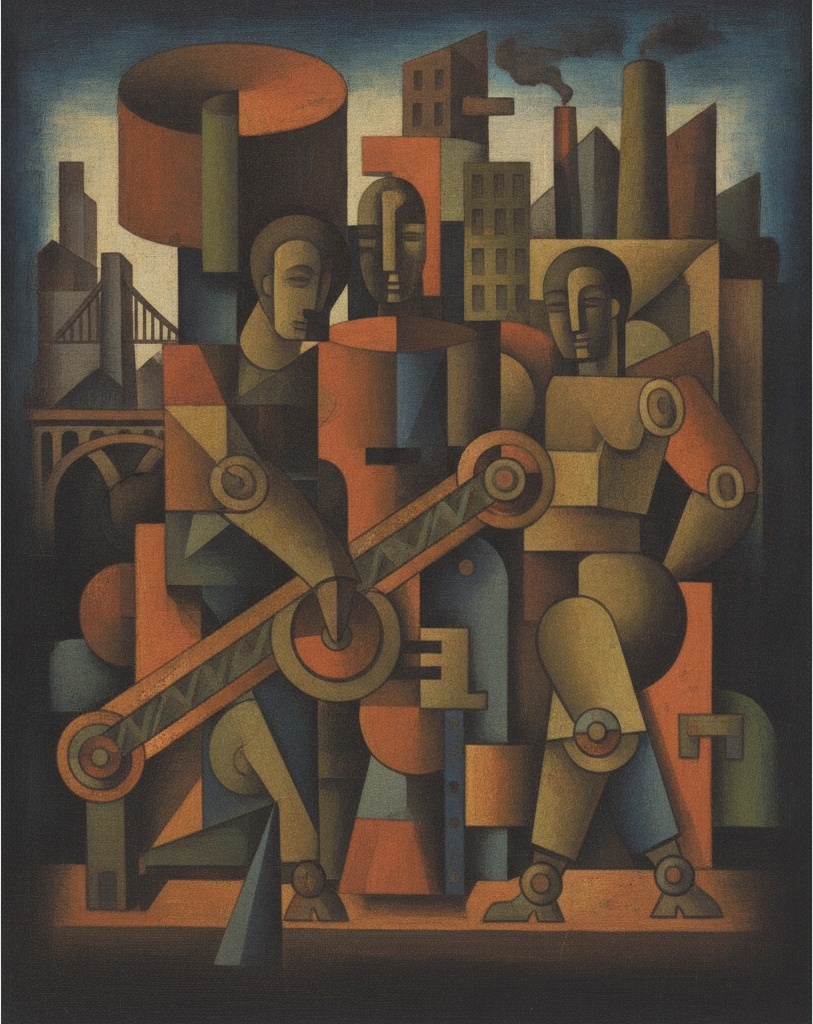
The Architect of Form: Fernand Léger and the Birth of Tubism
To understand the evolution of twentieth-century modernism, one must confront the rhythmic, structural audacity of Fernand Léger. While his contemporaries in the Cubist circle, such as Picasso and Braque, were often preoccupied with the fragmentation of space and the deconstruction of the object, Léger sought a different kind of truth—one found in the volume, the cylinder, and the robust presence of form. He did not merely wish to break the world apart; he wished to rebuild it through a lens of structural integrity and sculptural weight.
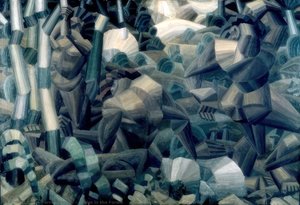
This pursuit led to the emergence of what critics famously termed Tubism. This was not merely a stylistic quirk but a profound philosophical shift in how the human figure and its environment were perceived. By emphasizing cylindrical shapes and tubular volumes, Léger infused his canvases with a sense of three-dimensional solidity that felt both futuristic and primordial. In works like The Woman in Blue, we witness this pivotal moment where geometric precision begins to dictate the very anatomy of the subject, creating a visual language that celebrates the strength of the contour over the softness of the flesh.
For the discerning collector, Léger’s early period represents a masterclass in the tension between organic life and mathematical order. His ability to manipulate the cylinder to suggest both movement and permanence remains one of the most compelling achievements of the Cubist era, offering a window into a world where art and architecture begin to merge into a singular, cohesive vision.
Chromatic Dynamism: The Intersection of Vibrant Color and Geometric Precision
If geometry provided the skeleton of Léger’s universe, then color served as its pulse. Unlike the muted, monochromatic palettes often associated with early Analytic Cubism, Léger embraced a chromatic intensity that demanded attention. He understood that for modern life to be truly represented, it required a palette that echoed the vibrancy of the street, the neon glow of the city, and the primary boldness of industrial signage.
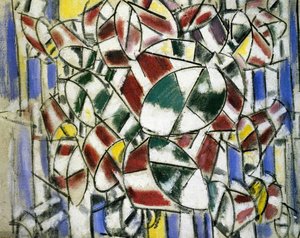
In masterpieces such as The Breakfast, color is not merely decorative; it is structural. Léger utilized bold, saturated hues to define boundaries and create depth, using color to guide the eye through a complex labyrinth of overlapping planes. This technique creates a unique optical vibration, where the interaction between a brilliant primary red and a deep, industrial blue can generate a sense of kinetic energy. The colors do not sit passively on the canvas; they collide and resonate, mirroring the frantic yet organized energy of the modern age.
This mastery of color allows his work to transcend simple abstraction. Even when the subject matter is fragmented, the emotional resonance of the palette provides a sense of familiarity and warmth. It is this delicate balance—the marriage of rigorous geometric discipline with an almost primal use of pigment—that gives Léger’s work its enduring vitality, making it a cornerstone for any collection focused on the expressive power of modernism.
The Machine Aesthetic: Celebrating Modernity and Industrial Progress
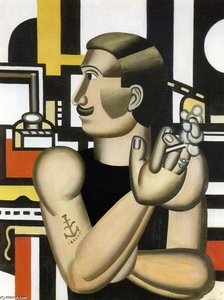
Léger was perhaps the most profound poet of the machine age. While many artists viewed the rapid industrialization of the early twentieth century with trepidation or nostalgia, Léger looked upon the gleaming steel, the rhythmic pistons, and the polished chrome of the new era with genuine reverence. He saw in the machine a new kind of beauty—a beauty defined by efficiency, repetition, and clarity.
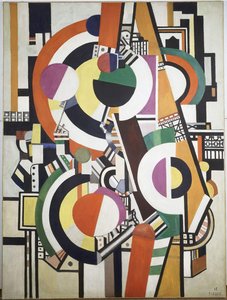
This fascination is palpable in works like The Man in the Tavern, where the presence of a motorcycle serves as more than just a backdrop; it is an integral part of the composition’s rhythmic logic. The artist found a kinship between the human form and the mechanical object, often rendering limbs and torsos with the same smooth, metallic sheen as the machinery surrounding them. This blurring of the line between man and machine reflects the zeitgeist of an era defined by unprecedented technological leaps.
To collect Léger is to curate a celebration of progress. His art captures the spirit of an age that was moving toward a brighter, more structured future. By elevating the mundane elements of industrial life—the gears, the pipes, and the urban sprawl—to the status of high art, he provided a visual manifesto for the modern worker and the modern citizen alike.
From Cubism to Pop Art: Lélegier’s Enduring Influence on Contemporary Visual Language
The legacy of Fernand Léger extends far beyond the boundaries of the Cubist movement. His radical approach to bold outlines, flat planes of color, and the celebration of everyday objects laid the essential groundwork for the Pop Art movement that would emerge decades later. One can trace a direct lineage from Léger’s fascination with mass-produced imagery and graphic clarity to the works of Andy Warhol and Roy Lichtenstein.
Léger’s ability to find the extraordinary within the ordinary—to see the monumental in a piece of fruit or the heroic in a factory worker—redefined the boundaries of subject matter. He taught subsequent generations of artists that art need not retreat into myth or history to find meaning; instead, it could be found in the very fabric of contemporary existence. His influence is seen in the way modern graphic design utilizes heavy contours and the way contemporary painters utilize high-contrast palettes to command attention.
For the modern collector, understanding this lineage is crucial. Léger is not a static figure of the past; he is a foundational architect of our current visual culture. His work remains a vital reference point for anyone exploring the intersection of fine art and popular imagery, proving that the geometric seeds he planted continue to bloom in the most unexpected contemporary forms.
Curating the Modernist Vision: Integrating Léger’s Geometry into Sophisticated Interiors
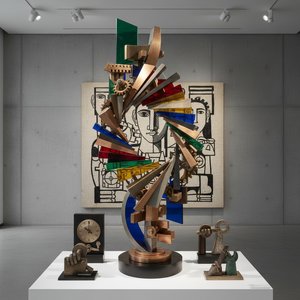
Integrating the works of Fernand Léger into a contemporary interior requires an eye for balance and an appreciation for architectural rhythm. Because his compositions are inherently structural, they function exceptionally well as focal points in spaces characterized by clean lines and modern minimalism. A large-scale reproduction of a Léger piece can act as a "visual anchor," providing much-needed weight and character to a room that might otherwise feel overly sterile.
When designing around such powerful imagery, consider the following principles of curation:
- Color Coordination: Utilize the primary hues found within the painting—such as deep blues or vibrant yellows—to inform your choice of textiles, cushions, or accent furniture. Scale and Proportion: In expansive rooms or grand staircases, consider multi-panel layouts or large-format canvases that allow the geometric complexity of the work to breathe.
- Material Contrast: Pair the "machine-like" smoothness of Léger’s aesthetic with organic textures like reclaimed wood, velvet, or stone to create a sophisticated tension between the industrial and the natural.
Ultimately, bringing Léger into your home is about more than mere decoration; it is about inviting a sense of structured dynamism into your private sanctuary. Whether through a meticulously hand-painted oil reproduction that captures every impasto stroke or a curated print that highlights his graphic precision, his vision offers a timeless way to celebrate the beauty of the modern world.
At ArtsDot.com, we specialize in preserving this profound human creativity. From bespoke, hand-painted oil reproductions on 100% cotton canvas to professional digital mockups that allow you to visualize art within your own space, our mission is to make the mastery of artists like Fernand Léger accessible to collectors worldwide. Whether you are seeking a custom "remix" of a historical masterpiece or a large-scale mural to transform an architectural space, our academy-trained artists ensure every brushstroke meets the highest standards of excellence.