Introduction
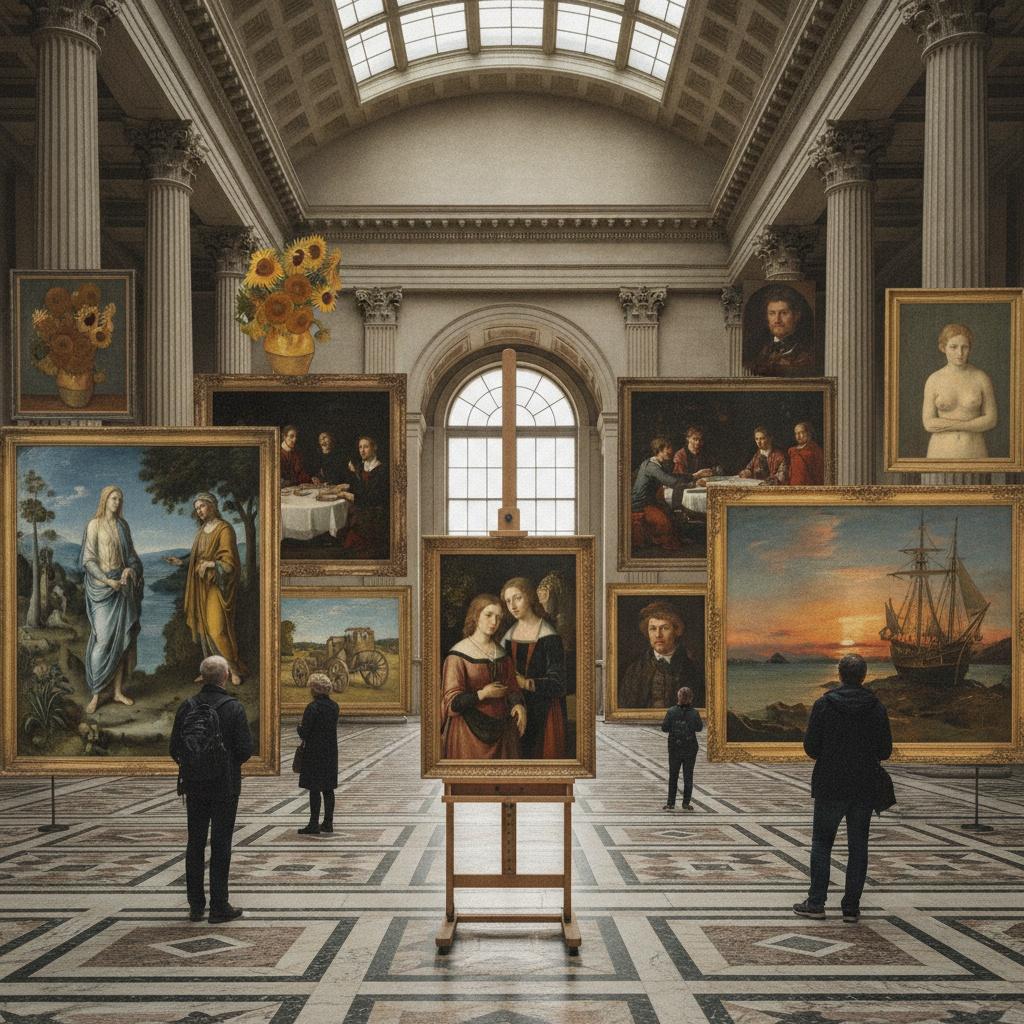
To step through the doors of the National Gallery in London is to enter a sanctuary where time seems to evened its forward march. Within these walls, the pulse of history beats through layers of pigment and canvas, offering a profound encounter with the very evolution of Western art. From the quiet, devotional intensity of early Renaissance works to the dramatic, light-drenched canvases of the Baroque era, the collection serves as a monumental chronicle of human perception and technical triumph.
For centuries, this institution has stood as a cultural cornerstone, preserving the legacies of masters who redefined the boundaries of what could be captured on a flat surface. The gallery does not merely display objects; it presents a dialogue between eras, where the meticulous precision of the 15th century meets the sweeping emotional landscapes of the 19th. This collection has shaped the aesthetic foundations of our modern world, influencing everything from classical architecture to contemporary visual media.
These twenty-five selected works remain deeply meaningful today because they transcend their historical origins. They continue to evoke raw emotion, spark intellectual inquiry, and command a sense of awe that remains undiminished by the passage of centuries. Each piece is a window into a different way of seeing—a testament to the enduring power of the artist's hand.
As we embark on this curated journey, we invite you to look closely at the brushstrokes and the stories embedded within each frame. The following list highlights twenty-five essential masterpieces that define the spirit of the National Gallery and continue to resonate with the global soul.
The Hay Wain - John Constable
 The Hay Wain - John Constable
The lines in The Hay Wain by John Constable aren’t merely drawn; they are choreographed. This is not just a landscape; it is a dance frozen in time, where the turbulent English sky and the tranquil River Stour exist in a delicate, rhythmic tension. As one of the most essential works within the National Gallery, London , it masterfully demonstrates how chaos can be transformed into harmony through the subtle interplay of light and shadow.
Constable’s technique—rich with expressive brushwork and a tactile sense of atmosphere—brings an incredible immediacy to this pastoral scene. The billowing, rain-heavy clouds create a dynamic energy that feels alive, as if the weather itself is part of the composition's movement. What if your own walls could breathe with this same rhythmic vitality? To bring such a masterpiece into a space is to invite a profound sense of balance and historical depth, allowing a room to hold the same quiet strength found in the heart of the English countryside.
Double Portrait of Jean de Dinteville and Georges de Selve (also known as The Ambassadors) - Hans Holbein the Younger
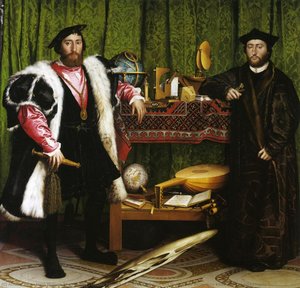 Double Portrait of Jean de Dinteville and Georges de Selve (also known as The Ambassadors) - Hans Holbein the Younger
If you shift your perspective just slightly while standing before Holbein’s masterpiece, a distorted, ghostly skull emerges from the floor. This anamorphic trick is more than a visual puzzle; it is a profound memento mori , a silent reminder of mortality amidst the worldly splendor of 1533. In this iconic work within the National Gallery, London , Hans Holbein the Younger achieves a level of Northern Renaissance precision that remains unparalleled. Every thread of silk, every glint on the celestial globe, and even the broken string of the lute are rendered with such hyper-realistic detail that the objects seem to pulse with life. The painting captures the intense political and religious friction of the Tudor era through a dense layer of symbolism—from Lutheran texts to navigational tools—creating a complex narrative of power and intellect. The sheer intellectual weight and focused composition of The Ambassadors offer more than historical insight; they provide a blueprint for a space of deep thought. Integrating the gravity and sophisticated atmosphere of such a masterpiece into a modern home office or study can inspire a sense of enduring focus and scholarly ambition.
The Origin of the Milky Way - Jacopo Tintoretto
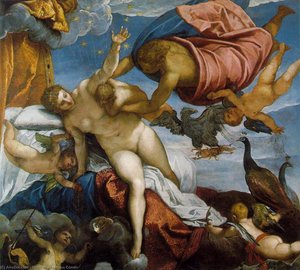 The Origin of the Milky Way - Jacopo Tintoretto
In The Origin of the Milky Way by Jacopo Tintoretto, the viewer is immediately arrested by a celestial chiaroscuro that seems to pulse with divine energy. The light does not merely illuminate; it erupts from the center, catching the edges of swirling clouds and the luminous skin of Venus, creating a profound sense of movement amidst the mythological chaos. This masterful command of illumination—where deep, velvety shadows collide with sudden, radiant bursts—is precisely what secures this work’s prestigious position among the top 25 artworks in the National Gallery, London .
Tintoretto’s ability to use light as a narrative force allows the heavens to feel tangible and alive. When brought into a contemporary setting, a faithful reproduction of such dramatic lighting offers more than mere decoration; it introduces an architectural layer of depth and unparalleled luxury. The interplay of shadow and brilliance can transform a modern wall into a window of historical grandeur, providing a sophisticated focal point that anchors any high-end interior with the soul of the Venetian Renaissance.
Winter Landscape - Caspar David Friedrich
 Winter Landscape - Caspar David Friedrich
Caspar David Friedrich once famously remarked that an artist must paint not only what he sees before him, but also what he perceives within himself—a philosophy that breathes profound life into the hauntingly beautiful Winter Landscape .
As a cornerstone of the National Gallery, London collection, this 1811 masterpiece transcends mere scenery to become a spiritual map. Friedrich’s technical genius lies in his ability to manipulate the "sublime," using a stark, monochromatic palette of frost and shadow punctuated by the unexpected, delicate pink ribbons on evergreen trees. The interplay between the cold, textured snow and the ethereal, glowing sky creates an atmospheric depth that pulls the viewer into a state of deep contemplation. The distant, silhouetted Gothic castle and the solitary wooden cross serve as anchors for a meditation on mortality and the infinite.
For those designing sophisticated modern environments, such as a high-end home office or executive study, this artwork offers more than aesthetic value; it provides a focal point of profound stillness. Integrating such an evocative landscape can foster the mental clarity and quiet focus essential for sustained productivity and intellectual rigor.
Venus, Cupid and Time (Allegory of Lust) - Agnolo Bronzino
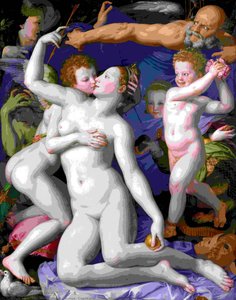 Venus, Cupid and Time (Allegory of Lust) - Agnolo Bronzino
Agnolo Bronzino’s Venus, Cupid and Time (Allegory of Lust) stands as a pinnacle of Mannerist sophistication within the National Gallery’s collection. This 1540 masterpiece captures a profound tension between beauty and mortality through its strikingly smooth, almost porcelain-like skin tones and a palette of deep, jewel-toned blues and purples. The painting’s intricate allegory—weaving together the figures of Venus, Cupid, and Time—offers an unparalleled exploration of human desire and its inevitable consequences.
As one of the top 25 works in London, it represents a pivotal shift from High Renaissance harmony to a more complex, emotionally charged aesthetic. For the modern collector or interior designer, the artwork’s dramatic chiaroscuro and refined elegance provide a commanding presence. Its ability to anchor a space with its intense visual narrative and sophisticated color theory makes it an enduring inspiration for contemporary luxury interiors, where bold historical statements meet modern architectural grace.
Still Life: Vase with Fourteen Sunflowers - vincent willem van gogh
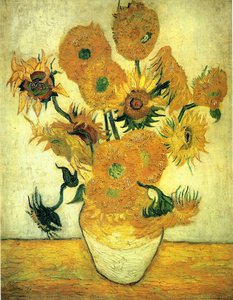 Still Life: Vase with Fourteen Sunflowers - vincent willem van gogh
In Still Life: Vase with Fourteen Sunflowers , one does not merely look at the flowers; one feels the radiant, sun-drenched pulse of life vibrating from the canvas. The primary emotion is an overwhelming sense of vitality, captured through Van Gogh’s thick, impasto brushstrokes that make the golden petals feel almost tactile. As one of the most iconic pieces among the top 25 artworks in 'National Gallery, London' , this masterpiece offers a profound psychological depth, mirroring the human capacity for joy and resilience amidst turbulence.
The heavy texture and warm, amber palette create a sensory experience that transcends simple decoration. Integrating such a powerful work into your environment can transform a quiet corner or a professional lounge into a space of profound energy and warmth. Whether you are looking to anchor a large-scale corporate installation or add a soulful touch to a private study, the rhythmic yellows and oranges provide an enduring focal point that invites reflection and celebrates the beauty of nature's persistence.
Salome with the Head of St. John the Baptist - Caravaggio
 Salome with the Head of St. John the Baptist - Caravaggio
In Salome with the Head of St. John the Baptist by Caravaggio, the composition is anchored by a profound geometric tension. The sharp, diagonal lines created by the interplay of light and shadow—Caravaggio’s signature tenebrism—guide the eye directly to the gruesome centerpiece: the severed head on the platter. This structural balance, where darkness consumes the periphery to highlight the central tragedy, achieves a sense of timeless perfection that secures its place among the top 25 artworks in the National Gallery, London .
There is a striking parallel here to modern minimalist design; just as minimalism relies on essential forms and high contrast to ground a space, Caravaggio’s reduction of the scene to raw, illuminated figures provides a powerful, uncluttered focal point. This dramatic interplay of light and dark does more than tell a biblical story; it creates an emotional weight that resonates within contemporary interiors, offering a sophisticated, commanding presence for any discerning collector.
Venus and Mars - Sandro Botticelli
 Venus and Mars - Sandro Botticelli
Venus and Mars by Sandro Botticelli stands as a profound investment in both cultural legacy and refined aesthetic taste for the discerning collector. As a cornerstone of the National Gallery, London , this 1483 masterpiece exemplifies the Renaissance's ability to harmonize the eternal tension between love and war. The painting’s historical significance is matched by its enduring influence on Western art, where Botticelli’s mastery of graceful, linear forms and symbolic depth creates a visual dialogue that has captivated scholars for centuries. Its position within this top 25 selection is cemented by its unparalleled ability to convey complex mythological narratives through soft, luminous skin tones and rich, textured landscapes.
For the modern professional or decorator, a high-quality reproduction of this work carries the same aesthetic authority and status, seamlessly integrating into luxury interiors. Whether used as a focal point in a corporate lobby or a sophisticated residential space, it provides an unmistakable sense of timeless grandeur and architectural prestige.
Portrait of Giovanni Arnolfini and his Wife (detail) (12) - Jan van Eyck
 Portrait of Giovanni Arnolfini and his Wife (detail) (12) - Jan van Eyck
In this breathtaking detail from Jan van Eyck’s 1434 masterpiece, the boundaries between reality and art dissolve. To witness this section of the Portrait of Giovanni Arnolfini and his Wife is to experience the very pinnacle of Northern Renaissance innovation. The artist’s pioneering use of oil glazes creates a luminous, almost breathing surface, where light dances across heavy fabrics and intricate textures with unparalleled precision.
Notice the deep, saturated reds and the subtle, shimmering golds that suggest an atmosphere of profound opulence. Every meticulously rendered fold in the drapery and every soft shadow cast by the directional lighting serves to pull the viewer into a world of quiet dignity and immense wealth. This isn't merely a study of light and pigment; it is a window into a vanished era of sophistication. For those seeking to surround themselves with historical genius, this detail offers more than visual beauty—it provides a transformative connection to the soul of the Renaissance.
Umbrellas - Pierre-Auguste Renoir
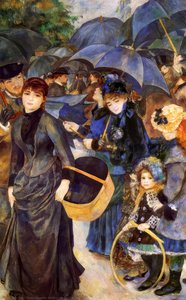 Umbrellas - Pierre-Auguste Renoir
To step into Pierre-Auguste Renoir’s “Umbrellas” is to feel the sudden, cool mist of a Parisian afternoon. This 1886 masterpiece does not merely depict a rainy day; it captures the very pulse of 19th-century social life. Through loose, expressive brushstrokes, Renoir dissolves the boundaries between light and shadow, creating a shimmering surface where blues, blacks, and browns dance upon wet pavement.
The composition draws us into a shared moment of intimacy—two women sheltered beneath a single blue umbrella, their connection mirrored by the playful energy of a child with a hoop nearby. It is a symphony of movement and atmosphere, where the heavy, damp air is lightened by pops of unexpected color. Within the halls of the National Gallery, this work stands as more than a painting; it is an invitation to find beauty in the fleeting, transient moments of existence, transforming a simple urban scene into a gallery of the soul.
St. George and the Dragon - Paolo Uccello
 St. George and the Dragon - Paolo Uccello
In St. George and the Dragon by Paolo Uccello, one is immediately struck by the breathless tension held within the knight’s resolute gaze as he prepares to strike. This masterpiece, a standout among the top 25 artworks in the National Gallery, London , captures more than just a medieval legend; it mirrors the eternal human struggle between courage and chaos. Through Uccello’s pioneering use of linear perspective, the scene unfolds with a mathematical precision that feels both structured and dreamlike, pulling the viewer into a world of vibrant reds, deep blues, and shimmering golds. The psychological weight of the encounter—the bravery of the saint against the looming shadow of the beast—offers a universal reflection on resilience. Integrating such a powerful narrative into your personal collection can transform a quiet corner of a room into a space for profound contemplation or strength, serving as a constant reminder of the triumph of light over darkness.
Mystic Nativity - Sandro Botticelli
 Mystic Nativity - Sandro Botticelli
In Mystic Nativity by Sandro Botticelli, one is immediately struck by the profound, quiet serenity radiating from the central figures, where the Virgin Mary’s tender gaze meets the divine light of the Christ child. This masterpiece, a cornerstone among the top 25 artworks in the National Gallery, London , captures a moment of celestial intersection between the heavens and the earth. As your eyes move through the intricate registers—from the swirling, angelic hosts above to the humble, shadowed figures below—you encounter a psychological depth that mirrors our own human search for hope amidst uncertainty. The vibrant palette of warm golds and deep reds creates an atmosphere of spiritual warmth, while the meticulous Renaissance detail invites endless contemplation. Bringing such a powerful emotional resonance into your own home can transform a personal sanctuary into a space for profound reflection or quiet calm, allowing the painting’s timeless grace to anchor your surroundings with a sense of eternal peace.
Susanna Fourment - Peter Paul Rubens
 Susanna Fourment - Peter Paul Rubens
Imagine stepping into the soft, flickering light of a 17th-century studio, where the gaze of Susanna Fourment meets yours with an arresting, quiet intimacy. As one of the most captivating pieces among the top 25 artworks in National Gallery, London , Rubens’ 1625 masterpiece captures far more than a mere aristocratic likeness; it embodies the very soul of the Baroque era.
The painting is a masterclass in chiaroscuro , where dramatic light illuminates the subject's delicate skin against the deep, textured shadows of her opulent beaver-felt hat and rich crimson sleeves. Rubens’ fluid brushwork renders the tactile luxury of fabric and the soft, atmospheric background with breathtaking realism, creating a sense of profound depth. This portrait offers an enduring elegance that transcends centuries; in a modern interior, its warm palette of golds and deep reds provides a sophisticated anchor, inviting a moment of quiet reflection and timeless beauty into any space.
Mary Magdalene in Ecstasy - Artemisia Gentileschi
 Mary Magdalene in Ecstasy - Artemisia Gentileschi
In Mary Magdalene in Ecstasy by Artemisia Gentileschi, the profound interplay of deep, velvety ebony and radiant, sun-kissed gold sets an atmosphere of intense, private devotion. The darkness does not merely surround the figure; it isolates her, heightening the spiritual weight of her transcendence. This masterful use of chiaroscuro—the dramatic tension between shadow and light—is precisely why this piece remains a cornerstone among the top 25 artworks in the National Gallery, London . Gentileschi’s ability to manipulate a concentrated palette to convey complex emotional states like rapture and vulnerability is nothing short of revolutionary.
For collectors looking to curate a sophisticated modern interior, this painting offers a masterclass in atmospheric design. Incorporating such deep, dramatic tones into a dining room or study can create a sense of moody elegance, where warm accent lighting mimics the luminous glow of the subject's skin, transforming a contemporary space into a sanctuary of quiet reflection and timeless grandeur.
The Holy Family with a Shepherd - Titian Ramsay Peale II
 The Holy Family with a Shepherd - Titian Ramsay Peale II
The Holy Family with a Shepherd by Titian Ramsay Peale II captures a profound sense of Renaissance tranquility, acting as a luminous window into a world of serene beauty and religious devotion. As a vital inclusion in the National Gallery, London’s top collection, this work stands as a masterclass in technique, particularly through its use of sfumato to create soft, lifelike transitions between light and shadow. The composition draws the eye through a landscape of deep blues and earthy greens, where Mary, Joseph, and the infant Jesus are cradled in a gentle, diffused glow. The presence of a kneeling shepherd adds a layer of humble adoration, while the subtle inclusion of a horse introduces an intriguing element of mystery. Beyond its historical weight, the painting’s balanced, pyramidal structure and calming color palette offer timeless inspiration for modern design, providing a sense of stability and quiet elegance that can transform any contemporary interior into a space of peaceful reflection.
Portrait of a Young Man - Sandro Botticelli
 Portrait of a Young Man - Sandro Botticelli
In the hallowed halls of the National Gallery, London, a singular encounter awaits: Sandro Botticelli’s Portrait of a Young Man . Created around 1483, this work transcends mere portraiture to become a profound psychological dialogue. While his contemporaries often favored the detached elegance of profile views, Botticelli dared to present his subject en face , inviting a direct, startling intimacy that feels remarkably modern.
The painting is a masterclass in Renaissance alchemy. A vibrant red turban provides a striking focal point against the somber, earthy tones of the sitter's heavy robe and luxurious fur-lined collar. Through meticulous layers of tempera, Botticelli achieves a luminous, pearlescent skin tone that seems to glow under soft, ambient light. To surround oneself with such genius is not merely to decorate a room; it is to undergo a transformation. This piece proves that true art does not just occupy space—it liberates the soul, turning any environment into a curated gallery of human emotion and historical depth.
Agony in the Garden - Andrea Mantegna
 Agony in the Garden - Andrea Mantegna
Close your eyes. Can you feel the light in Agony in the Garden by Andrea Mantegna? It is not merely illumination; it is a language of profound, divine sorrow. The artist did not simply paint light—he composed it, weaving an ethereal glow through turbulent skies and jagged rocky outcrops to underscore Christ’s isolation. As you stand before this Renaissance masterpiece in the National Gallery, London , you witness a masterclass in perspective and sculptural weight.
Mantegna uses light to define the very texture of human suffering, casting heavy shadows across the sleeping disciples while angelic figures descend with the instruments of the Passion. The palette of muted ochres and stony greys creates a sense of eternal gravity and meticulous detail. Now, open your eyes. That same dramatic, spiritual light is waiting to spill into your home, turning your walls into portals of historical inspiration and profound contemplation.
Supper at Emmaus - Caravaggio
 Supper at Emmaus - Caravaggio
Caravaggio’s Supper at Emmaus stands as a definitive cornerstone among the top 25 artworks in the National Gallery, London , capturing the visceral moment where divinity intersects with the mundane. This 1601 masterpiece embodies the Baroque revolution, utilizing revolutionary tenebrism to pierce enveloping darkness with sharp, dramatic shafts of light. Such intense chiaroscuro does more than illuminate a scene; it heightens the psychological tension of recognition and doubt, drawing the viewer into the very heart of the disciples' astonishment.
Beyond its technical mastery, the painting’s gritty realism—the unadorned table and weathered hands—serves as a profound meditation on humanity and perception. It reminds us that the most transformative truths often emerge within the simplest settings. For those curating sophisticated modern environments or prestigious collections, the dramatic interplay of shadow and light in this work offers an enduring inspiration, providing a blueprint for creating spaces defined by depth, drama, and quiet contemplation.
Artemisia Gentileschi - Artemisia Gentileschi
 Artemisia Gentileschi - Artemisia Gentileschi
To stand before a canvas where shadows hold as much weight as the light is to encounter the very essence of the Baroque era. Among the top 25 artworks in National Gallery, London , few possess the visceral emotional gravity found in Self-Portrait as Saint Catherine of Alexandria by Artemisia Gentileschi .
Created around 1615, this work is a masterclass in tenebrism , using dramatic contrasts to illuminate a face defined by both grace and grit. The viewer is drawn into the tactile reality of the scene—the rough texture of the broken martyrdom wheel and the soft, symbolic palm frond held against her chest. Through rich, deep pigments and confident brushwork, Gentileschi transforms a religious icon into a personal manifesto of resilience. Her ability to navigate a male-dominated world is etched into every shadow. This masterpiece remains essential because it transcends its historical moment; it serves as a timeless reminder of how powerful imagery can transform any space into an arena of profound human reflection and enduring strength.
Danaë - Artemisia Gentileschi
 Danaë - Artemisia Gentileschi
In the quiet, shadowed depths of Artemisia Gentileschi’s Danaë , one encounters a visceral masterclass in Baroque emotion that distinguishes it among the top 25 artworks in 'National Gallery, London' . Painted when the artist was a burgeoning prodigy, this work captures the precise moment where myth intersects with palpable reality, as Zeus descends upon the princess not as thunder, but as a shimmering rain of gold. The painting possesses a profound psychological weight, exploring themes of confinement and the transformative power of fate. Through her masterful use of chiaroscuro , Gentileschi employs stark contrasts to sculpt flesh and precious metal from the darkness, creating a sensory experience that remains strikingly relevant. In contemporary interior curation, where deep, moody tones and narratives of female resilience are highly valued, Danaë serves as an evocative focal point, bridging the gap between historical grandeur and modern aesthetic sensibilities.
Self Portrait as Saint Catherine of Alexandria - Artemisia Gentileschi
 Self Portrait as Saint Catherine of Alexandria - Artemisia Gentileschi
Observe the dramatic interplay of light and shadow in Artemisia Gentileschi’s 1615 masterpiece, where the heavy, deliberate application of oil paint creates a palpable sense of tension. The masterful use of chiaroscuro—a revolutionary technique borrowed from Caravaggio—emerges from deep, velvety shadows to illuminate Saint Catherine’s face with startling realism. Every visible brushstroke contributes to the physical texture of the broken wheel and the metallic sheen of her crown, embodying a profound narrative of resilience.
As one of the most significant works in the National Gallery, London , this painting is defined by its visceral, emotional depth. Our mission is to preserve this exact tactile, three-dimensional quality for the connoisseur's home. Through our high-end hand-painted reproductions, we ensure that the physical presence of the original—the raised impasto and the dramatic tonal range—is captured with precision, bringing the enduring strength of Gentileschi’s artistry into your space.
Christina of Denmark, Ducchess of Milan - Hans Holbein the Younger
 Christina of Denmark, Ducchess of Milan - Hans Holbein the Younger
In Christina of Denmark, Duchess of Milan by Hans Holbein the Younger , the composition is anchored by a striking verticality and formal symmetry. The long, flowing lines of her sleeves and her upright, regal posture create a structural harmony that feels both stable and eternal. This geometric precision, paired with the disciplined, conical silhouette of her mourning gown, establishes a sense of timeless perfection that secures its place among the top 25 artworks in the National Gallery, London .
Beyond its historical significance, the painting’s restrained, almost monochromatic palette—dominated by deep blacks and subtle gold accents—resonates powerfully with the principles of modern minimalist design. The way Holbein utilizes soft, diffused light to pull the subject forward from a shadowy void provides a grounding element for contemporary interiors, where clean aesthetics and balanced proportions are paramount. It is a masterclass in how classical structural balance can inform and elevate a sophisticated, modern architectural space.
Annunciation - Duccio di Buoninsegna
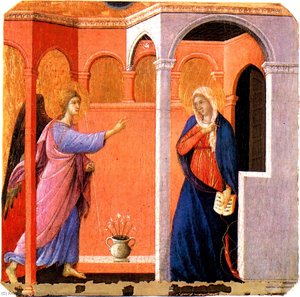 Annunciation - Duccio di Buoninsegna
The rich, ethereal gold leaf in Duccio di Buoninsegna’s Annunciation immediately envelops the viewer in a sense of divine permanence and sacred warmth. This shimmering backdrop, paired with the deep, symbolic red of the background wall, creates a profound emotional tension between heavenly grace and earthly passion. As one of the top 25 artworks in National Gallery, London , this piece earns its place through its masterful transition from Byzantine rigidity toward a more human, lyrical Gothic style. The innovative use of deep blues in Gabriel’s robes against the gilded surface provides a breathtaking depth that was revolutionary for 1308. For those looking to curate a sophisticated modern interior, this palette offers incredible inspiration; integrating deep crimson accents or metallic gold textures can evoke the same sense of historical weight and quiet dignity in a dining room or formal living space, transforming a contemporary room into a sanctuary of refined elegance.
Christ Mocked (Crowning with Thorns) - Hieronymus Bosch
 Christ Mocked (Crowning with Thorns) - Hieronymus Bosch
In Christ Mocked (Crowning with Thorns) , the viewer is immediately met by the profound, quiet vulnerability within Christ’s gaze, a stark contrast to the chaotic cruelty of the surrounding crowd. Bosch does not merely depict a historical event; he creates a psychological mirror of human frailty and our capacity for spiritual corruption. As one of the most hauntingly beautiful pieces among the top 25 artworks in 'National Gallery, London' , this painting uses a claustrophobic composition—layering aggressive reds and yellows against the pale, luminous whites of Christ’s form—to evoke an unsettling tension. The mastery of light and shadow invites us to contemplate the darker depths of the human experience. Integrating the emotional resonance of such a powerful masterpiece into your home can transform a personal sanctuary into a space for profound reflection and quiet prestige, turning a wall into a window for deep, meditative thought.
The Virgin and Child with Saints Dominic and Aurea - Duccio di Buoninsegna
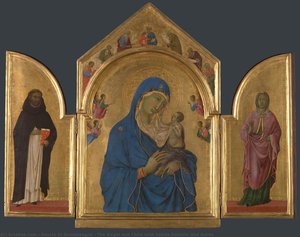 The Virgin and Child with Saints Dominic and Aurea - Duccio di Buoninsegna
Imagine a masterpiece designed not for a fixed cathedral altar, but to travel the rugged pilgrimage routes of medieval Italy alongside a high-ranking Cardinal. Duccio di Buoninsegna’s The Virgin and Child with Saints Dominic and Aurea is a breathtaking testament to this portable devotion. As a cornerstone of the Sienese School, this work showcases a technical leap in Gothic elegance; the luminous tempera and shimmering gold leaf create a celestial atmosphere that feels both intimate and infinite. The deliberate placement of saints and prophets weaves a complex tapestry of divine history, guiding the eye through layers of sacred symbolism.
Standing as a vital highlight among the top 25 artworks in the National Gallery, London , Duccio’s ability to capture profound spiritual focus is truly unparalleled. Integrating the disciplined beauty of such a masterpiece into a modern study or home office can inspire an environment of quiet strength and sophisticated, focused productivity.
Conclusion
As we conclude our journey through the halls of the National Gallery, London, we are reminded that these masterpieces are far more than mere relics of a bygone era. They are living presences , breathing through every textured brushstroke and every carefully captured shadow. To stand before them is to enter into a timeless conversation that spans centuries, connecting the hands of long-passed masters with the eyes of modern admirers. These works do not simply hang on walls; they shape our spaces, infuse our interiors with soul, and continue to ignite the spark of human creativity in an ever-changing world. Whether it is the profound depth of a Renaissance portrait or the vibrant energy of an Impressionist landscape, each piece carries a fragment of the artist's spirit, waiting to be rediscovered. We invite you to explore this enduring legacy and bring a piece of this history into your own environment by browsing our full collection . In every pigment and every layer of oil, the dialogue between the past and the present remains beautifully unbroken.