Understanding the Global Landscape: Import Duties and Customs Fundamentals
 Customs
Customs is an authority or agency in a country responsible for collecting tariffs and for controlling the flow of goods, including animals, transports, personal effects, and hazardous items, into and out of a country. Traditionally, customs has been ...
The acquisition of a masterpiece is often an emotional journey, a pursuit of beauty that transcends geographical boundaries to find a permanent home within a private sanctuary. However, as any seasoned collector knows, moving high-value assets across borders introduces a layer of complexity that exists far beyond the aesthetic appreciation of the work itself. At its core, the global landscape of art acquisition is governed by customs authorities—the gatekeepers of international trade. These agencies are tasked with more than just taxation; they manage the security and flow of goods, ensuring that every shipment complies with the specific legal frameworks of the destination country.
To navigate this terrain, one must understand that customs duties, often referred to as tariffs, are levies imposed by a nation upon imported goods. These duties are not arbitrary but are calculated based on the country of origin, the declared value of the artwork, and the specific classification of the piece. While some trade agreements may offer exemptions for certain types of art, the fundamental reality remains that the importer of record bears the responsibility for these costs. Failure to respect these established protocols can lead to significant disruptions, ranging from administrative delays to the more severe consequence of seizure by customs authorities. Understanding this foundational layer is the first step in ensuring that your passion for contemporary or classical art does not become entangled in the friction of international bureaucracy.
Decoding VAT and Import Taxes: What Every Collector Needs to Know
 F.A.Q.: Navigating Customs and Duties for Elite Collectors
Understanding Import Duties & Taxes: A Global Perspective for Collectors For the discerning collector, acquiring art transcends borders. However, navigating international shipping complexities—particularly import duties and taxes—is crucial to a seam...
Beyond the standard customs duties lies the intricate web of Value Added Tax, commonly known as VAT, which serves as a significant fiscal component of the importation process. For the discerning collector, VAT represents one of the most critical variables in the total cost of acquisition. Unlike a simple tariff, VAT is a consumption tax applied to the value of the goods entering a territory, and its rates can fluctuate dramatically depending on the destination. In many jurisdictions, the imposition of these taxes is a standard procedure designed to regulate domestic markets and generate revenue, yet for the global buyer, it can feel like an unforeseen shadow cast over a brilliant acquisition.
The complexity deepens when considering that VAT is often levied at the moment of delivery or upon arrival at the port of entry. This requires a high levelary of financial foresight. It is essential to distinguish between the purchase price of the artwork and the subsequent tax obligations triggered by its movement across borders. For those acquiring works from international studios, particularly those shipping from hubs like China to Europe or the Americas, being aware of the specific tax triggers in your local jurisdiction is paramount. A truly seamless experience relies on the ability to anticipate these costs, treating them not as hidden fees, but as a known element of the global art market's economic architecture.
The Importer of Record: Navigating Responsibilities and Compliance
Customs duties in the United StatesThe United States imposes tariffs (customs duties) on imports of goods. The duty is levied at the time of import and is paid by the importer of record. Customs duties vary by country of origin and product. Goods from many countries are exempt from du...
In the high-stakes world of international logistics, the concept of the "Importer of Record" is perhaps the most vital designation for a collector to grasp. This role carries the legal weight of the transaction; it is the entity—whether an individual collector, a gallery, or a professional agent—responsible for ensuring that all customs regulations are met and that all necessary duties and taxes are paid. When you commission a hand-encoded oil reproduction or purchase a limited edition print, you are essentially stepping into this role, assuming the duty to declare the transaction value and the origin of the work accurately.
Compliance is not merely about payment; it is about the integrity of the declaration. The importer must provide comprehensive documentation, including an accurate invoice and a detailed packing list, to allow customs officials to assess the shipment correctly. In the United States, for instance, Customs and Border Protection (CBP) enforces strict rules regarding the declaration of goods, and any discrepancy in the declared value can result in penalties. For the collector, maintaining a transparent and meticulous approach to these responsibilities is the only way to ensure that the arrival of a new piece—be it a vibrant Pop Art canvas or a delicate Renaissance-inspired oil painting—is met with celebration rather than legal scrutiny.
Strategic Documentation: Essential Paperwork for Seamless Border Clearance
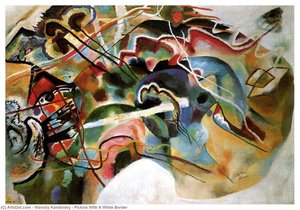 Picture With A White Border
Explore Wassily Kandinsky’s masterpiece ‘Picture With A White Border,’ a vibrant abstract painting embodying Expressionism's emotional depth and featuring iconic animals & geometric shapes within its striking white border.
The difference between a smooth delivery and a logistical nightmare often rests on a few sheets of paper. In the realm of international art transport, documentation serves as the primary language of communication between the collector, the carrier, and the customs authority. To facilitate a seamless transition through border checkpoints, one must treat paperwork with the same reverence as the artwork itself. The most critical elements include the commercial invoice, which must clearly state the value, description, and origin of the art, and the packing list, which details the physical characteristics of the shipment.
Furthermore, specific regional requirements demand specialized attention to detail. For collectors in Brazil, for example, the provision of a CPF (taxpayer ID) is an absolute necessity for clearance. Similarly, acquisitions destined for Mexico require specific tax identification. In certain European contexts, such as Italy, providing a formal Reproduction Declaration can be essential for verifying the nature of the work. By ensuring that every piece of documentation is precise, legible, and complete, collectors can significantly reduce the risk of delays in bonded warehouses or customs-controlled zones, allowing the artwork to move swiftly from the studio to its intended gallery wall.
Mitigating Financial Surprises: Proactive Strategies for International Acquisitions
 ArtsDot.com F.A.Q.: Hassle-Free International Customs & Duty Refunds
Seamless Global Logistics: Our Commitment to Secure International Delivery The acquisition of a fine art reproduction is an experience that transcends mere commerce; it is an emotional journey of bringing history and beauty into one's private sanctua...
The true hallmark of an elite collector is the ability to mitigate financial surprises through proactive planning. The sudden imposition of unexpected fees can disrupt even the most well-funded acquisition strategies. To avoid this, it is prudent to adopt a strategy of transparency and verification. Before a transaction is finalized, it is highly recommended to engage with the logistics provider or the art studio to understand the potential for import duties in your specific region. This includes investigating whether there are any existing trade agreements that might lower the tariff burden for works originating from certain countries.
Another effective strategy involves the use of professional intermediaries and specialized couriers like DHL, FedEx, or UPS, who possess the expertise to navigate complex customs landscapes. Furthermore, maintaining a clear line of communication with the project coordinator or the supplier regarding the exact shipping terms is vital. By treating the logistics as an integral part of the art's value, collectors can build a budget that accounts for the total cost of ownership, ensuring that the focus remains on the aesthetic and historical significance of the collection rather than the volatility of international trade costs.
The Refund Protocol: How to Reclaim Paid Customs Fees and VAT
 F.A.Q.: Customs Fees Refund – A Guide for Elite Collectors
F.A.Q.: Customs Fees Refund – A Guide for Elite Collectors At ArtsDot.com, we make international collecting smooth and transparent. Here’s how our customs/VAT refund works for your peace of mind. How the Customs/VAT Refund Works We ship your artwork...
While much of our focus is on prevention, there are instances where the imposition of VAT or import fees becomes an unavoidable reality upon delivery. In such moments, the sophisticated collector turns toward the established protocols for reimbursement. The process of reclaiming paid customs fees is a structured procedure that requires meticulous record-keeping. To successfully navigate a refund, one must possess clear, official proof of the payment made to the local customs authority or the carrier. This typically takes the form of an official customs invoice that clearly displays the amount paid, the date of the transaction, and the specific nature of the tax.
The protocol for requesting a refund involves submitting this verified documentation to the art provider's support team. For instance, when working with established global platforms, the process is often streamlined: once a clear photo or digital copy of the official invoice is emailed to the support department—including the relevant order number—the verification process can begin. It is important to note that certain regions may have specific limitations, such as caps on refund amounts in Italy or Brazil, which necessitates an awareness of these nuances. By following this disciplined approach to documentation and communication, collectors can protect their investments and ensure that the financial integrity of their collection remains uncompromable.