
The Glitch in the Canvas: Why Neo-Impressionism is the Original Digital Revolution
Before we had high-resolution Retina displays, 4K monitors, or the mesmerizing pixel grids of modern gaming, there was a radical movement that sought to decode the very DNA of light. While the Impressionists were busy chasing the fleeting, spontaneous vibes of a sunset with loose, messy brushstrokes, a new breed of visual rebels emerged in late 19th-century Paris. They weren't interested in just capturing a moment; they wanted to engineer it. This was Neo-Impressionism—a movement that felt less like a traditional art school and more like the first high-definition software update in human history.
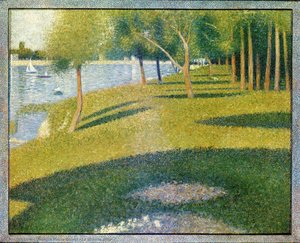
Imagine walking into a gallery in 1886 and seeing something that looked fundamentally broken, yet strangely hyper-real. To the untrained eye, these works appeared as a collection of fragmented, disconnected marks. But as you stepped back, a digital-like magic occurred. The chaos resolved into a crisp, vibrating reality. This wasn't just painting; it was an attempt to hack the human eye. By treating the canvas like a grid of data points, artists like Georges Seurat and Paul Signac bypassed the muddy, blended pigments of the past to create a visual experience that felt electric, much like the high-contrast, saturated aesthetics we crave in contemporary street art and digital design today.
Pointillism Unlocked: The Science of Optical Mixing and Color Theory
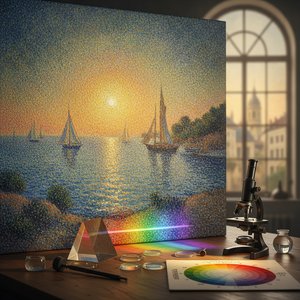
Forget everything you know about mixing paint on a wooden palette. For the Neo-Impressionists, the palette was secondary to the observer’s brain. They pioneered a technique known as mélange optique, or optical mixture. Instead of physically blending a blue pigment with a yellow one to create green—a process that often results in a dull, desaturated tone—they placed tiny, pure dots of blue and yellow side-by-side. The magic happens in the space between the canvas and your retina. As light bounces off these distinct points, your brain performs a real-time render, synthesizing the colors into a luminous, shimmering green that feels far more vibrant than anything achieved through traditional blending.
This wasn't just an artistic whim; it was a calculated, scientific strike against the status quo. Influenced by the cutting-edge color theories of scientists like Eugène Chevreul and Ogden Rood, these artists approached their work with the precision of a coder writing an algorithm. They understood that color is not static but a dynamic interaction of light and perception. This method, often called Divisionism, allowed them to achieve a level of luminosity that mimicked the actual pulsation of sunlight. It was the birth of a structured, analytical approach to beauty, where every dot of pigment served as a deliberate building block in a larger, high-voltage visual architecture.
Seurat’s Blueprint: Deconstructing the Masterpiece 'La Grande Jatte'
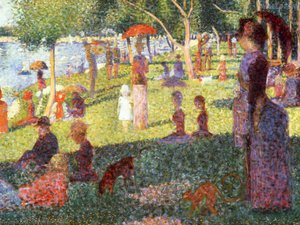
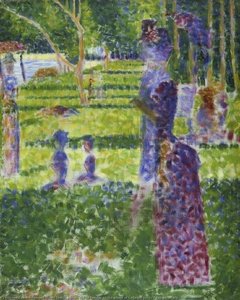
At the heart of this revolution stands Georges Seurat’s magnum opus, A Sunday on La Grande Jatte. At first glance, the scene depicts a tranquil afternoon of Parisians relaxing by the Seine, but look closer and you will find a masterpiece of mathematical precision. There is no randomness here. Every figure, every shadow, and every ripple in the water is part of a meticulously planned composition designed to guide the eye through a structured landscape of light. Seurat didn't just paint a park; he constructed a monumental experiment in visual harmony.
The sheer scale of the work belies the microscopic effort required to execute it. Each inch of the canvas is a dense field of individual strokes, creating a texture that feels both solid and ethereal. The figures themselves possess a certain statuesque, almost iconic quality, reminiscent of modern graphic silhouettes. By utilizing the scientific principles of contrast and light, Seurat achieved a sense of permanence that the fleeting Impressionists could never grasp. It is a work that demands your attention, pulling you into its rhythmic, dot-by-dot construction, proving that true innovation lies in the balance between rigorous structure and breathtaking visual impact.
Beyond the Brush: How Divisionism Predicted Modern Graphic Design
It is impossible to look at the structured dots of Neo-Impressionism without seeing the fingerprints of modern graphic design and digital media. The movement’s obsession with breaking images down into their smallest constituent parts is the direct ancestor of the halftone pattern in pop art, the pixelated textures of early computer graphics, and even the sophisticated dithering used in contemporary digital rendering. The Neo-Impressionists were essentially the first designers to understand that complexity is built from simplicity—that a massive, immersive world can be reconstructed from a series of discrete, intentional marks.
This legacy lives on in every high-impact visual we encounter today, from the bold, flat colors of Lichtenstein’s comic-book aesthetic to the hyper-saturated palettes of modern anime. The movement taught us that by controlling the separation of color and the placement of detail, we can manipulate emotion and perception. They moved art away from the purely romantic and toward the technical, paving the way for an era where visual communication is as much about the science of seeing as it is about the soul of the artist. In every vibrant, high-contrast image that hits your screen, the ghost of Seurat’s revolutionary dot-work is present.
The High-Voltage Aesthetic: Bringing Neo-Impressionist Energy to Contemporary Spaces
In a world dominated by flat, digital surfaces, there is a profound hunger for art that possesses tactile depth and visual energy. The Neo-Impressionist aesthetic offers exactly that—a way to inject a sense of movement and light into modern interiors. Whether it is through the heavy, textured impasto of a hand-painted reproduction or the bold, graphic impact of a large-scale multi-panel set, bringing this style into your space creates a focal point that refuses to be ignored. It is art for those who appreciate the intersection of history and high-tech energy.
Integrating these works into a contemporary home allows you to bridge the gap between classical mastery and modern design. Imagine a wide, minimalist wall transformed by a multi-panel divisionist landscape, where the light seems to pulse within the frame. It provides a sophisticated edge that complements everything from industrial lofts to sleek, urban apartments. By embracing the high-voltage spirit of Neo-Impressionism, you aren't just decorating a room; you are curating an experience of light, science, and pure, unadulterated visual power.
At ArtsDot.com, we specialize in bringing this level of extraordinary visual impact to your doorstep. Whether you are looking for a meticulously hand-painted oil reproduction that captures the physical texture of Seurat’s technique or a custom "remix" that transforms a modern photo into a Pointillist masterpiece, our master artists are dedicated to preserving the energy of art history. From large-format murals to bespoke multi-panel sets, we help you command your space with art that is as bold and revolutionary as the movements that inspired it.