


The Manifesto of Velocity: Understanding the Futurist Revolution
To understand Futurism is to embrace the exhilarating, often jarring, sensation of a world suddenly accelerating. Emerging from the early 20th century, primarily within Italy, this movement was not merely an aesthetic choice but a radical ideological rupture. It was a feverish rejection of the past—a disdain for the stagnant weight of classical antiquity and the museum-bound traditions that had long defined European culture. The Futurists sought to replace the contemplative stillness of the Renaissance with the roar of the engine, the frantic pulse of the metropolis, and the relentless forward march of technology.
At its core, the movement was fueled by a profound obsession with the machine age. The pioneers of this era believed that the beauty of a racing car, gleaming with its polished metal and rhythmic pistons, was far more evocative than any ancient marble sculpture. This was an art of confrontation, designed to shock the senses and awaken the viewer to the new reality of industrialization. For the discerning collector, studying Futurism offers a window into that pivotal moment when humanity first began to synchronize its heartbeat with the mechanical rhythm of progress, creating a legacy of raw, unadulterated energy.
Fragmented Forms and Kinetic Energy: The Aesthetics of Motion
The visual language of Futurism is characterized by a deliberate disintegration of form. To capture motion on a static canvas, artists could not rely on the traditional boundaries of subject and background. Instead, they employed techniques of fragmentation, where lines of force and overlapping planes create a sense of continuous movement. This approach, heavily influenced by the burgeoning science of relativity and the study of chronophotography, allows the viewer to perceive multiple stages of an action simultaneously. The eye does not rest upon a single point; rather, it is pulled through a labyrinth of intersecting trajectories.
This aesthetic creates a profound sense of kinetic energy. Through the use of sharp, angular shapes and a vibrant, often clashing, color palette, the Futurists achieved what many thought impossible: the depiction of time itself. The canvas becomes a site of struggle where light and shadow are no longer mere descriptive tools but active participants in the drama of movement. When observing these works, one does not simply see a subject; one experiences the vibration of its passage through space, feeling the very friction of the air as the forms slice through the composition.
Umberto Boccioni and the Mastery of Dynamic Composition
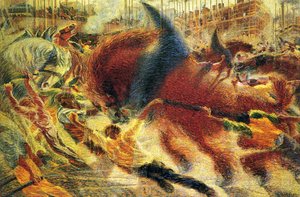
No exploration of this movement is complete without a deep reverence for Umberto Boccioni, perhaps the most intellectually profound figure among the Futurists. Boccioni possessed an unparalleled ability to translate the abstract concept of "dynamism" into tangible, muscular forms. His work serves as the bridge between the raw aggression of the early manifesto and a sophisticated, sculptural understanding of space. He did not merely paint movement; he painted the way movement alters the very atmosphere surrounding an object.
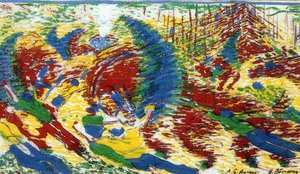
Consider the brilliance found in works such as Dynamism of a Human Body, where vibrant reds and oranges explode across the canvas to evoke the internal heat and external momentum of life. Or look to the rhythmic complexity of Soccer (Dynamic Action Image), which captures the frantic, multidirectional energy of sport through a masterful arrangement of overlapping figures and light. Even in his more structured studies, such as Dynamism of a Cyclist, Boccioni utilizes fragmented forms and bold color to convey the sensation of speed. His mastery lies in his ability to balance the chaos of motion with a rigorous, academic command of composition, ensuring that even the most turbulent scenes possess an underlying structural integrity.
Capturing the Machine Age: Light, Speed, and Urban Vitality
The Futurist gaze was perpetually turned toward the horizon of the modern city. The urban landscape—with its electric lights, tramways, and teeming crowds—provided the ultimate stage for their experiments in light and speed. For these artists, the city was a living organism, a swirling vortex of sensory input that demanded a new way of seeing. They were fascinated by how artificial light could fracture the night, creating new textures and shadows that defied classical perception.
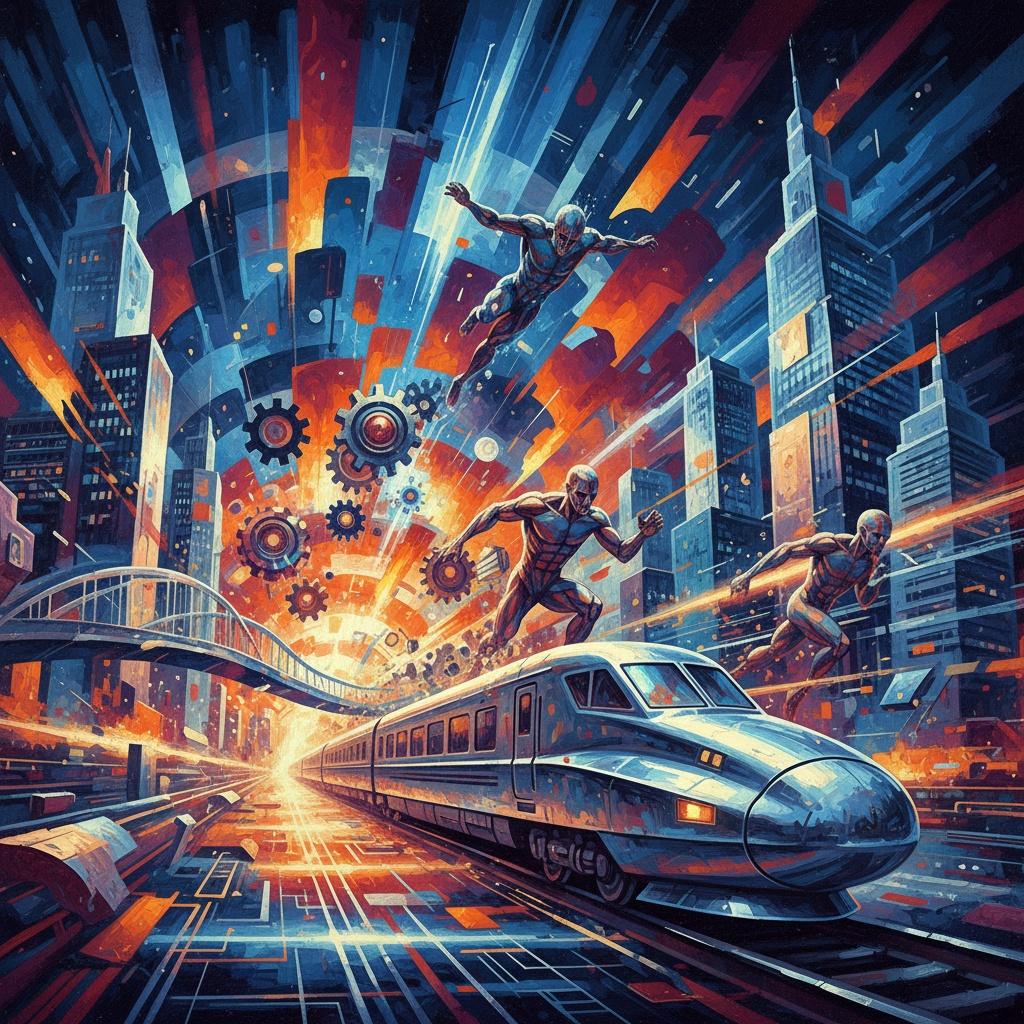
This fascination with urban vitality extended to the depiction of industrial power. The roar of factories, the clatter of construction, and the sleek lines of locomotives were celebrated as symbols of a new era. By focusing on these elements, Futurism captured the psychological shift of a society transitioning from agrarian stability to industrial uncertainty. For the contemporary connoisseur, these paintings serve as powerful evocations of an era defined by its courage to embrace the unknown, offering a sophisticated reflection on the eternal human relationship with technological advancement.
Integrating Futurism into the Modern Collector's Interior
Incorporating the bold spirit of Futurism into a modern collection requires a nuanced approach to interior design. Because these works are inherently high-energy and visually commanding, they function best as focal points within a curated space. A large-scale reproduction of a Boccioni masterpiece can anchor a room, providing a sense of movement that breathes life into minimalist or contemporary architectural settings. The fragmented lines and intense palettes of the movement pair exquisitely with the clean edges of modern furniture and the starkness of industrial-inspired decor.
When selecting pieces for a collection, one might consider the use of multi-panel layouts to expand the sense of motion across a wide wall, or perhaps utilize the textural depth of hand-painted oil reproductions to enhance the tactile experience of the art. Whether through a singular, striking canvas or a series of coordinated works, the presence of Futurist aesthetics introduces a sophisticated dialogue between historical revolution and modern luxury, ensuring that the pulse of the machine age continues to resonate within the sanctuary of the home.
ArtsDot.com is dedicated to making the profound beauty of art history accessible to a global audience. Since 2004, we have specialized in providing exquisite, hand-painted reproductions and custom commissions that preserve the soul of the masters. From the vibrant energy of Umberto Boccioni to the delicate light of Monet, our master artists use traditional oil techniques on fine cotton canvas to create works of enduring quality. Whether you are looking to transform a personal photograph into a Renaissance masterpiece or seeking a large-scale mural for a professional project, ArtsDot offers an unparalleled service of craftsmanship, customization, and global delivery.