The Rebellion Against Reason: How Romanticism Recharged the Visual World
 Romanticism
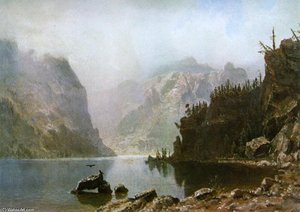
Romanticism (also known as the Romantic movement or Romantic era) was an artistic and intellectual movement that originated in Europe towards the end of the 18th century. The purpose of the movement was to advocate for the importance of subjectivity,...
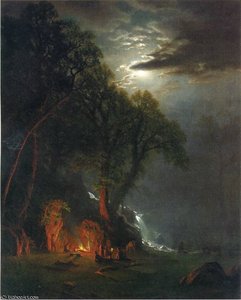
Before the mid-19th century, the intellectual landscape of the West was dominated by the rigid, calculated structures of the Enlightenment. It was an era defined by logic, order, and the clinical pursuit of scientific truth. But as the Industrial Revolution began to churn, casting soot over the once-pristine horizons, a profound cultural rebellion ignited. This was the birth of Romanticism—a movement that traded the cold precision of reason for the heat of human passion and the untamed power of the imagination. It wasn't just an aesthetic shift; it was a visceral rejection of social convention in favor of subjectivity and intuition.
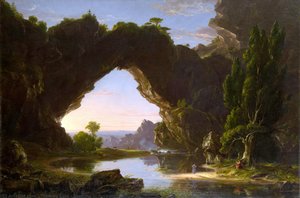
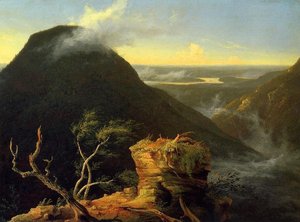
The Romantics believed that truth could not be found solely in a laboratory or a mathematical equation, but rather in the gut-wrenchting awe one feels when standing before a storm or a vast, silent forest. They championed the individual, celebrating the capacity for intense emotion and the spiritual resonance of the natural world. This movement sought to evoke the "sublime"—that intoxicating, slightly terrifying blend of beauty and overwhelming power that reminds us of our own smallness. By prioritizing feeling over form, Romanticism paved the way for a new visual language, one capable of capturing the soul rather than just the surface.
The Hudson River School: Capturing America’s Raw, Unfiltered Soul
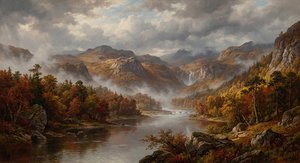 Hudson River School: 10 Masterpieces That Capture America's Wild Beauty | ArtsDot
Introduction Imagine standing before a vast canvas, sunlight dappling through ancient trees, mist rising from a pristine river… This is the world of the Hudson River School, an artistic movement that didn’t just depict America’s landscape, but sought...
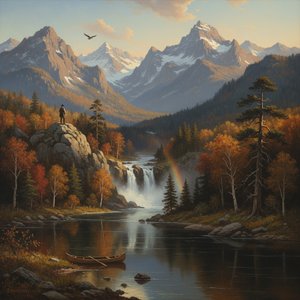
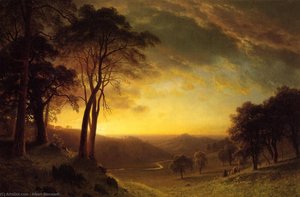
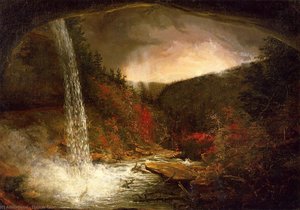
As this wave of emotional intensity crossed the Atlantic, it found its most fertile ground in the burgeoning United States. While Europe looked backward to classical ruins and ancient mythologies to find meaning, a new generation of American artists turned their gaze toward the primordial landscapes of their own continent. The Hudson River School emerged not merely as a collection of landscape painters, but as a powerful declaration of national identity. These artists were the visual architects of a young nation, documenting a wilderness that felt both infinite and divine.
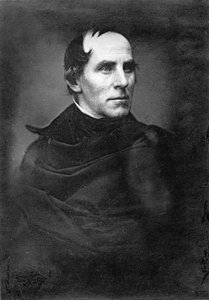
The movement flourished between 1825 and 1870, capturing the tension of an era defined by exploration and settlement. Artists like Thomas Cole and Frederic Church didn't just paint geography; they painted a vision of an unspoiled Eden. Their canvases served as a counterpoint to the encroaching industrialization of the East Coast, offering a window into a world where humanity and nature existed in a state of profound, albeit fragile, coexistence. Through their work, the American landscape became more than just territory—it became a spiritual experience, a source of national pride that sought to define the very essence of the American spirit through its rugged, untamed beauty.
Luminism & The Sublime: Mastering Light and High-Impact Atmosphere
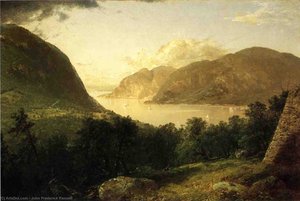 Hudson River Scene
A Serene Vision of the Hudson Valley: John Frederick Kensett’s “Hudson River Scene” John Frederick Kensett's "Hudson River Scene," painted in 1857, isn’t merely a landscape; it’s a carefully constructed meditation on light, tranquility, and the subli...
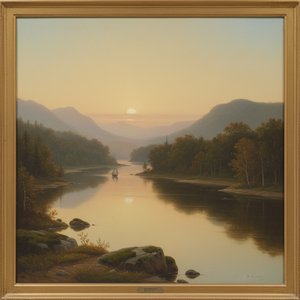
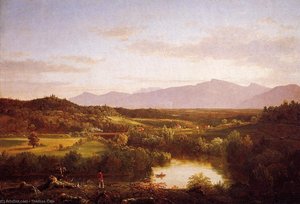
Within the broader Hudson River School, a specialized, high-impact technique known as Luminism emerged to push the boundaries of atmospheric storytelling. If Romanticism provided the emotional blueprint, Luminism provided the light. This style is characterized by an almost supernatural clarity, where sunlight doesn't just illuminate a scene but seems to emanate from within it. Artists like John Frederick Kensett and Johann Hermann Carmiencke mastered the art of subtle tonal variations, using light to create a sense of infinite depth and stillness.
In a masterpiece like Kensett’s Hudson River Scene, the viewer is invited into a meditation on tranquility. The technique prioritizes atmospheric effects—the way mist clings to a distant mountain or how sunlight dapples through an ancient canopy—over dramatic, cluttered detail. This approach creates a luminous quality that feels tactile, as if the warmth of the sun could be felt through the oil on canvas. By manipulating light and shadow, these painters achieved the sublime, capturing that precise moment where the beauty of a landscape becomes so vast and radiant that it borders on the overwhelming, leaving the viewer in a state of breathless contemplation.
Beyond the Canvas: The Spiritual Power of the American Wilderness
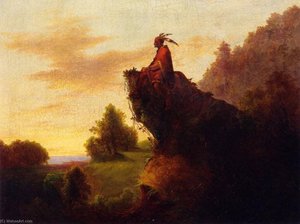 jesse talbot
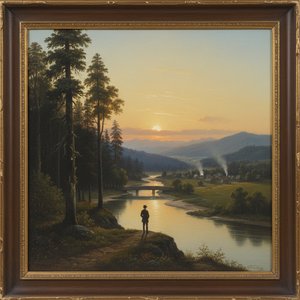
A Visionary of the American Sublime: Jesse Talbot and the Hudson River School Jesse Talbot, a name perhaps less immediately recognized than his contemporaries in the illustrious Hudson River School, nonetheless occupies a vital and deeply resonant po...
To understand the impact of these works, one must recognize that for the artists of this era, nature was far more than a subject; it was a manifestation of the divine. The landscapes depicted—from the mist-shrouded peaks of the Catskills to the rugged expanses of the Rockies—were viewed as sacred texts written in earth and water. This spiritual dimension gave their paintings an intensity that transcends mere decoration. When you look at a work by Jesse Talbot or Charles Herbert Moore, you are witnessing a profound connection between the human spirit and the wild.
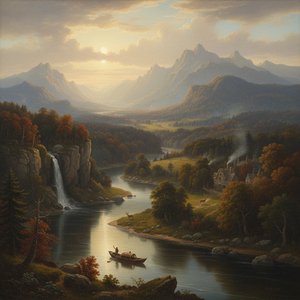
The presence of small, solitary figures or tiny boats navigating gentle currents often serves as a symbolic anchor. These elements do not intrude upon the landscape; rather, they emphasize the scale and majesty of the environment. They represent humanity’s role as an observer and participant in a much larger, cosmic drama. This reverence for the wilderness fostered a sense of awe that would eventually inspire early conservation efforts, as the very beauty captured on these canvases became something the nation felt compelled to protect from the relentless march of progress.
Curating the Wild: Bringing High-Energy Landscapes into Modern Spaces
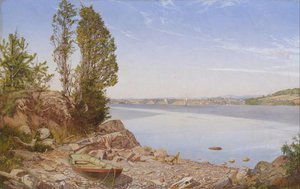 Hudson River, Above Catskill
A Serene Encounter with the Hudson River In the heart of the mid-nineteenth century, a profound connection between humanity and the untamed American wilderness began to take shape on canvas. Charles Herbert Moore’s Hudson River, Above Catskill serves...
In today’s increasingly urbanized and digital existence, the high-impact energy of American Romanticism offers a much-needed reconnection to the physical world. For the modern collector, these paintings are not relics of the past; they are powerful, living windows into an era of raw authenticity. Integrating such profound works into a contemporary interior provides a striking visual anchor, offering a sense of depth and historical weight that modern minimalism often lacks.
Whether through a massive multi-panel installation that spans a grand staircase or a carefully placed Luminist piece that brings a soft, golden glow to a study, these landscapes command attention. They invite conversation and contemplation, acting as a bridge between the frantic pace of modern life and the enduring, rhythmic pulse of the natural world. To own a piece of this movement is to possess a fragment of the sublime, ensuring that the untamed spirit of the American wilderness continues to breathe within the walls of the modern home.