Early Life & Artistic Roots: The Waite Family Legacy
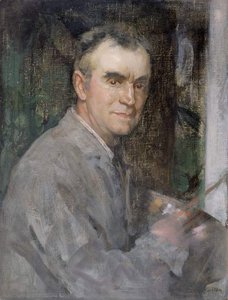
Edward Wilkins Waite RBA (14 April 1854 – 1924) was a prolific English landscape painter. Waite was born in Leatherhead, Surrey, the son of the Rev. Edward Waite, MA, and his wife Cleopha Julia (née Dukes) – there were six sons and two daughters in t...
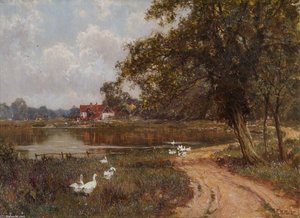
Edward Wilkins Waite, a name perhaps less immediately recognizable than some of his Victorian contemporaries, nevertheless occupies a significant and charming niche within the pantheon of British landscape painters. Born in Leatherhead, Surrey, in 1854, Waite’s artistic inclination wasn't a solitary spark but rather a familial flame passed down through generations. His grandfather, William Watkin Waite, practiced as a miniaturist, while his father, Reverend Edward Waite, cultivated a passion for amateur watercolour painting. This nurturing environment, coupled with the creative talents of three artist brothers – Charles, Harold, and Arthur – established a strong foundation for young Edward’s burgeoning artistic sensibilities. While formal training details remain somewhat elusive, it's clear that Waite benefited from an upbringing steeped in visual creativity, laying the groundwork for his later dedication to capturing the beauty of the English countryside.
Interestingly, Waite’s path wasn’t immediately directed towards art. A period of working as a lumberjack in Ontario, Canada, in 1874 provided a stark contrast to the idyllic scenes he would eventually become known for. This experience, however, may have instilled within him an appreciation for the raw beauty of nature and a sense of resilience that subtly informs his work. Upon his return to England, Waite fully embraced painting as a profession, embarking on a prolific career marked by consistent exhibition at prestigious venues like the Royal Academy from 1878 until 1919.
Surrey's Pastoral Charm: Capturing the Essence of Rural England
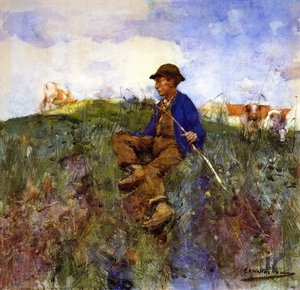
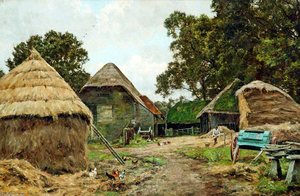 The Thatcher
Explore 'The Thatcher' by Edward Wilkins Waite – a serene 19th-century landscape painting of rural Surrey barns & countryside life. Oil on canvas, evocative realism.
Waite’s artistic identity is inextricably linked to Surrey. He didn’t merely depict the county; he *embodied* it within his canvases. His paintings are not grand, sweeping vistas but intimate portrayals of rural life – rolling hills dotted with barns, sun-dappled meadows, and quiet country lanes. Works like “At Peaslake” exemplify this focus, presenting a serene landscape imbued with a sense of tranquility and detailed observation. The scenes he chose weren’t dramatic or sensational; instead, they reflected the everyday beauty found in the heart of the English countryside.
This dedication to Surrey wasn't simply geographical; it was an aesthetic choice. Waite sought to capture a specific mood – one of peacefulness, harmony, and a deep connection to nature. He meticulously rendered light and shadow, creating paintings that evoke not just what he *saw*, but how the landscape *felt*. The gentle undulation of hills, the texture of thatched roofs, and the soft glow of sunlight all contribute to this immersive experience. His work offers a glimpse into a vanishing way of life, preserving a romanticized vision of rural England at the turn of the century.
Pre-Raphaelite Influences & Impressionistic Tendencies in Waite’s Style
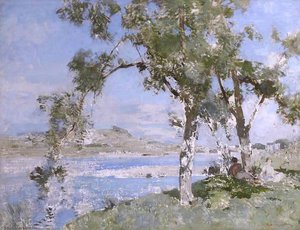
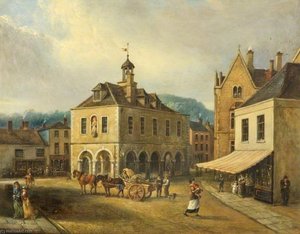
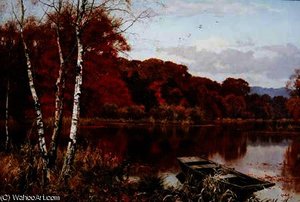
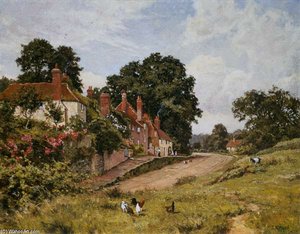 The Terrace At Fittleworth
Discover "The Terrace At Fittleworth" by Edward Wilkins Waite – a serene Impressionistic landscape painting of Surrey's rural beauty. Explore its soft light & textured brushwork.
While firmly rooted in realism, Waite's style wasn’t entirely devoid of external influences. The Pre-Raphaelite Brotherhood, with their emphasis on detailed observation and vibrant color palettes, cast a subtle shadow over his work. Though he didn’t adopt the overtly symbolic or narrative elements often found in Pre-Raphaelite paintings, Waite shared their commitment to accuracy and naturalism. This is particularly evident in the meticulous rendering of foliage and architectural details within his landscapes.
Simultaneously, a nascent Impressionistic sensibility began to emerge in Waite’s later works. Paintings like “The Terrace At Fittleworth” demonstrate a looser brushstroke and a greater focus on capturing fleeting moments of light and atmosphere. The soft, textured quality of the paint application creates an almost ethereal effect, moving beyond mere representation towards a more emotive interpretation of the scene. This blend of Pre-Raphaelite precision and Impressionistic fluidity is what sets Waite apart, creating a unique style that resonates with both traditional and modern sensibilities.
Beyond Representation: Symbolism and Spirituality in Waite’s Work
In works of art, literature, and narrative, a symbol is a concrete element like an object, character, image, situation, or action that suggests or hints at abstract, deeper, or non-literal meanings or ideas. The use of symbols artistically is symboli...
To view Waite solely as a recorder of Surrey landscapes would be to overlook a deeper layer within his art. While not overtly symbolic in the manner of some Victorian artists, his paintings often hint at underlying spiritual themes. The quietude of his scenes, the reverence for nature, and the emphasis on harmony suggest a connection to the Romantic ideals of finding divinity in the natural world. The choice of subject matter – rural churches, peaceful gardens, and idyllic farmsteads – further reinforces this sense of spirituality.
Artistic symbol, as understood within art history, isn’t always explicit; it can be subtle, residing in the overall mood or atmosphere of a work. In Waite's case, the recurring motif of light could be interpreted as representing hope, enlightenment, or even divine presence. Furthermore, considering the broader context of Western esotericism prevalent during the Victorian era, it’s plausible that Waite imbued his landscapes with personal meaning beyond mere aesthetic appeal. The serene beauty he captured may have been intended to evoke a sense of inner peace and connection to something larger than oneself.
Waite’s Artistic Career: Exhibitions, Recognition & Lasting Impact
Edward Wilkins Waite enjoyed a remarkably consistent career as an exhibiting artist. His frequent presence at the Royal Academy from 1878 to 1919 solidified his reputation within the London art scene. He also exhibited at numerous regional galleries, broadening his reach and establishing a loyal following. In 1893, he was elected a member of the prestigious Royal Society of British Artists (RBA), a testament to his skill and artistic merit.
While Waite may not have achieved the same level of fame as some of his contemporaries, his work continues to be appreciated for its quiet beauty and technical proficiency. His paintings offer a valuable glimpse into Victorian rural life, capturing a specific moment in time with remarkable detail and sensitivity. Today, collectors are drawn to his serene landscapes, recognizing their enduring appeal and historical significance.
Collecting Edward Wilkins Waite Today: A Guide for Enthusiasts
For those interested in acquiring works by Edward Wilkins Waite, the market offers a range of options. Oil paintings on canvas are the most sought-after pieces, with prices varying depending on size, subject matter, and condition. Smaller studies and watercolors can also be found, offering more accessible entry points for collectors. Auction houses regularly feature Waite’s works, providing opportunities to bid on original paintings.
When considering a purchase, it's essential to examine the painting carefully, paying attention to brushwork, color palette, and overall condition. Authenticity is paramount, so purchasing from reputable dealers or auction houses with established provenance is highly recommended. Waite’s paintings are not merely decorative objects; they are windows into a bygone era, offering a glimpse of Surrey's pastoral charm and the artistic vision of a dedicated Victorian painter. At ArtsDot.com, we offer high-quality reproductions of Waite’s most beloved works, allowing you to experience his serene landscapes in your own home. Explore our collection today and discover the enduring beauty of Edward Wilkins Waite.