Early Life and Artistic Foundations: From Glasgow Studios to Nasmyth's Influence
Horatio McCulloch, born in Glasgow in 1805, emerged from a city burgeoning with industrial energy yet possessed of a deep-seated artistic tradition. His initial training within the studio of John Knox provided him with foundational skills, but it was his subsequent apprenticeship under William Home Lizars that subtly steered his path. Lizars’s work coloring illustrations for ornithological studies instilled in McCulloch a meticulous attention to detail and an appreciation for natural observation – qualities that would become hallmarks of his mature style. However, the true catalyst for McCulloch's artistic development arrived with his exposure to the works of Alexander Nasmyth, a towering figure in Scottish landscape painting. Nasmyth’s influence was profound; he championed a classically-informed approach to landscape, blending idealized forms with topographical accuracy. While McCulloch initially absorbed these principles, he would ultimately forge a distinctly individual path, moving beyond mere imitation towards a more emotionally resonant and uniquely Scottish vision.
The Rise of Highland Romanticism: Scott, Thomson, and McCulloch’s Emerging Vision
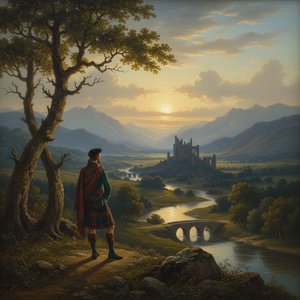
The early 19th century witnessed a burgeoning fascination with the Scottish Highlands, fueled in no small part by the literary achievements of Sir Walter Scott. His novels and poetry romanticized the rugged beauty and historical narratives woven into the fabric of the landscape, captivating audiences across Britain and beyond. This cultural shift profoundly impacted McCulloch’s artistic trajectory. Simultaneously, his encounter with John Thomson, minister of Duddingston Kirk and a gifted watercolorist, proved pivotal. Thomson's paintings weren’t simply depictions of scenery; they were imbued with a spiritual sensibility, reflecting a deep connection to the land and its history. McCulloch absorbed this poetic approach, recognizing that landscape could be more than just a visual record—it could be a vehicle for expressing profound emotional and philosophical ideas. This convergence – Scott's romantic narratives and Thomson’s spiritual landscapes – ignited McCulloch’s artistic imagination, setting him on course to become Scotland’s premier interpreter of the Highlands.
Pyramidal Composition & Poetic Detail: Analyzing McCulloch’s Signature Style
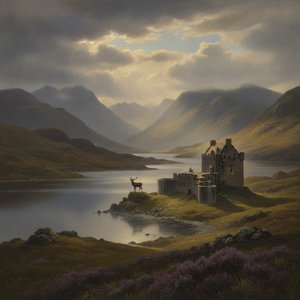
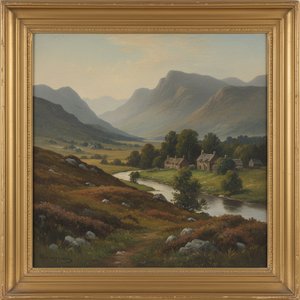
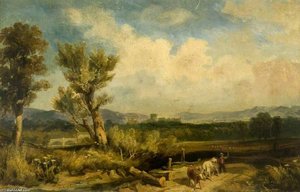
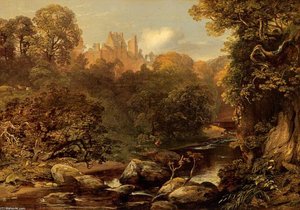
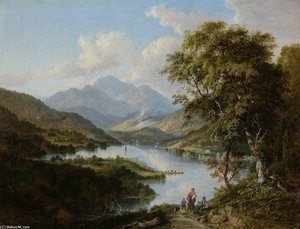
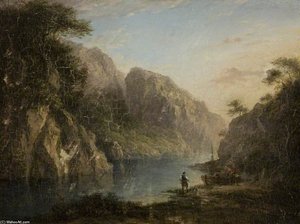
McCulloch’s paintings are immediately recognizable for their distinctive compositional structure. He frequently employed a pyramidal arrangement, grounding his scenes with solid forms and drawing the viewer's eye towards a focal point – often a distant peak or a solitary tree. This technique, borrowed from classical landscape painting, provided stability and order to his compositions. However, McCulloch’s true mastery lay in his poetic detailing. His brushwork is characterized by a rich impasto, creating textures that evoke the ruggedness of the Scottish terrain. He meticulously rendered the nuances of light and shadow, capturing the atmospheric effects of Highland weather – the brooding mists, the dramatic skies, and the vibrant hues of wildflowers. Consider A Scottish Landscape, where the pyramidal form of the hills anchors the scene while the delicate brushstrokes bring the heather and bracken to life. Or examine Landscape-, a work that showcases his ability to convey both grandeur and intimacy through careful observation and expressive oil textures. His use of color, though often subdued, is remarkably effective in conveying mood and atmosphere.
Spirituality in the Landscape: Exploring Themes of Nature and Transcendence
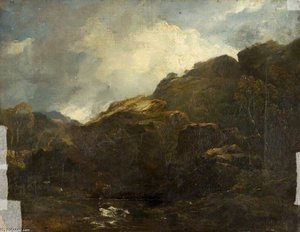
Beyond mere topographical representation, McCulloch’s landscapes are deeply imbued with a sense of spirituality. He wasn't simply painting what he *saw*; he was attempting to capture the essence of nature – its power, its mystery, and its ability to evoke profound emotional responses. This spiritual dimension is evident in his frequent depiction of remote, untouched wilderness areas. His scenes often feature solitary figures dwarfed by the immensity of the landscape, emphasizing humanity’s smallness in the face of the natural world. Rural Landscape-, for example, presents a dramatic sky and leading lines that draw the viewer into the vastness of the Highlands, suggesting a sense of awe and reverence. McCulloch's work resonates with Romantic ideals – a belief in the inherent goodness of nature, a rejection of industrialization, and a yearning for spiritual connection. He sought to convey not just the visual beauty of Scotland but also its soul.
McCulloch's Legacy and Scottish Identity: Bridging Tradition and Modernity
Horatio McCulloch’s impact on Scottish art is undeniable. He bridged the gap between the old world of classical landscape painting and the emerging sensibilities of the Romantic era, establishing a distinctly Scottish artistic identity. While he drew inspiration from European traditions, he remained deeply rooted in his native land, capturing its unique beauty and spiritual essence with unparalleled sensitivity. His influence extended beyond his immediate contemporaries; generations of Scottish artists would follow in his footsteps, drawn to the Highlands as a source of inspiration. McCulloch’s paintings continue to resonate today, not only for their technical brilliance but also for their profound emotional depth and enduring celebration of Scotland's natural heritage. He stands as a testament to the power of art to capture the spirit of a place and the soul of a nation. At ArtsDot, we are proud to offer meticulously crafted reproductions of McCulloch’s masterpieces, allowing you to experience the beauty and tranquility of his landscapes firsthand.