The Doctor’s Brush: Joseph Clover’s Unique Path to Artistic Innovation
 Wikipedia: Joseph Thomas Clover
Joseph Thomas Clover (born 28 February 1825; baptised 7 May 1825 – 27 September 1882) was an English doctor and innovator of anaesthesia. He invented a variety of pieces of apparatus to deliver anaesthetics, including ether and chloroform, safely and...
Joseph Thomas Clover (1825-1882) occupies a fascinating, and somewhat unusual, position within the annals of 19th-century British art. He wasn't a painter by formal training or early inclination; rather, his artistic pursuits blossomed from a life deeply rooted in scientific precision and medical necessity. A respected physician and a pivotal figure in the development of safe anaesthesia practices, Clover’s dedication to alleviating suffering unexpectedly intertwined with a profound passion for capturing the ephemeral beauty of the natural world. This duality – the meticulous observer of human physiology and the sensitive interpreter of light and atmosphere – forms the core of his artistic identity, setting him apart from many of his contemporaries.
Born in Aylsham, Norfolk, Clover’s early life provided little indication of the artist he would become. His apprenticeship to a local surgeon steered him towards University College Hospital, where he studied alongside Joseph Lister, later renowned for his pioneering work in antiseptic surgery. However, it was his relentless pursuit of safer and more controllable methods of administering anaesthetics – ether and chloroform being the primary tools of his trade – that truly defined his early career. He invented a series of ingenious apparatuses, including the now-iconic ‘Clover’s chloroform apparatus,’ designed to regulate dosage and minimize risk. By 1871, he had administered anaesthetics over thirteen thousand times without a single fatality, a testament to his dedication and ingenuity. This commitment to precision, honed through years of medical practice, would later translate into the careful observation and rendering of light and form in his paintings.
The transition from physician to artist wasn’t abrupt. Clover's involvement with prominent surgical cases – assisting at operations on figures like Napoleon III, Princess Alexandra, and Sir Robert Peel – exposed him to a world of privilege and refinement, but also likely heightened his sensitivity to the fragility of life and the fleeting nature of beauty. It was this awareness, coupled with an innate artistic sensibility, that prompted him to seek solace and expression through painting.
Beyond Anesthesia: The Rise of Landscape Painting in Clover's Oeuvre
As Clover’s medical practice flourished, he found himself increasingly drawn to the restorative power of nature. Ill health eventually led him to curtail his surgical work in 1853, allowing him to dedicate more time to painting. He established a practice at Cavendish Place, London, but it was the landscapes surrounding the city – and further afield – that truly captured his imagination. Unlike many artists who sought dramatic or exotic subjects, Clover found beauty in the ordinary, in the quiet tranquility of rural scenes.
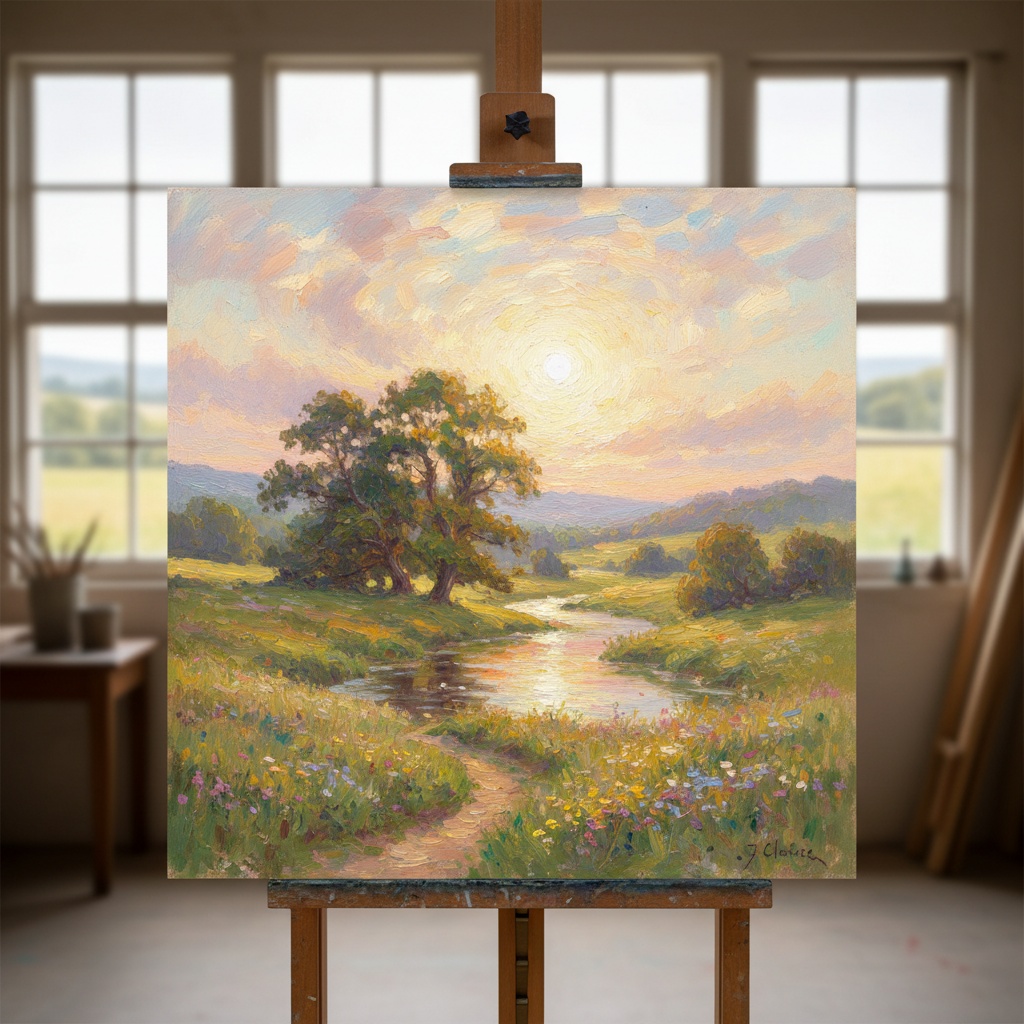
His early paintings reflect this inclination; they are not grand statements about the sublime power of nature, but rather intimate studies of light and atmosphere. He favoured depictions of country houses nestled amongst trees, farm buildings bathed in golden sunlight, and winding drives that invite the viewer into a world of peaceful contemplation. These weren’t merely topographical representations; Clover sought to capture the *feeling* of a place, the subtle nuances of light and shadow that evoke a sense of calm and serenity. He wasn't interested in recreating reality with photographic accuracy, but rather in conveying his emotional response to it.
This shift towards landscape painting coincided with a growing interest in capturing the transient effects of weather and light – a hallmark of the emerging Impressionist movement on the continent. While Clover’s work doesn’t fully align with the radical experimentation of Monet or Renoir, it shares a similar sensibility: a desire to capture a fleeting moment in time, to convey the subjective experience of seeing.
Capturing Fleeting Light: Clover and the Principles of 'En Plein Air'
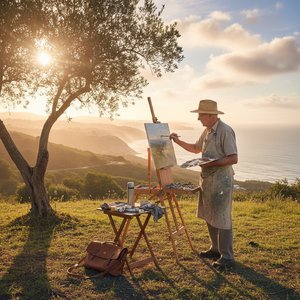
En plein air (pronounced [ɑ̃ plɛ.n‿ɛʁ]; French for 'outdoors'), or plein-air painting, is the act of painting outdoors. This method contrasts with studio painting or academic rules that might create a predetermined look. The theory of 'En plein air' ...
Central to understanding Clover’s artistic achievement is his embrace of en plein air painting – the practice of painting outdoors directly from nature. Though pioneered by artists like Pierre-Henri de Valenciennes earlier in the century, it was only with the advent of portable canvases and, crucially, commercially produced oil paints in tubes that the technique became widely accessible. Clover wholeheartedly adopted this method, recognizing its potential to capture the ever-changing qualities of light and atmosphere.
Painting outdoors presented significant challenges. Artists had to contend with unpredictable weather conditions, shifting shadows, and the logistical difficulties of transporting materials. However, these very challenges were seen as opportunities – a chance to truly observe and respond to the natural world in real time. Clover’s medical background likely contributed to his patience and meticulousness; he approached painting with the same attention to detail and precision that characterized his surgical work.
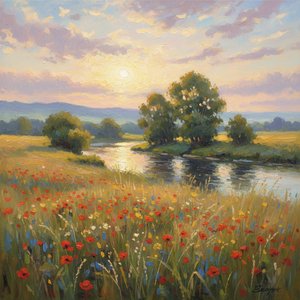
His paintings are imbued with a sense of immediacy, as if captured in a single moment. The brushstrokes are visible, textures are authentic, and the colours are often muted and subtle, reflecting the soft light of the English countryside. He wasn’t interested in bold contrasts or dramatic effects; instead, he sought to create a harmonious balance between light and shadow, colour and tone.
A Palette of Subtlety: Examining Clover’s Romantic Colour Theory & Technique
Clover's palette is characterized by its restraint and subtlety. He eschewed the vibrant, often jarring colours favoured by some of his contemporaries, opting instead for a more muted and harmonious range of tones. Earthy browns, greens, and greys dominate his landscapes, punctuated by occasional touches of ochre or pale blue. This limited palette isn’t indicative of a lack of skill; rather, it reflects his desire to capture the delicate nuances of light and atmosphere.
His technique is equally refined. He employed a layering approach, building up colour gradually to create depth and texture. The brushstrokes are often short and broken, creating a sense of movement and vibrancy. However, unlike the loose, impasto style of some Impressionists, Clover’s brushwork remains controlled and deliberate. He wasn't interested in showing off his technical prowess; instead, he used his skills to create a seamless and harmonious representation of nature.
The influence of the Romantic movement is evident in Clover’s work. Like many Romantic painters, he sought to evoke emotion through landscape, but unlike the dramatic landscapes of Turner or Constable, Clover’s paintings are characterized by their quiet intimacy and understated beauty. He wasn't interested in portraying the sublime power of nature; instead, he focused on capturing its gentle tranquility.
Clover’s Circle: Influences, Contemporaries, and Artistic Legacy
While Clover largely worked independently, he was undoubtedly aware of the artistic currents swirling around him. The Barbizon School, with its emphasis on painting outdoors and depicting rural life, likely exerted some influence on his work. He would have been familiar with the paintings of artists like Charles-François Daubigny and Théodore Rousseau, who pioneered the practice of en plein air painting in France.
His contemporaries included a diverse range of artists, from the established masters of the Royal Academy to the emerging Impressionists. While he didn’t actively participate in any artistic movements, his work shares certain affinities with both traditions. His dedication to capturing light and atmosphere aligns him with the Impressionists, while his emphasis on emotional response and quiet intimacy connects him to the Romantic movement.
Although Clover never achieved widespread recognition during his lifetime, his work has gained increasing appreciation in recent years. Today, he is celebrated as a unique and visionary artist – a physician who found solace and expression through painting. His landscapes offer a glimpse into a bygone era, capturing the beauty and tranquility of the English countryside with remarkable sensitivity and skill.
Rediscovering a Visionary: The Enduring Appeal of Joseph Thomas Clover's Work
The enduring appeal of Joseph Thomas Clover’s work lies in its quiet intimacy and understated beauty. In an age dominated by spectacle and sensation, his paintings offer a welcome respite – a chance to reconnect with the natural world and appreciate the simple pleasures of life. His landscapes are not grand statements about the sublime power of nature; instead, they are intimate studies of light and atmosphere, capturing the fleeting moments that often go unnoticed.
His story is also compelling—a testament to the transformative power of art and the unexpected paths that creativity can take. A dedicated physician who found solace in painting, Clover’s unique perspective informs every brushstroke. At ArtsDot.com, we are proud to offer high-quality reproductions of his work, allowing you to experience the beauty and tranquility of his landscapes firsthand. Explore our collection today and discover a visionary artist whose legacy deserves to be celebrated.