The Sculptor's Eye: Blossfeldt’s Early Life & Artistic Foundations
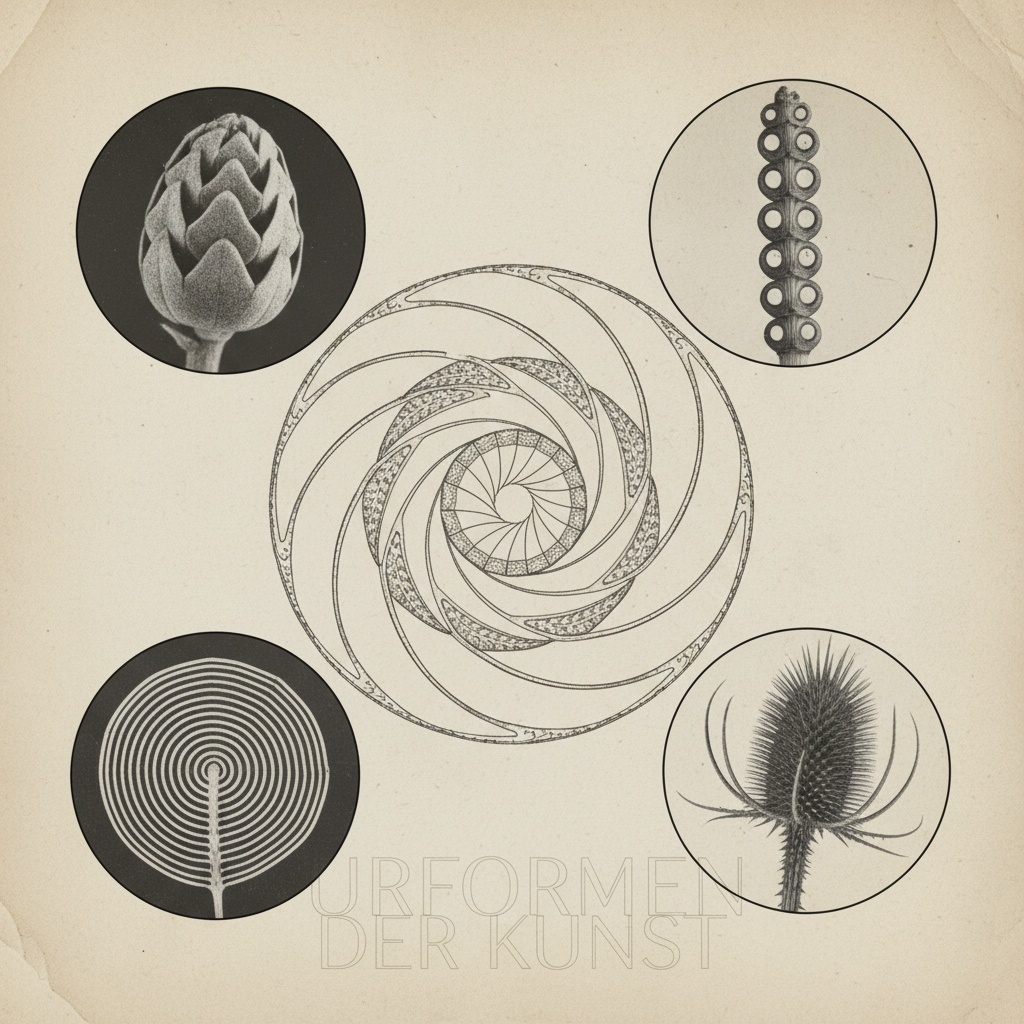
Karl Blossfeldt (13 June 1865 – 9 December 1932) was a German photographer and sculptor. He is best known for his close-up photographs of plants and living things, published in 1929 as Urformen der Kunst. He was inspired, as was his father, by natur...
Karl Blossfeldt, a name synonymous with the strikingly detailed close-up photographs of plants, wasn’t initially driven by a passion for photography itself, but rather by an enduring fascination with form. Born in 1865 near the Harz Mountains of Germany, his early life was steeped in the natural world, a landscape that would profoundly shape his artistic vision. However, Blossfeldt's initial training lay not behind a lens, but at the iron foundry in Mägdesprung. This apprenticeship instilled within him a deep appreciation for the structural integrity and decorative potential of plant motifs – elements frequently incorporated into wrought-ironwork. He wasn’t merely replicating nature; he was learning to *construct* it, to understand its underlying architecture through the demanding process of metal casting.
This foundational experience proved pivotal. Blossfeldt later pursued studies at the School of the Museum of Decorative Arts in Berlin, further honing his skills in modeling and design. A scholarship allowed him to work alongside Moritz Meurer in Rome, where he photographed botanical specimens for use as references – a task that would gradually evolve into something far more ambitious than simple documentation. These early photographs weren’t conceived as art objects; they were tools for instruction, intended to illuminate the principles of natural form to aspiring artists and craftsmen. Yet, even at this stage, a unique sensibility began to emerge—a meticulous attention to detail, a stark clarity of composition, and an almost sculptural approach to capturing the essence of each plant.
From Teaching Tool to Masterwork: The Genesis of *Urformen der Kunst*
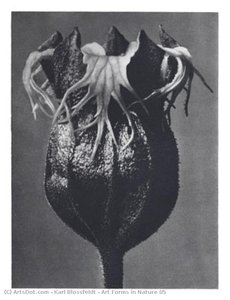
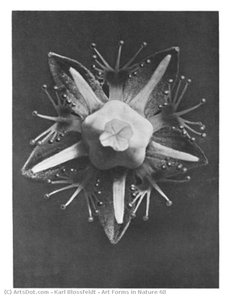 Art Forms in Nature 68
Discover 'Art Forms in Nature 68' by Karl Blossfeldt (1928). This groundbreaking work showcases biomorphic sculpture – a pioneering style of modern art. Explore its unique beauty and historical significance.
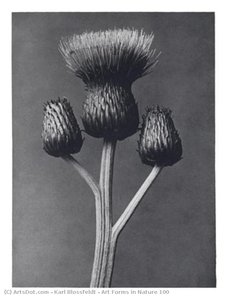
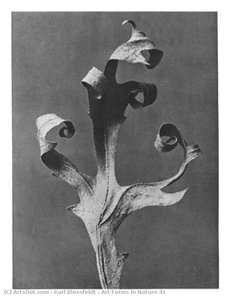
For three decades, Blossfeldt dedicated himself to teaching “Modeling from Plants” at the Berlin University of the Arts. His classroom became a laboratory for his photographic explorations. He developed a custom-built camera equipped with powerful magnifying lenses, allowing him to reveal details invisible to the naked eye. These weren’t casual snapshots; each photograph was carefully considered, meticulously composed, and intended as a precise record of botanical structure. He amassed an extraordinary archive—estimated at around 6,000 images—a testament to his unwavering dedication.
However, it wasn't until the mid-1920s that Blossfeldt’s work began to attract wider attention as art in its own right. The gallerist Karl Nierendorf recognized the exceptional quality and unique aesthetic of these photographs, championing their publication. In 1928, *Urformen der Kunst* (Fundamental Forms of Art) was released, instantly captivating audiences with its stark beauty and unconventional subject matter. The book wasn’t merely a collection of plant portraits; it was a revelation—a demonstration that the fundamental building blocks of artistic design could be found in the most unassuming corners of the natural world. The success of *Urformen der Kunst* propelled Blossfeldt to international acclaim, transforming him from an obscure professor into a celebrated pioneer of modern photography.
Anatomy of Detail: Deconstructing Blossfeldt’s Photographic Technique
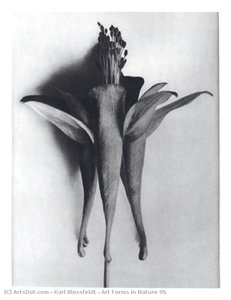 Art Forms in Nature 95
Discover Karl Blossfeldt’s ‘Art Forms in Nature 95,’ a stunning black & white photograph capturing exquisite botanical detail. Explore German Expressionism's precision & beauty.
Blossfeldt's photographic style was remarkably direct and unadorned. He eschewed the painterly effects favored by many of his contemporaries, opting instead for a clinical precision that emphasized form over atmosphere. His subjects were typically isolated against plain backgrounds—often cardboard—eliminating distractions and focusing attention on the intricate details of each plant. Northern light provided even illumination, revealing subtle textures and tonal variations.
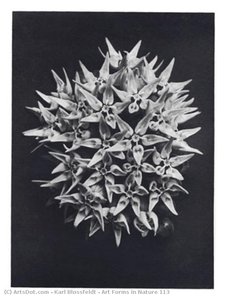
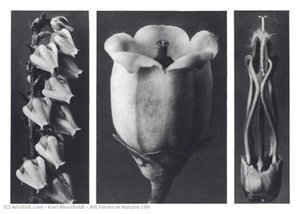
Crucially, Blossfeldt rarely altered his specimens. He believed in presenting plants as they were found, allowing their inherent structure to speak for itself. This commitment to scientific accuracy was coupled with a keen artistic sensibility—a talent for composition that transformed these botanical studies into compelling works of art. He often photographed multiple plant specimens on a single negative, creating collages that showcased variations within a species and highlighted the diversity of natural forms. The resulting images possess an almost sculptural quality, resembling detailed line drawings rather than traditional photographs. This technique wasn’t simply about capturing likeness; it was about revealing the underlying geometry and architectural principles inherent in nature.
New Objectivity and the Aesthetic Elevation of the Natural World
The New Objectivity (in German: Neue Sachlichkeit) was a movement in German art that arose during the 1920s as a reaction against expressionism. The term was coined by Gustav Friedrich Hartlaub, the director of the Kunsthalle in Mannheim, who used it...
Blossfeldt's work emerged during a period of significant artistic upheaval, as artists sought new ways to represent the world after the devastation of World War I. He became closely associated with the New Objectivity (Neue Sachlichkeit) movement—a reaction against the emotional intensity of Expressionism and a call for clarity, precision, and objectivity in art. While not explicitly aligned with all tenets of the movement, Blossfeldt shared its rejection of subjective interpretation and its emphasis on depicting reality as it was.
However, Blossfeldt’s approach differed from that of many New Objectivity photographers who focused on urban landscapes or industrial subjects. He turned his attention inward, to the hidden world of plants, revealing a beauty often overlooked in the pursuit of grand narratives. His photographs weren't merely objective records; they were acts of aesthetic elevation—transforming humble weeds and common flora into objects of contemplation and admiration. This focus on natural forms also resonated with broader currents within German Expressionism, which frequently explored themes of spirituality and the power of nature, albeit through a more subjective lens.
Beyond Representation: Blossfeldt's Legacy & Influence on Modern Art
Karl Blossfeldt’s impact on modern art is undeniable. *Urformen der Kunst* challenged conventional notions of beauty and representation, demonstrating that artistic inspiration could be found in the most unexpected places. His photographs paved the way for new approaches to botanical illustration, photomicrography, and abstract photography. Artists across various disciplines—from sculpture and architecture to industrial design—were inspired by his meticulous attention to detail and his exploration of natural forms.
His work continues to resonate today, reminding us of the inherent beauty and complexity of the natural world. Blossfeldt’s legacy extends beyond the realm of art history; it speaks to a broader appreciation for scientific accuracy, aesthetic precision, and the power of observation. The enduring appeal of his photographs lies in their ability to transform our perception—to reveal the hidden structures and underlying geometries that shape the world around us. At ArtsDot.com, we celebrate Blossfeldt’s pioneering spirit by offering high-quality reproductions of his iconic images, allowing you to bring the beauty of *Urformen der Kunst* into your own home.