
Introduction
To step into the world of Sir Alfred James Munnings is to leave the frantic pace of the modern era behind and enter a realm defined by the rhythmic clip-clop of hooves, the scent of damp English earth, and the golden, fleeting light of the Suffolk countryside. His work does not merely depict scenes; it captures the very heartbeat of a vanishing way of life. As we prepare to journey through his 25 most profound masterpieces, we are not just looking at paintings, but witnessing a lifelong love affair with the equine spirit and the pastoral traditions of the United Kingdom.
Born in 1878, Munnings emerged from a background rooted in the practicalities of design and the disciplined observation of the Norwich School of Art. His evolution as an artist was deeply influenced by the plein air techniques of the Newlyn School, which taught him to chase the light across a canvas. Through his eyes, we see the transition of Britain from a landscape of rural tradition to one forever altered by the industrial and global shifts of the 20th century. His time as an official war artist with the Canadian Cavalry Brigade added a layer of poignant gravity to his repertoire, allowing him to document the profound, often somber bond between soldier and horse amidst the shadows of conflict.
These twenty-five selected works remain deeply meaningful today because they serve as a visual sanctuary. In an age of digital abstraction, Munnings offers us something tactile and visceral—the visible energy of a brushstroke, the muscular tension of a galloping Thoroughbred, and the serene stillness of a sun-drenched meadow. His mastery of color and movement allows the viewer to feel the wind of a chase and the quiet dignity of the countryside.
As you navigate this curated collection, you will encounter works that range from intimate portraits of working ponies to sweeping, cinematic depictions of the hunt. Each painting is an invitation to rediscover the grace, the grit, and the enduring beauty of the natural world. We invite you to linger on these canvases, exploring the legacy of a master who ensured that the elegance of the English equestrian tradition would never truly fade from our collective memory.
The 6th Earl Winterton, MFH - Sir Alfred James Munnings
 The 6th Earl Winterton, MFH - Sir Alfred James Munnings
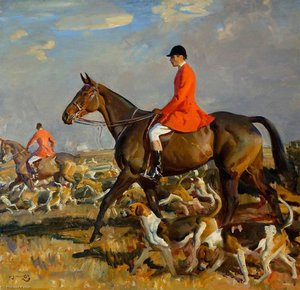
To encounter "The 6th Earl Winterton, MFH" is to step directly into the heart of British equestrian heritage, a moment of profound nobility captured by the hand of Sir Alfred James Munnings. As one of the most commanding entries in our collection of the top 25 artworks of Sir Alfred James Munnings, this piece transcends simple portraiture; it is a visceral celebration of the English hunting tradition.
The composition vibrates with life, centered on the striking scarlet of the Earl’s hunting jacket which acts as a brilliant focal point against the lush, verdant meadows. Munnings utilizes his signature plein air mastery to render the muscular tension of the brown horse and the kinetic energy of nine eager hounds, all bathed in a luminous, sun-drenched atmosphere. For the sophisticated collector, this painting offers more than historical depth; its bold palette and textured brushwork provide a magnificent anchor for luxury interiors, bringing a sense of timeless prestige and the romantic spirit of the countryside into the modern home.
The Fancy Dress Ball - Sir Alfred James Munnings
 The Fancy Dress Ball - Sir Alfred James Munnings
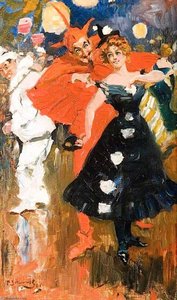
In The Fancy Dress Ball , the lines of Sir Alfred James Munnings are not merely drawn; they are choreographed . This 1901 masterpiece is far more than a depiction of an Edwardian social gathering; it is a dance frozen in time . Through a masterful use of Impressionistic technique, Munnings captures the fleeting energy of masked identities and opulent movement, where diagonal compositions guide the eye through a sea of vibrant reds, deep blacks, and luminous yellows.
The artist employs a heavy impasto , using thick, tactile brushstrokes to build a sense of physical presence and rhythmic vitality. As light diffuses across silk gowns and velvet masks, the canvas achieves a rare harmony between social chaos and aesthetic grace. This work stands as a vital entry in the top 25 artworks of Sir Alfred James Munnings because it invites the viewer into a world of mystery and celebration. What if your own walls could breathe rhythm ? For those seeking to bring this same sense of historical elegance and movement into a modern interior, our museum-quality handmade oil reproductions offer the perfect way to hold this balance in your home.
Stranded - Sir Alfred James Munnings
 Stranded - Sir Alfred James Munnings
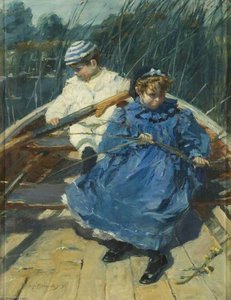
In Stranded , painted in 1898, Sir Alfred James Munnings captures a moment of profound, quiet vulnerability that transcends the boundaries of a simple childhood scene. The painting invites us into a serene waterborne world where two children, adrift in a small boat, navigate the gentle ripples of life. There is an unmistakable sense of innocence and stillness in their focused expressions as they grip the oars, framed by the soft, Impressionistic light that characterizes one of the top 25 artworks of Sir Alfred James Munnings . The presence of birds gliding above and a distant figure on the shore adds layers of narrative depth, suggesting a world that is both vast and intimately connected.
This masterpiece serves as a universal mirror for the human experience—capturing those fleeting moments of solitude and the quiet courage found in navigating life's currents. For the discerning collector, bringing this piece into a home can transform a personal sanctuary into a space for profound reflection and calm. Whether you are drawn to his mastery of light or his ability to evoke nostalgia, owning a hand-made oil reproduction of such an evocative work allows the tranquil spirit of the English countryside to reside permanently within your walls.
The Ford - Sir Alfred James Munnings
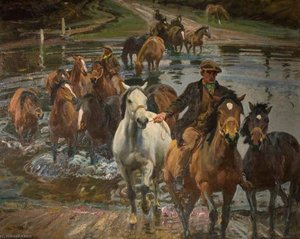 The Ford - Sir Alfred James Munnings
In The Ford , painted in 1910, Sir Alfred James Munnings captures a breathtaking moment of kinetic energy that transcends mere landscape painting. As one of the most vital entries in the top 25 artworks of Sir Alfred James Munnings, this piece serves as a window into a vanishing Edwardian era. The canvas is alive with the splashing of muddy waters and the rhythmic movement of nine horses navigating a flooded field. One cannot help but be drawn to the central rider, whose authoritative presence anchors a scene teeming with at least twelve figures in a state of organized chaos.
Munnings utilizes a masterful blend of Impressionistic light and equestrian precision; his loose, vibrant brushstrokes transform the swirling water into a dynamic vortex of earthy browns and reflected blues. There is a gaze in The Ford that follows you—not with judgment, but with an understanding of the raw, unbridled spirit of the English countryside. To possess a handmade oil reproduction of this masterpiece is to bring that very sense of movement and historical soul into your own home, reminding you that you are part of a much larger, enduring story.
A Dark Bay Hunter - Sir Alfred James Munnings
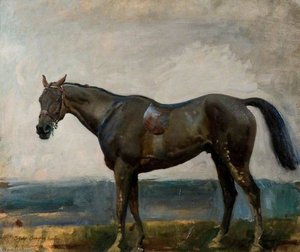 A Dark Bay Hunter - Sir Alfred James Munnings
In A Dark Bay Hunter , Sir Alfred James Munnings achieves a breathtaking synthesis of anatomical precision and Impressionistic vitality. This 1922 masterpiece stands as a cornerstone in the top 25 artworks of Sir Alfred James Munnings because it transcends mere equine portraiture; it captures the very pulse of the English countryside. The deep, rich tones of the bay coat, punctuated by that singular, striking white mark, create a focal point of immense strength against the soft, atmospheric textures of the meadow.
Munnings utilizes broken brushstrokes to render the horse's musculature, lending a sense of latent energy to the creature as it stands amidst the grass. For the modern collector, this piece offers a profound sense of heritage and pastoral calm, making it an exquisite addition to sophisticated interiors that seek to evoke a timeless, aristocratic ambiance. Whether you are drawn to the tactile depth of his impasto technique or the romantic nostalgia of the hunt, this painting serves as a window into a vanishing era of grace. For those wishing to bring this legacy into their own homes, our hand-painted oil reproductions meticulously recreate every vigorous stroke and luminous highlight found in this iconic work.
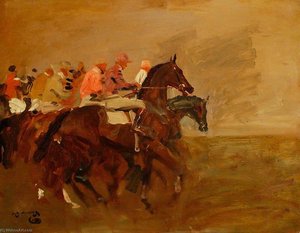
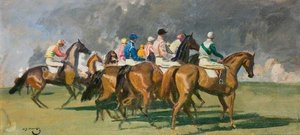
The Start, October Meeting, Newmarket, Suffolk - Sir Alfred James Munnings
A surge of kinetic energy and the rhythmic thundering of hooves define The Start, October Meeting, Newmarket, Suffolk by Sir Alfred James Munnings, a work that captures the very heartbeat of the English countryside. This masterpiece earns its place in our Top 25 collection through its unparalleled ability to freeze a fleeting moment of tension and triumph. Through bold, Impressionistic brushstrokes and a vibrant interplay of light, Munnings does not merely depict a race; he translates the palpable excitement and the dust-filled atmosphere of Newmarket into a visual symphony of movement.
The painting stands as an irreplaceable pillar of British equestrian art, symbolizing the enduring nobility of the horse and the storied traditions of rural life. Its dynamic composition, where jockeys lean into the momentum of their mounts, offers a profound emotional resonance that transcends time. At ArtsDot.com, we believe such transformative beauty should not be confined to museum walls. You can bring this same spirit of prestige and vitality into your own home or office through our exquisite, hand-painted oil reproductions, allowing the legacy of Munnings to inspire your personal gallery for generations.
The Royal Carriage Entering the Long Walk, Windsor, on the Return from the Ascot Races, 1925 - Sir Alfred James Munnings
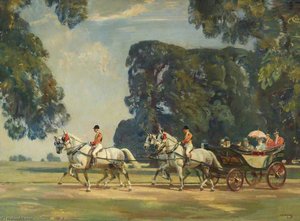 The Royal Carriage Entering the Long Walk, Windsor, on the Return from the Ascot Races, 1925 - Sir Alfred James Munnings
In The Royal Carriage Entering the Long Walk, Windsor, on the Return from the Ascot Races, 1925 , Sir Alfred James Munnings achieves a breathtaking synthesis of aristocratic grandeur and Impressionistic vitality. This masterpiece stands as a cornerstone in the top 25 artworks of Sir Alfred James Munnings because it does more than document a royal procession; it captures the very heartbeat of British tradition. Through loose, textured brushstrokes and a luminous palette, Munnings renders the dappled sunlight filtering through the Windsor trees, making the movement of the four powerful horses feel almost palpable.
The painting evokes a sense of celebratory prestige, where the elegance of the carriage and the formal attire of the passengers reflect a world of enduring stability. For the modern collector, this work offers a sophisticated infusion of heritage into contemporary interiors. Its vibrant energy and rhythmic composition pair beautifully with classic or stately decor, bringing an atmosphere of timeless nobility to any space. To possess such a piece is to hold a window into a vanished era of grace and equestrian splendor.
Nobby Gray with the Hunt - Sir Alfred James Munnings
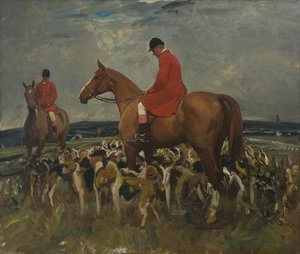 Nobby Gray with the Hunt - Sir Alfred James Munnings
In the sweeping landscape of British Impressionism, few works capture the visceral pulse of rural tradition as masterfully as Sir Alfred James Munnings’s “Nobby Gray with The Hunt.” Completed around 1928, this painting is far more than a mere sporting scene; it is an immersive window into a vanishing era of English heritage. At its heart lies Nobby Gray, a powerful presence that anchors a composition brimming with kinetic energy. As the rider in his iconic red jacket surges forward, accompanied by a spirited assembly of hounds, the viewer is swept into the very thrill of the chase.
Munnings utilizes thick, impasto applications of oil paint to create a sculptural quality, where dappled sunlight seems to dance upon the horse’s musculature. The earth-toned palette—rich in ochre, umber, and deep crimson—evokes the rustic warmth of the English countryside. There is a gaze in “Nobby Gray with the Hunt” that follows you—not with judgment, but with an understanding of tradition. It acts as a mirror to our own longing for connection to the land. Imagine this masterpiece in your space; it does not merely decorate a wall, but reminds you that you are part of a grand, enduring story.
Study for 'Lady Munnings Riding on Exmoor' - Sir Alfred James Munnings
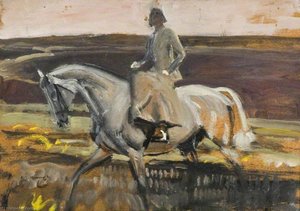 Study for 'Lady Munnings Riding on Exmoor' - Sir Alfred James Munnings
In the Study for ‘Lady Munnings Riding on Exmoor’ , a soft, ethereal grey dominates the canvas, setting a mood of misty, morning tranquility that perfectly encapsulates the rugged Somerset landscape. This particular shade, used to render the magnificent hunter ‘Magnolia,’ serves as the anchor for Munnings' masterful palette. His ability to layer thin, luminous washes of color allows the light to appear as if it is breathing through the paint, a technique that secures this work's place among the top 25 artworks of Sir Alfred James Munnings . The interplay between the cool greys and the earthy tones of the Exmoor terrain creates a sense of profound movement and vitality.
For the discerning collector, integrating such a piece into a modern interior offers a way to introduce a sophisticated, pastoral atmosphere. The muted, atmospheric color scheme is ideal for curating emotional lighting in a dining room or study, providing a serene focal point that evokes the timeless elegance of the English countryside. Whether you are admiring the original spirit through a handmade oil reproduction or exploring his broader legacy, this study remains a breathtaking window into the artist's soul.
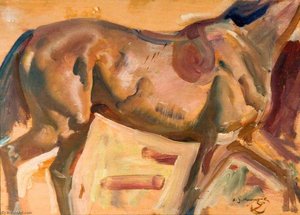
Study of 'Rufus' for 'Our Mutual Friend the Horse' - Sir Alfred James Munnings
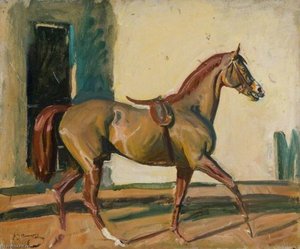 Study of 'Rufus' for 'Our Mutual Friend the Horse' - Sir Alfred James Munnings
To witness the Study of 'Rufus' for 'Our Mutual Friend the Horse' by Sir Alfred James Munnings is to feel the rhythmic pulse of a vanishing English countryside. This preparatory masterpiece captures more than just the musculature of a chestnut horse; it distills the very essence of kinetic energy and the profound, silent bond between animal and artist. As one of the top 25 artworks of Sir Alfred James Munnings, this study holds a prestigious place due to its raw, uninhibited movement and its role in revealing the meticulous anatomical observations that defined his legendary equestrian portraits.
Munnings utilizes loose, Impressionistic brushstrokes and an earthy palette of ochre and deep brown to translate the horse's power onto the canvas. The work serves as a vital bridge between classical realism and the fleeting light of modernism, making it an indispensable part of his legacy. Today, this sense of vitality can be brought into your own space; through our high-fidelity handmade oil reproductions, you can invite the transformative presence and spirited grace of Munnings’s world into any home or personal gallery.
A Racehorse in a Landscape - Sir Alfred James Munnings
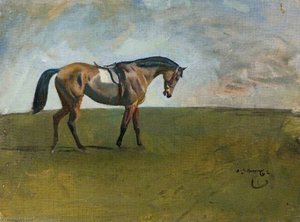 A Racehorse in a Landscape - Sir Alfred James Munnings
In A Racehorse in a Landscape , Sir Alfred James Munnings achieves more than mere equestrian portraiture; he captures the very heartbeat of a vanishing pastoral era. This masterpiece stands as a cornerstone among the top 25 artworks of Sir Alfred James Munnings because it distills the profound tension between movement and stillness. The viewer is drawn to the rhythmic gait of the brown horse, its white facial stripe acting as a focal point amidst the lush, sun-drenched textures of the English countryside.
Munnings utilizes a brilliant tonal Impressionistic approach, where loose, energetic brushstrokes allow light to dance across the grassy expanse, evoking a sense of fleeting beauty. In today’s fast-paced digital age, this painting serves as a vital cultural touchstone, offering a meditative retreat into a world defined by tradition and natural grace. For collectors seeking to bring this sense of timeless elegance into a modern interior, our hand-painted oil reproductions recreate the palpable depth and luminous atmosphere of Munnings’s original vision, preserving the soul of the English landscape for generations.
Study for 'The Saddling Paddock, Cheltenham March Meeting' - Sir Alfred James Munnings
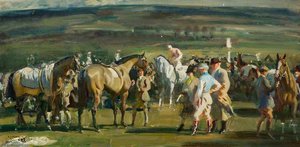 Study for 'The Saddling Paddock, Cheltenham March Meeting' - Sir Alfred James Munnings
Before the final, sweeping grandeur of his finished masterpiece was realized, Munnings sat amidst the frantic energy of the Cheltenham paddock, capturing the raw, unscripted pulse of the March Meeting. In this 1947 study, we witness the artist’s technical genius at its most visceral; he does not merely paint horses, but rather the very sunlight reflecting off their coats and the electric anticipation of the crowd. Through a masterful use of impasto , Munnings builds layers of textured paint that breathe with movement, utilizing loose, Impressionistic brushstrokes to prioritize atmosphere over rigid detail.
The composition serves as a profound exploration of light and shadow, where the gleaming flanks of the horses act as vessels for the era's romantic sporting spirit. This preparatory work is a cornerstone among the top 25 artworks of Sir Alfred James Munnings because it reveals the disciplined observation required to transform a chaotic moment into timeless art. Such a vibrant display of focus and kinetic energy makes this piece an extraordinary choice for a modern study or home office, providing a sophisticated atmosphere of inspiration and enduring British heritage.
Study of a Wood (verso) - Sir Alfred James Munnings
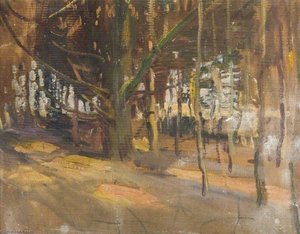 Study of a Wood (verso) - Sir Alfred James Munnings
In Study of a Wood (verso) , Sir Alfred James Munnings demonstrates his unparalleled mastery of light, utilizing a delicate interplay of chiaroscuro to breathe life into the English thicket. The composition is defined by broken shafts of sunlight that pierce through a dense canopy, creating a rhythmic dance of dappled illumination across mossy greens and deep, earthy ochres. This sophisticated command of light—capturing the fleeting moment where shadow meets brilliance—is precisely what secures this piece among the top 25 artworks of Sir Alfred James Munnings .
As a preparatory study, the work possesses an intimate, raw energy; the loose, Impressionistic brushstrokes prioritize atmosphere over rigid form, inviting the viewer into a quiet woodland reverie. When brought into a modern interior, a high-quality handmade oil reproduction of this piece offers more than mere decoration. The palpable texture of the paint and the depth of the tonal range add a layer of historical luxury and organic warmth to any contemporary wall, serving as a window into a vanishing, romanticized era of British landscape art.
Spring Evening, Cornwall - Sir Alfred James Munnings
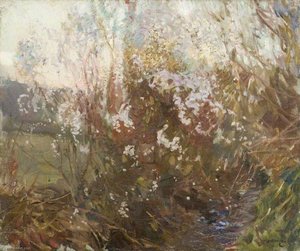 Spring Evening, Cornwall - Sir Alfred James Munnings
In Spring Evening, Cornwall , Sir Alfred James Munnings achieves a breathtaking structural harmony that secures its place among the top 25 artworks of Sir Alfred James Munnings . The composition is anchored by the vertical grace of blossoming trees, whose delicate white petals create a rhythmic interplay against the horizontal serenity of the reflecting river. This geometric balance—a soft intersection of organic lines and tranquil planes—evokes a sense of timeless perfection that transcends the era of its creation.
The painting’s internal equilibrium mirrors the principles of modern minimalist design; by stripping away narrative clutter to focus on light, color, and form, Munnings provides a grounding element for contemporary interiors. The cool blues of the water and the luminous whites of the blossoms offer a clean, sophisticated aesthetic that integrates seamlessly into a modern home. For collectors seeking to capture this atmospheric brilliance, our hand-made oil reproductions bring the palpable texture and Impressionistic light of this Cornish dusk to life on 100% cotton canvas, preserving the soul of Munnings's vision for generations.
Sheep on Exmoor - Sir Alfred James Munnings
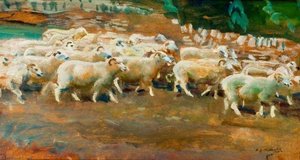 Sheep on Exmoor - Sir Alfred James Munnings
To stand before Sheep on Exmoor by Sir Alfred James Munnings is to step into a sanctuary of stillness, far removed from the turbulence of the modern age. Painted in the early 1940s, as the shadows of World War II began to lengthen over Britain, this work serves as a profound pastoral anchor. It is an essential inclusion in our collection of the top 25 artworks of Sir Alfred James Munnings because it captures more than just livestock; it preserves a vanishing sense of English tranquility.
Munnings employs his signature impressionistic realism, using loose, rhythmic brushstrokes to animate the flock. The palette is a masterclass in subtle earth tones—muted greens and deep browns that ground the composition, punctuated by the luminous, textured whites of the sheep’s wool catching the light. There is a palpable sense of movement as the herd wanders across the dirt field, embodying a spirit of resilience and continuity. This masterpiece does not merely decorate a room; it invites a meditative atmosphere into any home, reminding us that even in times of great change, the beauty of the natural world remains an eternal constant.
Huntsman Crossing the Dunkery Beacon, Exmoor - Sir Alfred James Munnings
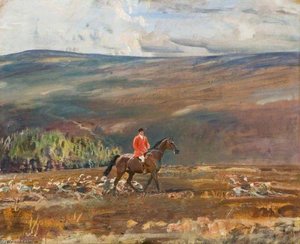 Huntsman Crossing the Dunkery Beacon, Exmoor - Sir Alfred James Munnings
In Huntsman Crossing the Dunkery Beacon, Exmoor , Sir Alfred James Munnings does not merely depict a landscape; he composes the very breath of the English countryside. To stand before this masterpiece is to feel the damp, invigorating mist of Somerset’s highest peak. The light here is not simply illumination—it is a language of atmosphere, captured through masterful Impressionistic layers that suggest the vastness of the Exmoor terrain.
Munnings utilizes horizontal bands of color to evoke the rugged breadth of the hills, while his visible, textured brushstrokes breathe life into the central figure. The huntsman and his horse emerge from the soft, diffused light, embodying a timeless harmony between man and animal. There is a palpable sense of movement in the pack of hounds, a rhythmic energy that pulls the viewer into the pursuit. This work remains a cornerstone of Munnings' legacy, capturing a vanishing world with profound emotional depth. For those seeking to bring this sense of pastoral grandeur into their own space, our hand-painted oil reproductions offer the same tactile soul and vibrant tonal range as the original, turning any wall into a portal to the British highlands.
Bagsworthy Water, Exmoor, at Cloud - Sir Alfred James Munnings
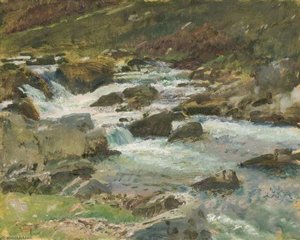 Bagsworthy Water, Exmoor, at Cloud - Sir Alfred James Munnings
To stand before the rugged landscapes of Exmoor is to witness the raw, unyielding spirit of the British countryside, a sentiment captured with profound intensity in Bagsworthy Water, Exmoor, at Cloud by Sir Alfred James Munnings . Painted in 1944, amidst the global uncertainties of the Second World War, this work transcends mere landscape painting to become an evocative study of resilience and natural force. Munnings utilizes a masterful impasto technique, where thick, rhythmic brushstrokes create a palpable texture that mimics the turbulent energy of water rushing over jagged stones.
The palette is a sophisticated arrangement of earthy greens, deep browns, and slate grays, punctuated by subtle, reflective blues that suggest a fleeting moment of light breaking through a heavy sky. As one of the top 25 artworks of Sir Alfred James Munnings, this piece is celebrated for its ability to translate atmospheric pressure into visual movement. It remains a timeless masterpiece, offering a sense of tranquil strength that continues to transform modern interiors, bringing the wild, breathing soul of the English wilderness into the sanctuary of the home.
Two Calves grazing by a Hedge - Sir Alfred James Munnings
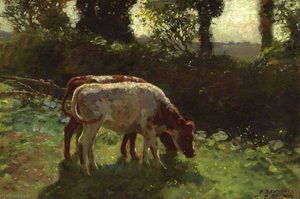 Two Calves grazing by a Hedge - Sir Alfred James Munnings
In the quietude of 1904, Sir Alfred James Munnings captured a breath of stillness in Two Calves Grazing by a Hedge . The scene unfolds with a cinematic softness; two young calves are nestled against the verdant edge of an English hedgerow, lost in the rhythmic, peaceful task of grazing. There is a profound intimacy in this moment, where the dappled sunlight filters through the foliage to illuminate the lush greens and earthy browns of the pasture, creating a tapestry of light that feels almost tactile.
Munnings utilizes his signature Impressionistic technique here, employing loose, spirited brushstrokes that prioritize the atmosphere of the countryside over rigid detail. The subtle interplay of light and shadow evokes a sense of nostalgia for a vanishing pastoral era, offering a sanctuary of calm. Bringing such a masterpiece into a modern home provides more than mere decoration; it introduces a window into a serene, timeless world. Whether through a large-scale oil reproduction or a delicate print, this work serves as a soulful anchor, inspiring reflection and a deep, quiet connection to the natural rhythms of life.
Langham Mill Pool on the Stour - Sir Alfred James Munnings
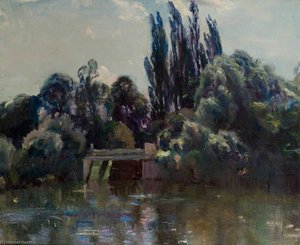 Langham Mill Pool on the Stour - Sir Alfred James Munnings
In Langham Mill Pool on the Stour , Sir Alfred James Munnings does not merely depict a river; he composes a visual sonata of light and memory. Painted in 1920, this work serves as a window into his beloved "Arcadia," capturing the River Stour in Suffolk at a moment when the traditional English countryside felt eternal, yet was poised on the edge of profound change. The artist does not simply paint the light—he invents it, using broken, Impressionistic brushstrokes to create a shimmering surface where emerald foliage meets the dappled, turquoise reflections of the water.
The atmosphere is one of profound tranquility, where the gentle ripples of the mill pool and the weeping willow branches invite the viewer into a lost, idyllic world. It is this palpable sense of nostalgia and the masterful interplay of shadow and luminosity that secures its place among the top 25 artworks of Munnings. For those seeking to bring this serene, historical essence into their own space, our museum-quality oil reproductions capture every textured stroke and vibrant hue, allowing this piece of British heritage to transform your walls into portals of pastoral inspiration.
A Farmyard Scene - Sir Alfred James Munnings
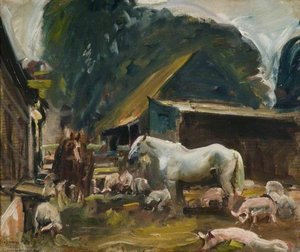 A Farmyard Scene - Sir Alfred James Munnings
In A Farmyard Scene , Sir Alfred James Munnings achieves a breathtaking mastery of natural illumination, where the light does not merely fall upon the subjects but seems to breathe life into the very soil of England. The brilliance of the sun catches the gleaming white coat of the central horse, creating a luminous focal point that contrasts sharply with the dappled shadows cast by the rustic barn and roaming livestock. This sophisticated interplay of light and shadow—a hallmark of his Impressionistic technique—captures the shimmering heat of a summer afternoon, securing this work's prestigious place among the top 25 artworks of Sir Alfred James Munnings .
To possess a hand-painted oil reproduction of this masterpiece is to bring that same atmospheric depth into your own home. The visible brushstrokes and rich, earthy textures of our museum-quality oils recreate the way light dances across the canvas, adding an unmistakable layer of luxury and historical soul to any contemporary wall. It is more than a painting; it is a window into a sun-drenched, vanishing era.
Tagg's Island - Sir Alfred James Munnings
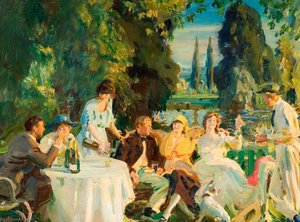 Tagg's Island - Sir Alfred James Munnings
To gaze upon Tagg's Island is to step into a sun-drenched memory of an England that once was. In this 1920 masterpiece, Sir Alfred James Munnings captures more than just a summer luncheon; he preserves the very essence of Edwardian leisure. The painting vibrates with the warmth of dappled sunlight filtering through lush foliage, illuminating a table laden with seasonal abundance and elegantly dressed figures caught in moments of quiet joy. It earns its place among the top 25 artworks of Sir Alfred James Munnings through its masterful use of Impressionistic light and its ability to evoke a profound sense of nostalgia for a vanishing way of life.
Munnings’ signature technique—the visible, energetic brushstrokes and rich impasto—gives the scene a tactile vitality that transcends mere representation. At ArtsDot.com, we honor this physical soul of the work. Our hand-painted oil reproductions are meticulously crafted on cotton canvas to ensure that every shimmering highlight and textured stroke of the original is faithfully recreated, allowing you to bring this timeless summer afternoon into your own home with museum-grade quality.
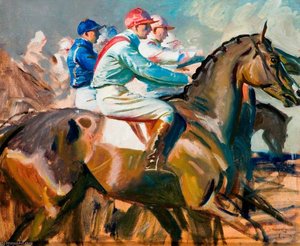
Under Starter's Orders - Sir Alfred James Munnings
In “Under Starter’s Orders,” Sir Alfred James Munnings captures the breathless anticipation that precedes the thunder of hooves. This masterpiece is a vibrant distillation of English sporting tradition, where the air seems to hum with the kinetic energy of the racecourse. Through his signature British Impressionist technique, Munnings employs loose, spirited brushstrokes and a palette of exploding reds, blues, and yellows to convey not just a visual scene, but the very pulse of competition.
The composition draws the viewer into the heart of the track, amidst jockeys in brilliant silks and the raw power of equine athletes. It is a sensory experience—the scent of turf, the bright flash of color, and the palpable tension of the starting gate. As one of the top 25 artworks of Sir Alfred James Munnings, this piece serves as a window into a vanishing era of rural nobility. For those seeking to transform their home into a gallery of the soul, owning a hand-painted oil reproduction of this work brings the timeless, romantic spirit of the English countryside directly into your private collection.
Daniel Tomkins and His Dog - Sir Alfred James Munnings
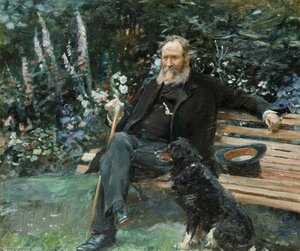 Daniel Tomkins and His Dog - Sir Alfred James Munnings
In Daniel Tomkins and His Dog , Sir Alfred James Munnings captures a profound sense of stillness, where the weathered gaze of an elderly man meets the steadfast, quiet loyalty of his canine companion. This work, one of the most evocative pieces in the top 25 artworks of Sir Alfred James Munnings , transcends simple portraiture to become a universal meditation on companionship and the passage of time. The composition is anchored by a palpable intimacy; the man’s seated posture and the dog's resting presence create a sanctuary of peace amidst the muted greens and earthy tones of the English countryside.
Munnings utilizes his signature Impressionistic brushwork to render the textures of tweed and fur, allowing dappled light to breathe life into this somber, dignified moment. For the discerning collector, bringing such an emotionally resonant masterpiece into a home can transform a private study or living space into a site of profound reflection. Whether through a hand-painted oil reproduction that captures every visible brushstroke or a high-quality print, this painting serves as a timeless window into a vanishing era of rural tranquility.
Hornberg, Black Forest - Sir Alfred James Munnings
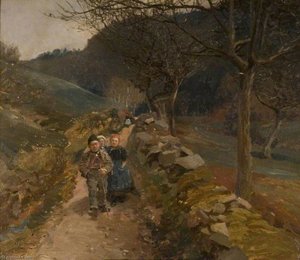 Hornberg, Black Forest - Sir Alfred James Munnings
Before the world accelerated into the industrial age, there existed a profound stillness found only in the communion between humanity and the landscape. This quietude is captured exquisitely in Hornberg, Black Forest by Sir Alfred James Munnings. Painted in 1903, this work stands as a vital entry in our collection of the top 25 artworks of Sir Alfred James Munnings, representing his early mastery of light and atmosphere long before he became the definitive voice of British equine art.
The scene unfolds along a sun-dappled dirt track, where a family wanders amidst the verdant shadows of the forest. Munnings employs an Impressionistic palette of earthy ochres, deep greens, and soft browns, using broken color techniques to simulate sunlight filtering through the canopy. His loose, expressive brushwork breathes life into the accompanying dogs and the distant horse, creating a palpable sense of movement and pastoral peace. To possess such a piece is to invite a moment of historical serenity into a modern home; whether through a museum-quality oil reproduction or a fine giclée print, this painting continues to transform contemporary spaces with its timeless, nostalgic soul.
Studies of a Brown Mare for 'Unsaddling Enclosure, Epsom' - Sir Alfred James Munnings
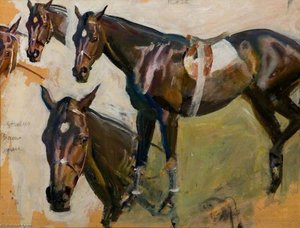 Studies of a Brown Mare for 'Unsaddling Enclosure, Epsom' - Sir Alfred James Munnings
In the Studies of a Brown Mare for 'Unsaddling Enclosure, Epsom' , Sir Alfred James Munnings invites us into the very heartbeat of British sporting tradition. This work serves as a profound meditation on anticipation and the raw, kinetic energy found in the moments before a race concludes. Rather than a static portrait, these studies capture the flickering light and muscular tension of the equine form, embodying the fleeting spirit of the Epsom Downs. The palette is a masterclass in earthy sophistication, utilizing rich ochres, deep umbers, and lush greens to ground the magnificent animals within their pastoral reality.
As one of the most captivating entries in our collection of the top 25 artworks of Sir Alfred James Munnings , this piece resonates deeply with modern collectors who value the intersection of classical technique and Impressionistic movement. The visible, rhythmic brushstrokes suggest a world in motion, making it a perfect centerpiece for those seeking to bring a sense of prestige and historical vitality to a contemporary space. For enthusiasts looking to preserve this legacy, our hand-painted oil reproductions allow you to experience the tactile depth and soulful character of Munnings’s equine mastery in your own home.
Conclusion
To wander through the works of Sir Alfred James Munnings is to embark on a journey through a vanishing England, where the rhythmic clip-clop of hooves and the golden light of the Suffolk countryside remain eternally preserved in oil and pigment. These twenty-five masterpieces are far more than mere historical artifacts or relics of a bygone era; they are living presences that continue to breathe life into our modern spaces, offering a window into a world defined by grace, tradition, and an unbreakable bond between humanity and nature. Each brushstroke carries the weight of a memory, inviting us to pause and reconnect with the quiet beauty of the pastoral life.
At ArtsDot.com , we believe that such profound beauty should not be confined to the silent halls of a museum. We strive to ensure that the soul of Munnings’s equine elegance can find a home within your own walls. Every reproduction we offer is a labor of devotion, meticulously hand-painted by skilled artists who honor the original's texture, movement, and light. Through our six-step process, we transform these canonical treasures into tangible heirlooms, capturing the very essence of the master's hand on 100% cotton canvas. Whether you are drawn to the spirited energy of a racing thoroughbred or the serene stillness of a rural landscape, we invite you to explore the full collection and bring the timeless spirit of Sir Alfred James Munnings into your daily life.