Early Life & Academic Foundations: Shaping a Naturalist Vision
 Wikipedia: Pascal Dagnan-Bouveret
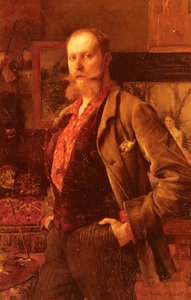
Pascal-Adolphe-Jean Dagnan-Bouveret (7 January 1852 – 3 July 1929) was a French painter, one of the leading members of the naturalist school. == Biography == He was born in Paris, the son of a tailor, and was raised by his grandfather after his fa...
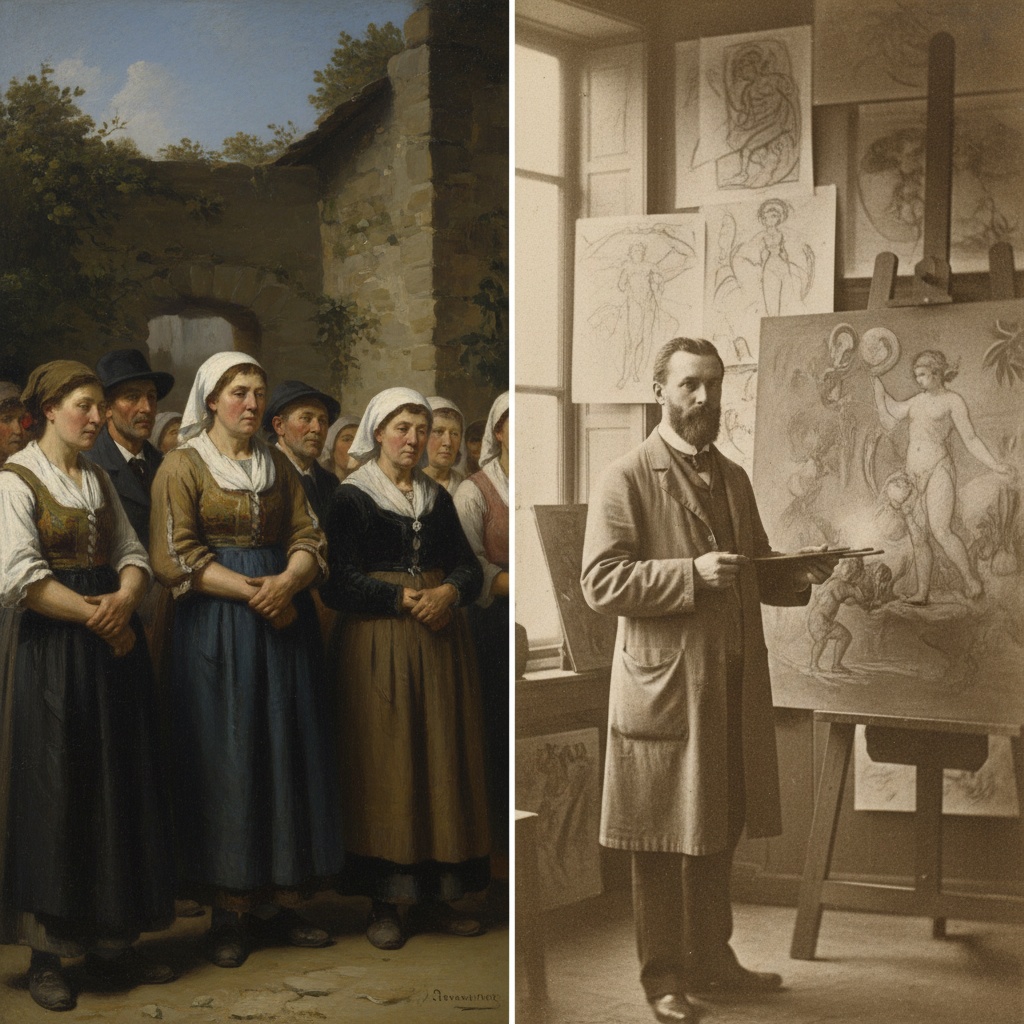
Pascal-Adolphe-Jean Dagnan-Bouveret, born in Paris in 1852, emerged from a modest background – the son of a tailor raised largely by his grandfather after his father’s emigration to Brazil. This early experience perhaps instilled a sensitivity to everyday life and a keen observation of character that would later define his artistic practice. While many aspiring artists of the era sought patronage or inherited wealth, Dagnan-Bouveret pursued a rigorous academic path, entering the prestigious École des Beaux-Arts in 1869. Initially studying under Alexandre Cabanel, he soon found himself drawn to the studio of Jean-Léon Gérôme, a master of historical and genre painting known for his meticulous detail and dramatic realism. This foundational training proved crucial; it provided Dagnan-Bouveret with the technical skills – the precise draftsmanship, understanding of anatomy, and mastery of oil paint – that would become hallmarks of his style. However, unlike some of his contemporaries who remained strictly within the academic tradition, Dagnan-Bouveret possessed a restless curiosity, an inclination to move beyond mere imitation towards a more personal and evocative form of representation.
The Breton Scenes: Capturing Rural Life with Photographic Precision
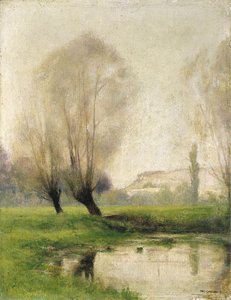 Landscape with Poplars
Discover 'Landscape with Poplars' by Pascal Dagnan-Bouveret, a stunning hand-painted reproduction capturing the beauty of French Naturalism. Own a piece of art history! #artreproduction #landscapepainting #naturalism #dagnanbouveret
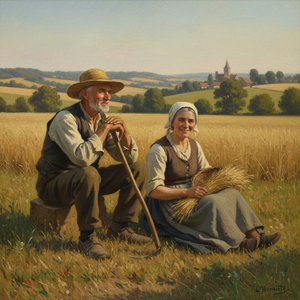
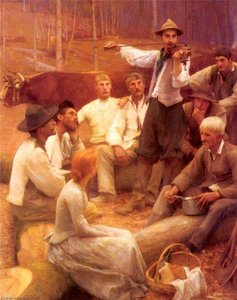
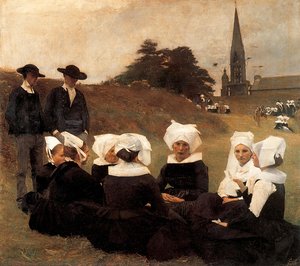
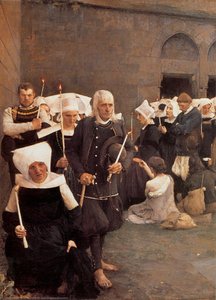
Dagnan-Bouveret’s name became synonymous with the depiction of Brittany in northern France. He wasn't merely documenting a region; he was captivated by its unique religious customs, its rugged landscapes, and the stoic dignity of its people. Paintings like Le Pain Bénit (Blessed Bread) exemplify this fascination. The scene, rendered with remarkable clarity, portrays a church gathering – penitents in traditional dress, their faces etched with solemnity, participating in a religious observance. What sets Dagnan-Bouveret apart is not simply the subject matter but *how* it’s portrayed. He wasn't idealizing rural life; he was presenting it with an unflinching honesty, capturing both its beauty and its hardship. This commitment to realism was significantly influenced by the burgeoning field of photography. Dagnan-Bouveret actively employed photographs as preparatory studies, meticulously composing scenes and capturing details that would later be translated onto canvas. In the Stable, for example, showcases this dramatic lighting and textured detail – a testament to his ability to transform fleeting moments into enduring works of art.
Beyond Realism: The Emergence of Symbolism in Dagnan-Bouveret’s Work
While initially celebrated as a leading figure of Naturalism, Dagnan-Bouveret's artistic trajectory took an intriguing turn towards Symbolism in the 1880s and 90s. This wasn’t a complete abandonment of his earlier style but rather a subtle infusion of deeper emotional and spiritual meaning into his realistic depictions. His paintings began to explore themes of faith, loss, and redemption with increasing intensity. The Pardon in Brittany, for instance, while rooted in observed reality, transcends mere documentation; it evokes a sense of collective piety and the weight of tradition. This shift is also evident in works like Madonna of the Rose, where religious iconography is imbued with a quiet intimacy and psychological depth. He moved away from simply *showing* life to suggesting its underlying currents – the hopes, fears, and beliefs that shape human experience.
Technique and Innovation: Photography's Influence on Composition and Detail
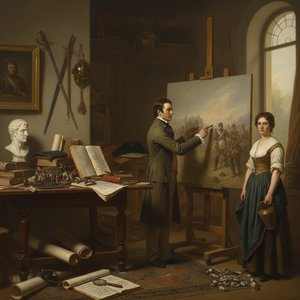
The role of photography in Dagnan-Bouveret’s artistic process cannot be overstated. He wasn’t simply using photographs as a shortcut to accuracy; he was actively experimenting with the medium, understanding its potential to capture light, form, and texture in new ways. He would meticulously pose models, arrange compositions, and take multiple shots, often combining elements from different images to create his desired effect. This innovative approach allowed him to achieve a level of realism previously unseen in academic painting. Critics at the time noted the “photographic” quality of his work, sometimes with skepticism, but it was precisely this attention to detail – the way light falls on fabric, the subtle expressions on faces – that made his paintings so compelling. His use of photography wasn’t about replicating reality; it was about *constructing* a heightened version of it, one imbued with emotional resonance and symbolic meaning.
Legacy & Recognition: Dagnan-Bouveret's Place in Art History
Pascal-Adolphe-Jean Dagnan-Bouveret’s career flourished throughout the late 19th century. He was internationally celebrated, exhibiting widely and receiving numerous accolades, including his election as an Officer of the Legion of Honour in 1891 and membership to the prestigious Institut de France in 1900. He became a staunch defender of academic tradition at a time when Modernism was gaining momentum, advocating for the importance of skill, craftsmanship, and historical context in art. While his later opposition to avant-garde movements may have overshadowed his earlier achievements for a period, recent scholarship has reaffirmed his significance as a pivotal figure bridging Realism and Symbolism. His paintings continue to captivate viewers with their quiet beauty, technical mastery, and profound emotional depth. At ArtsDot.com, we are proud to offer high-quality reproductions of Dagnan-Bouveret’s most iconic works, allowing you to experience the enduring legacy of this remarkable French artist firsthand.