
The Architect of Glamour: Defining the Art Deco Aesthetic through Erté's Vision
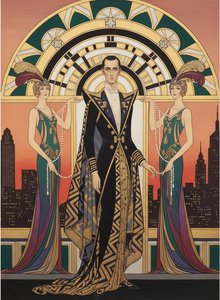
To step into the world of Romain de Tirtoff, known universally as Erté, is to surrender to a realm where geometry meets grace and where every silhouette tells a story of unbridled opulence. As the preeminent architect of the Art Deco aesthetic, Erté did not merely illustrate fashion; he choreographed it. His vision was a departure from the organic, swirling whimsy of Art Nouveau, replacing it with a structured, rhythmic elegance that mirrored the burgeoning industrial sophistication of the early 20th century. Through his eyes, the modern woman became an icon of streamlined strength, draped in fabrics that seemed to possess both the weight of silk and the lightness of air.
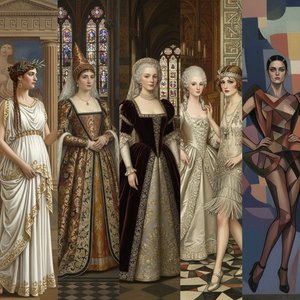
This era was defined by a pursuit of the new, a celebration of progress, and an obsession with symmetry. Erté captured this zeitgeist by synthesizing the exoticism of ancient civilizations with the sleekness of modern machinery. His work served as a visual manifesto for a generation that sought to break free from Victorian constraints, embracing instead a stylized reality where luxury was measured in the precision of a curve and the brilliance of a jewel-toned palette. It was a period of profound transformation, and Erté stood at its epicenter, providing the visual vocabulary for an age of unprecedented glamour.
Linear Precision and Fluidity: The Mathematical Beauty of the Art Deco Line
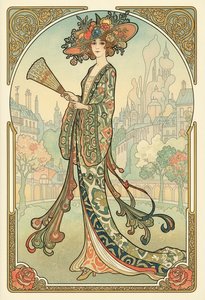
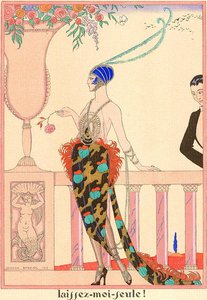
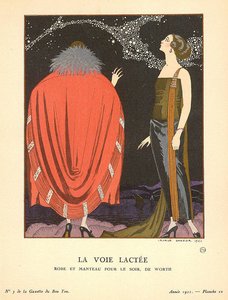
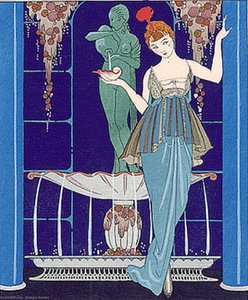
The true genius of Erté lies in his mastery of the line—a singular, commanding element that dictates the movement of his compositions. In his hands, the line is never merely a boundary; it is a rhythmic pulse. There is a mathematical rigor to his work, an almost architectural approach to the human form that utilizes elongated limbs and exaggerated proportions to create a sense of otherworldly height. This linear precision creates a tension between the rigid geometry of the background and the fluid, serpentine grace of the figures themselves.
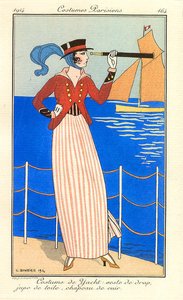
One observes a fascinating duality in his technique: the ability to maintain a sharp, decisive edge while simultaneously suggesting the soft drape of chiffon or the shimmer of sequins. This interplay of hard and soft edges creates a visual vibration, drawing the eye across the canvas in a choreographed dance. Much like the works of his contemporaries such as Georges Barbier or the geometric explorations of Sonia Delaunay, Erté’s line work evokes a sense of controlled motion. It is a disciplined beauty, where every stroke is calculated to contribute to a larger, harmonious whole, reflecting the era's fascination with order, symmetry, and the sublime.
Couture on Canvas: Exploring the Intersection of High Fashion and Illustration
For the discerning collector, Erté’s illustrations represent the pinnacle of fashion as fine art. He did not simply document trends; he elevated the garment to a sculptural object. His work for legendary publications transformed the fashion plate into a masterpiece of storytelling, where the texture of a bead or the fall of a train was rendered with such exquisite detail that one could almost feel the tactile luxury of the textile. This intersection of haute couture and illustration allowed fashion to transcend the ephemeral nature of seasonal trends and enter the permanent canon of art history.
The influence of this period is evident in the way we perceive luxury today. The motifs he popularized—the stylized plumes, the geometric patterns, the use of negative space—continue to resonate in modern high-fashion houses. His ability to blend the real with the surreal allowed him to create "dream garments" that pushed the boundaries of what was physically possible in tailoring, yet remained deeply rooted in the aesthetic desires of the elite. To study his work is to witness a period where the illustrator held as much power over the definition of elegance as the couturier herself.
The Stage as a Canvas: Theatricality, Costume Design, and Visual Narrative
Beyond the printed page, Erté’s influence extended into the very heart of the performing arts. His work in costume design for the ballet and theatre brought his stylized vision to life in three dimensions, turning the stage into a living, breathing Art Deco painting. The theatricality of his designs relied heavily on visual narrative; every costume was a character in itself, designed to enhance the movement of the dancer and the emotional arc of the performance. He understood that in the theatre, light and shadow are as much a part of the costume as the fabric itself.
This theatrical sensibility infused his illustrations with a sense of drama and motion. His figures often appear caught in a moment of profound significance—a dramatic pose, a sudden turn, or a sweeping gesture that suggests a larger, unseen narrative. This ability to imbue static images with the energy of a live performance is what separates his work from mere decoration. He utilized the stage as an experimental laboratory, testing the limits of silhouette and light, which in turn informed the breathtakingly dramatic compositions found in his most celebrated illustrations.
A Legacy of Opulence: The Enduring Influence of Erté on Modern Luxury Design
The echoes of Erté’s aesthetic can be heard across the decades, manifesting in everything from contemporary jewelry design to the grandest architectural interiors. His legacy is one of unapologetic opulence and a refusal to compromise on beauty. In an age often characterized by minimalism, the resurgence of Art Deco motifs in luxury branding and high-end decor speaks to a deep-seated human desire for the intricate, the ornamental, and the magnificent.
Modern designers frequently look back to this era to find inspiration for creating spaces that feel both timeless and avant-garde. The use of metallic accents, bold geometric patterns, and a sophisticated interplay of light—all hallmarks of the Erté era—remain essential tools in the repertoire of the luxury interior designer. His work serves as a permanent reminder that true elegance is found in the balance between structure and ornament, a principle that continues to guide the creation of the world's most prestigious aesthetic environments.
Curating the Golden Age: Integrating Art Deco Masterpieces into Contemporary Interiors
Integrating the grandeur of the Art Deco era into a modern residence requires a sophisticated touch—a curation that honors the historical weight of the period without overwhelming the contemporary space. The key lies in the strategic placement of focal points. A large-scale, hand-painted reproduction of an Erté-inspired composition can serve as the definitive anchor for a grand salon or a formal dining room, providing a sense of historical depth and unparalleled sophistication.
When selecting pieces to complement such works, one should look for a dialogue between textures. The sharp lines of Art Deco art pair exquisitely with the soft, tactile surfaces of velvet, silk, and polished marble. For those looking to expand their collection, consider the use of multi-panel layouts or bespoke commissions that allow the artwork to wrap around the architectural features of a room, much like the grand frescoes of the past. By treating these illustrations not merely as decor, but as essential components of an architectural narrative, one can recreate the intoxicating glamour of the Golden Age within the context of a modern masterpiece.
About ArtsDot.com
ArtsDot.com is the global flagship for premium art reproductions and bespoke commissions. Since 2004, we have been dedicated to making the grandeur of the Old Masters and the elegance of Art Deco accessible to the world's most discerning collectors. Our studio specializes in 100% hand-painted oil reproductions on fine cotton canvas, ensuring that every brushstroke reflects the soul and texture of the original. Whether you are looking to transform a personal photograph into a Renaissance masterpiece or seeking to curate a large-scale collection of Art Deco illustrations for a luxury hotel, our master artists and dedicated Project Coordinators provide a seamless, professional experience. From digital mockups to global white-glove delivery via DHL/FedEx, ArtsDot ensures that your investment is preserved for generations.