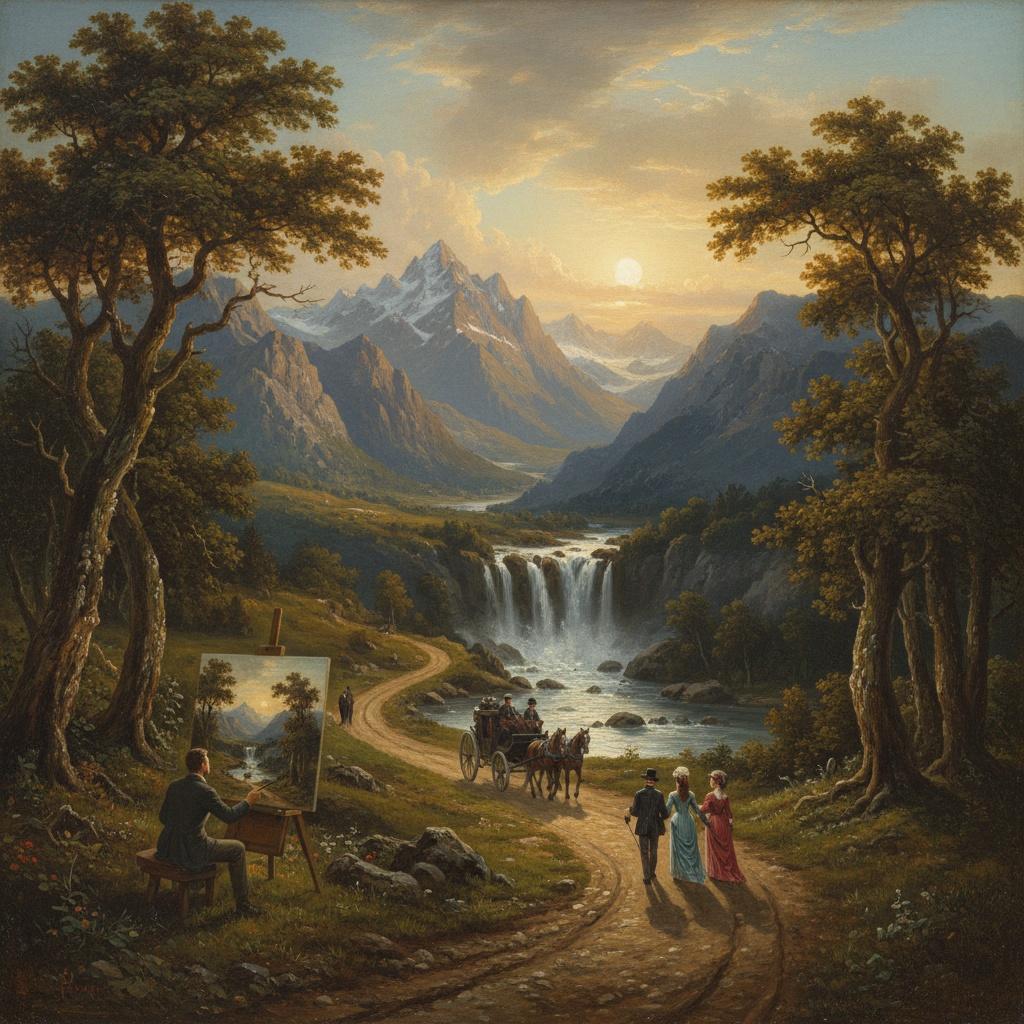
The Golden Age of Exploration: Art as a Window to the 19th-Century World
To gaze upon a nineteenth-century landscape is to embark on a journey through a world that was, for many, still draped in mystery and grandeur. This era, defined by an unprecedented expansion of human knowledge and the burgeoning spirit of global exploration, found its most profound expression not in maps or journals, but on the textured surfaces of oil canvases. As the boundaries of the known world began to shift, artists became the primary chroniclers of a changing Earth, capturing the essence of distant lands and the quiet majesty of the untamed wilderness.
The nineteenth century was a period of profound transition, where the romanticism of the unknown met the burgeoning precision of scientific observation. For the traveler of this age, every horizon promised a new discovery, and for the painter, every vista offered a chance to translate the sublime into pigment. These works served as more than mere decorations; they were windows into an era of wanderlust, allowing those who remained in the quietude of their studies to experience the salt spray of coastal dunes or the dense, emerald shadows of ancient woodlands. Through the careful application of light and shadow, these masters preserved a sense of wonder that remains palpable even centuries later.
Sunlight and Solitude: The Romanticism of the Natural Landscape
At the heart of this artistic movement lay the concept of the Sublime—the overwhelming feeling of awe and even terror inspired by the vastness of nature. In the works of the great landscape masters, we see a profound preoccupation with the interplay between light and the infinite. Consider the way sunlight filters through a canopy or rests upon a quiet meadow; it is never merely a physical phenomenon, but an emotional one. The era’s artists mastered the ability to evoke solitude, inviting the viewer to stand alone before the majesty of a setting sun or the silent strength of a mountain range.
This romantic pursuit of emotion often led to scenes of breathtaking serenity. In paintings such as A Panoramic Summer Landscape With Travellers Resting In The Dunes by Andreas Schelfhout, we are transported to a moment of respite amidst the sweeping Dutch coastlines. Here, the light does not just illuminate; it warms and settles, creating a sense of peace that transcends time. Such works remind us that the true spirit of travel is found not just in the movement between places, but in the profound stillness one finds when truly witnessing the beauty of the natural world.
Pathways through History: Capturing Movement and Human Presence in Nature
While the landscapes themselves are often the protagonists, the nineteenth-century canvas frequently includes the subtle, rhythmic presence of humanity. These figures—travelers, shepherds, or solitary wanderers—serve as vital anchors for our own empathy. They provide scale to the vastness of the scenery and a narrative thread that connects the viewer to the historical moment. Whether it is a group resting along a coastal path or small figures traversing a wooded track, these inclusions transform a static landscape into a living story of movement and existence.
In the works of artists like James Arthur O’Connor, we find A Wooded Landscape With Figures On A Track, where the presence of travelers amidst the sunset hues adds a layer of quiet narrative. These figures are rarely the focus; rather, they are part of the landscape's breath, illustrating the harmonious, if humble, relationship between man and the environment. They represent the very essence of 19th-century wanderlust—the human desire to navigate, to explore, and to find one's place within the grand tapestry of the earth.
Technique and Texture: How Realism Defined the Era's Visual Language
The emotional resonance of these paintings is inextricably linked to the technical mastery of the artists. The nineteenth century saw a magnificent refinement of Realism, where the goal was to capture the tactile reality of the world with unprecedented accuracy. This was achieved through a sophisticated understanding of light, color theory, and the physical properties of oil paint. Artists utilized varying thicknesses of pigment—from thin, translucent glazes that mimicked the clarity of water to thick, impasto strokes that gave form to the rugged bark of a tree or the heavy texture of earth.
The brilliance of this era lies in its ability to use texture to convey truth. When we observe a work like James Peel’s Landscape with Cows, we are not just seeing a depiction of nature; we are experiencing the weight of the atmosphere and the structural integrity of the trees through visible, purposeful brushwork. This dedication to the physical reality of the subject matter allowed for a deeper tonal range and a more immersive experience, ensuring that the viewer could almost feel the dampness of the morning mist or the heat of the midday sun.
Bringing the Grand Tour Home: Curating Historical Landscapes for Modern Interiors
In the modern era, the desire to surround ourselves with the beauty of the past remains as strong as ever. The tradition of the Grand Tour—the educational journey through Europe undertaken by the elite—once brought these much-coveted landscapes into the grand estates of the world. Today, we can recreate that sense of cultural sophistication and historical depth within our own contemporary spaces. Integrating these classical themes into a modern home allows for a dialogue between the present and the past, adding layers of narrative and soul to an interior design.
Curating a collection of historical landscapes requires an eye for both aesthetic harmony and emotional resonance. Whether through large-scale multi-panel compositions that transform a wide wall or a single, focused masterpiece that serves as a room's anchor, these works bring a sense of permanence and tranquility to the modern environment. By selecting pieces that reflect the light, color palette, and spirit of our personal journeys, we do more than decorate; we continue the legacy of the wanderers, keeping the spirit of exploration alive on our very own walls.
At ArtsDot.com, we are dedicated to preserving this legacy of human creativity. Our mission is to make the beauty of the Old Masters and the profound landscapes of the nineteenth century accessible to collectors worldwide. Through our meticulous process of hand-painted oil reproductions, we ensure that every brushstroke and every nuance of light is honored, allowing you to bring a piece of history into your home with unparalleled authenticity.