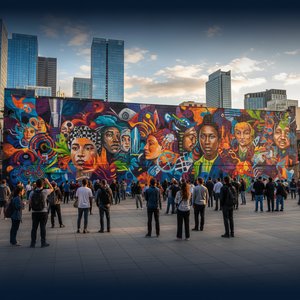
The Dagger in the Urban Canvas
In the quiet, rain-swept streets of Bergen and the bustling corridors of Oslo, a silent revolution once took shape through the sharp edges of stencils and the spray of aerosol. Andreas Hamran Færø, known to the world by his evocative pseudonym Dolk—meaning dagger in Norwegian—has emerged as the preeminent voice of Norwegian street art. Born in 1979, Færø’s journey is not merely one of an artist finding a medium, but of a visual storyteller discovering how to pierce the veil of societal complacency. His work, characterized by its biting wit and unmistakable graphic clarity, serves as a rhythmic pulse within the urban landscape, turning cold concrete into a stage for profound social commentary.
The genesis of Dolk’s aesthetic can be traced back to a unique intersection of technical discipline and rebellious inspiration. Before his stencils began to claim the walls of Europe's major metropolises, Færø pursued studies in graphic design in Melbourne, Australia. This formal training provided him with a sophisticated understanding of composition, color theory, and visual impact—tools that would later allow him to elevate street art from mere vandalism to a high-impact medium of communication. His encounter with the works of Banksy acted as a pivotal catalyst, inspiring him to adopt the stencil technique not just for its speed and efficiency in the shadows of the night, but for its ability to deliver sharp, unmistakable messages that resonate long after the paint has dried.
A Symphony of Pop Culture and Satire
To encounter a piece by Dolk is to engage in a playful yet provocative dialogue with contemporary culture. His artistic language is built upon the familiar; he masterfully deconstructs recognizable pop-culture icons, reassembling them within contexts that are often humorous, unsettling, or deeply critical. By juxtaposing beloved imagery with unexpected, sometimes subversive elements, he creates a cognitive dissonance that forces the viewer to pause and reflect. This technique allows him to navigate complex themes ranging from political critique and environmental activism to the nuances of human desire and social alienation.
The technical execution of his work is as intentional as its conceptual depth. While many street artists lean toward the chaotic energy of freehand graffiti, Dolk favors the controlled precision of the stencil. This choice offers several layers of meaning:
- Visual Impact: The bold, high-contrast nature of black and white stenciling ensures that his messages remain legible even from a distance or under the dim light of an alleyway.
- The Raw Aesthetic: He embraces the "dirty" and raw look inherent to the medium, utilizing the textures of the urban environment to add a sense of grit and authenticity to his narratives.
- Speed and Subversion: The stencil allows for rapid deployment, a necessity for an artist operating within the ephemeral and often illicit boundaries of street art, yet it carries a level of graphic sophistication rarely seen in traditional graffiti.
A Global Legacy Written on Walls
The reach of Dolk’s vision extends far beyond the borders of Norway, tracing a map of urban interventions across the globe. His murals and stencils have become landmarks in cities such as Berlin, Copenhagen, Barcelona, Lisbon, Stockholm, London, Prague, and Melbourne. Each city provides a different backdrop for his ongoing investigation into the human condition, allowing his work to participate in the unique cultural dialogues of each locale. This international presence has transitioned him from a local street phenomenon to a respected figure in the global contemporary art scene, with his works moving from the streets into prestigious gallery spaces since 2006.
Ultimately, the historical significance of Andreas Hamran Færø lies in his ability to bridge the gap between the underground and the institutional. He has proven that street art can possess the intellectual weight of fine art while maintaining its democratic, accessible spirit. Through his use of satire, his mastery of graphic design, and his unwavering commitment to social commentary, Dolk continues to wield his metaphorical dagger, cutting through the noise of the modern age to reveal the truths hidden in plain sight.