The Venetian Legacy of Antonio Veneziano
To encounter the works of Antonio Veneziano, known to history as Antonio the Venetian, is to step into a world where the spiritual and the terrestrial converge through the delicate language of late Gothic and early Renaissance art. Born in the maritime splendor of Venice around 1400, his life and artistry served as a vital bridge between the medieval traditions of devotion and the burgeoning humanism of the Italian Renaissance. While the biographical shadows cast by time obscure many specific details of his early years, his presence is indelibly etched into the sacred spaces of Italy’s most venerable cities, from the lagoons of Venice to the hallowed halls of Siena and Pisa.
The foundation of Veneziano’s mastery was laid under the guidance of Taddeo Gaddi, a formidable figure in the Florentine tradition. This apprenticeship provided him with more than just technical proficiency; it infused his Venetian sensibilities with the structural clarity and narrative depth characteristic of the Florentine school. Through this connection, he learned to manipulate light and form to serve theological truths, a skill that would later allow him to navigate the complex demands of ecclesiastical commissions across the Italian peninsula.
A Journey Through Sacred Spaces
Veneziano’s career was defined by a remarkable mobility, as his reputation for excellence led him far beyond the borders of his native Venice. His travels took him into the heart of Tuscany and Umbria, where he engaged with some of the most significant religious projects of his era. In Siena, he undertook the monumental task of decorating chapels within the Siena Cathedral, creating fresco cycles that breathed life into sacred narratives for the local faithful. These works were not merely decorations but immersive spiritual experiences designed to guide the viewer through complex biblical histories.
One of his most profound historical contributions occurred in Pisa, specifically within the Campo Santo. Between 1384 and 1387, Antonio was entrusted with completing the frescoes of Saint Ranieri, a task originally begun by Andrea da Firenze. This period of intense creativity showcased his ability to handle large-scale compositions and his growing command over perspective and symbolic depth. Though much of this magnificent work suffered during the ravages of World War II, the historical record preserves the memory of an artist capable of transforming cold stone into a vibrant, breathing testament to faith.
Technique, Symbolism, and Artistic Spirit
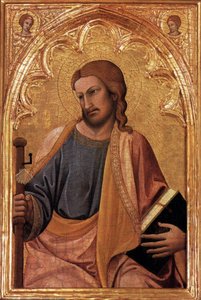
The artistry of Antonio Veneziano is characterized by a profound sense of piety and a meticulous attention to the symbolic weight of his subjects. Whether working in fresco or on wood panels, he possessed a unique ability to imbue his figures with a solemn dignity that commanded reverence. His use of light was particularly evocative; in works such as his depiction of Apostle James the Greater, one can observe how luminosity seems to emanate from within the sacred subjects themselves, suggesting a divine presence that transcends the physical medium.
His technical repertoire included several key elements that defined his stylistic identity:
- Mastery of Medium: His skill in painting on wood panels allowed for a richness of color and a depth of texture that captured the light in ways that earlier, flatter Gothic styles could not.
- Iconographic Depth: He utilized intricate gold frameworks and symbolic objects—such as the staff of a pilgrim or sacred scriptures—to create a layered dialogue between the viewer and the divine.
- Collaborative Spirit: Much like the great masters of the Venetian school, Veneziano embraced the collaborative nature of Renaissance workshops, working alongside contemporaries like Andrea Vanni to decorate the ceilings of Pisa Cathedral.
Ultimately, the significance of Antonio Veneziano lies in his role as a cultural conduit. By blending the decorative elegance of the late Gothic period with the emerging structural innovations of the Renaissance, he helped shape a visual language that would eventually define the glory of Italian art. His legacy remains a testament to an era when every brushstroke was an act of devotion and every painted surface a window into the eternal.