The Sculptural Legacy of the Beretta Brothers
In the heart of Lombardy, Italy, around 1791, a creative partnership was forged that would leave an indelible mark upon the architectural and spiritual landscape of Milan. Carlo Beretta and Giovanni Domenico Beretta emerged not merely as craftsmen, but as pivotal sculptors of the late eighteenth century, capturing the dramatic essence of the Baroque era. Their collaborative spirit allowed them to navigate the complex demands of monumental religious commissions, ultimately securing their place within the hallowed halls of the Duomo di Milano. Through their hands, cold Carrara marble was transformed into breathing narratives of faith, emotion, and classical grandeur.
The artistic evolution of the Beretta brothers was deeply rooted in the fervent atmosphere of the Baroque period, an era defined by its embrace of emotional intensity and theatrical ornamentation. They drew profound inspiration from the masters of their time, most notably the neoclassical elegance of Antonio Canova and the expressive dynamism of Alessandro Falcone. By blending these influences, they developed a technique that married anatomical precision with a spiritual luminosity. Their mastery of marble carving allowed them to manipulate light and shadow, creating works that seemed to pulse with a life of their own, bridging the gap between the earthly and the divine.
Masterpieces of the Milan Cathedral
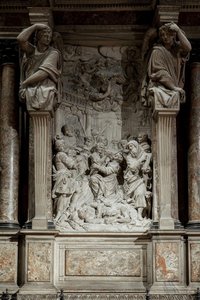
The pinnacle of their professional achievement can be found within the Milan Cathedral, where their monumental sculptures serve as cornerstones of the cathedral's altar decorations. Their most celebrated work, “Martyrdom of Saint Agnes,” stands as a testament to their ability to convey profound Christian virtues through stone. In this masterpiece, the brothers utilized the natural translucency of Carrara marble to illuminate the serene yet sorrowful countenance of the saint. Every fold of her expressive drapery and every detail of her idealized musculature was meticulously rendered to evoke a sense of unwavering faith amidst the tragedy of martyrdom.
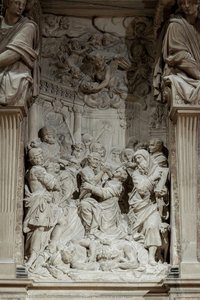
< p>Beyond the grand scale of their primary commissions, the Beretta brothers demonstrated an extraordinary level of precision in their smaller-scale studies. Their work, such as the “Detail of the altar of Saint Agnes,” reveals a meticulous attention to the nuances of form and texture. This dedication to detail ensured that even the smallest fragment of their sculptural program contributed to the overwhelming sense of realism and spiritual contemplation that characterizes their oeuvre. Through these works, they achieved a rare balance between the monumental and the intimate, making them essential figures in the history of Italian Baroque sculpture.Historical Significance and Artistic Impact
The historical significance of Carlo and Giovanni Domenico Beretta lies in their ability to sustain the grandeur of the Baroque tradition during a period of shifting artistic tides. While biographical records from their era remain somewhat sparse, their physical contributions to one of the world's most iconic cathedrals provide a permanent record of their talent. Their work represents a crucial moment in Lombardy's cultural history, where the sculptural arts were used to reinforce the religious and architectural identity of Milan.
To reflect on the Beretta brothers is to reflect on the power of collaborative artistry. Their legacy is defined by:
- Technical Mastery: The sophisticated use of Carrara marble to achieve both anatomical realism and spiritual radiance.
- Architectural Integration: The seamless way their sculptures enhance the monumental scale of the Duomo di Milano.
- Emotional Resonance: The ability to translate complex theological narratives into palpable, human emotions through stone.