A Glimpse into the Past: The Legacy of Carrie Victoria Dennis
The annals of art history often hold quiet corners reserved for those whose lives remain partially shrouded in mystery, yet whose brushstrokes continue to whisper stories of a bygone era. Carrie Victoria Dennis (1872–1939) stands as one such figure, an artist whose biographical details are as elusive as the moonlight she so skillfully captured on canvas. Born in the United Kingdom in 1872, her life spanned a transformative period of history, moving from the late Victorian era into the early decades of the twentieth century. While much of her personal journey remains undocumented, her artistic contribution provides a poignant window into the atmospheric landscapes and maritime memories of her time.
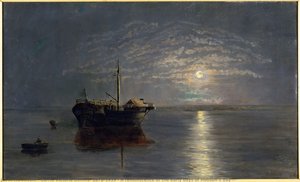
The essence of Dennis's artistry is most profoundly felt in her ability to evoke nostalgia through light and shadow. Her work serves as a visual bridge to the past, particularly through her evocative depictions of coastal life and historical settings. One of her most notable contributions to the art world is the piece titled "A reminiscence of the early days of Hobson’s Bay." In this work, she masterfully recreates a moonlit scene, focusing on the haunting presence of the prison hulk. Through her use of light, she does more than merely paint a landscape; she reconstructs a memory, inviting the viewer to contemplate the weight of history and the somber beauty of maritime life in the bay.
Artistic Vision and Historical Resonance
Though the specific influences that shaped her early training are not widely recorded, the technical execution found in her surviving works suggests a deep sensitivity to atmosphere and environmental storytelling. Her ability to manipulate the interplay between darkness and illumination allows her subjects—often maritime or coastal in nature—to emerge with a spectral, dreamlike quality. This technique transforms historical landmarks into emotive symbols of endurance and change.
The significance of Carrie Victoria Dennis lies not only in her individual skill but in her role as a chronicler of local heritage. Her paintings act as a form of visual preservation, capturing the essence of locations like Hobson’s Bay before they were altered by the relentless march of modernization. To study her work is to engage with a lost world, where the following elements resonate:
- Atmospheric Depth: The use of moonlight and shadow to create a sense of mystery and historical gravity.
- Narrative Nostalgia: A profound ability to evoke the "early days" of coastal settlements through detailed, evocative scenes.
- Maritime Heritage: A focus on the sea, ships, and the structures that defined the maritime identity of the era.
As we continue to explore the archives of art history, figures like Dennis remind us that even when a life is not fully documented, the soul of an artist lives on through the enduring power of their imagery. Her legacy remains a quiet but powerful testament to the beauty found in the shadows of history.