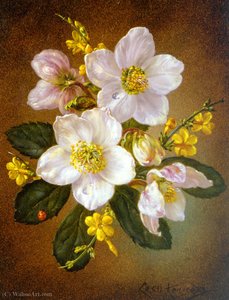
A Legacy of Botanical Brilliance: The Life and Art of Cecil Kennedy
To step into a world created by Cecil Kennedy is to enter a meticulously curated sanctuary where nature’s most delicate moments are frozen in eternal, luminous splendor. Born on 4 February 1905 in Leyton, Essex, Kennedy was destined for a life steeped in the pigments and textures of the visual arts. He emerged from a remarkably large and talented Victorian family; as the youngest of thirteen children, he was surrounded by a lineage of creators, including his grandfather, father, and four uncles, all of whom were painters. This early immersion provided him with an instinctive understanding of light and form, though his path would eventually lead him far beyond the simple landscapes practiced by his father toward the intricate, breathing ecosystems of floral still life.
While his roots were firmly planted in British soil, Kennedy’s artistic soul was profoundly shaped by his experiences abroad. During the Second World War, his posting as a young soldier to Antwerp served as a transformative turning point. In the heart of Europe, he found himself amidst the shadows of history, yet it was within the quiet halls of great museums that he discovered his true calling. By studying the works of the Dutch and Flemish Masters, Kennedy became enamored with their ability to render texture and light with scientific precision and emotional depth. This encounter with the Old Masters instilled in him a lifelong commitment to a technique characterized by thin, translucent glazes and an exuberant color palette, allowing him to achieve a level of luminosity that made his petals appear almost dew-kissed and alive.
The Artistry of Detail and the Living Canvas
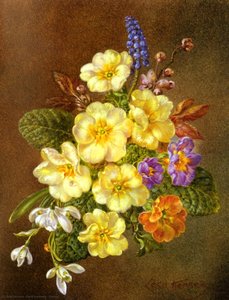
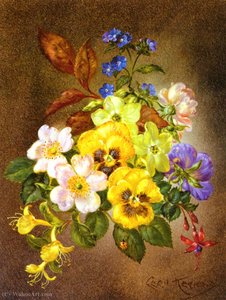
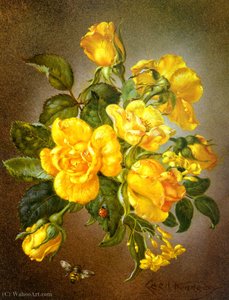
Kennedy’s mature style is defined by an uncompromising dedication to botanical accuracy, yet his work transcends mere scientific illustration through its sheer vitality. He did not merely paint flowers; he composed miniature worlds. His canvases often feature a subtle, enchanting movement, frequently achieved through the inclusion of small, spirited inhabitants like ladybugs or bumblebees. This signature touch transformed his still lifes from static arrangements into vibrant, pulsing habitats. Much of this inspiration was drawn from his domestic life; his wife, Winifred, was a master of floral arrangement, often utilizing exquisite mid-eighteenth century Waterford vases from their personal collection to create the very compositions that Kennedy would later immortalize on canvas.
The technical mastery required to produce such works was immense. Kennedy utilized a sophisticated layering process, building up surfaces with meticulous brushstrokes and occasionally employing a palette knife to capture the tactile essence of a stem or the velvety softness of a petal. His approach was a beautiful paradox: it possessed the precision of a naturalist but retained the atmospheric soul of an Impressionist. Influenced by the light-drenched sensibilities of Claude Monet and Pierre Auguste Renoir, Kennedy sought to capture not just the physical structure of a bloom, but the fleeting quality of light as it dances across a leaf or settles within a cup of a tulip.
Recognition and Lasting Significance
As his career progressed, Kennedy’s reputation ascended to the highest echelons of the British art world. He became a regular presence in prestigious institutions, exhibiting at the Royal Academy in London, the Royal Scottish Academy, and the Royal Hibernian Academy. His talent earned him international acclaim at the Paris Salon, where he was honored with a silver medal in 1956 and a gold medal in 1970. For nearly two decades, his work was a staple of the esteemed Fine Art Society, captivating collectors and even earning the patronage of figures such as Queen Mary. It was famously suggested by the Queen herself that he should always include a ladybird in his compositions, a charming anecdote that further cemented his identity as a painter of life's small, precious details.
Cecil Kennedy passed away on 12 December 1997 in St Albans, leaving behind a body of work that remains a benchmark for excellence in floral painting. His significance lies in his ability to elevate the genre of still life, moving it away from mere decoration and into the realm of complex, thoughtful fine art. Today, his paintings continue to be cherished for their ability to evoke a sense of wonder and peace, reminding us of the intricate beauty that exists within the smallest corners of the natural world. His legacy is one of light, color, and an enduring reverence for the botanical wonders of our earth.