The Poet of Wood: The Soulful Legacy of George Nakashima
George Katsutoshi Nakashima was far more than a master craftsman; he was an architect of the spirit, a philosopher who saw the heartbeat within every grain of timber. Born in 1905 in Spokane, Washington, his life was a profound tapestry woven from the threads of diverse cultures and transformative historical upheavals. His early years were marked by the shadows of global conflict, particularly the displacement experienced during the Second Sino-Japanese War, an era that instilled in him a lifelong reverence for cultural heritage and the sanctity of preservation. This deep-seated connection to his roots would eventually manifest in a design language that bridged the gap between the ancient traditions of Japan and the burgeoning modernism of the West.
Nakashima’s journey toward mastery was as much an architectural odyssey as it and a spiritual one. After graduating from the University of Washington with a degree in architecture, he pursued advanced studies at M.I.T., eventually embarking on a global pilgrimage that would shape his aesthetic soul. In Paris, he encountered the legendary Le Corbusier, finding common ground in the belief that architecture is a moral and spiritual obligation to society. His travels through North Africa and Japan brought him into the orbit of Antonin Raymond, an influential architect whose modernist principles of simplicity and functionality became a cornerstone of Nakashima’s vision. It was under the tutelage of master carpenter Gentaro Hikogawa that Nakashima truly learned the language of wood, mastering the meticulous Japanese joinery techniques that allowed pieces to stand strong without the need for nails or glue.
A Symphony of Nature and Craftsmanship
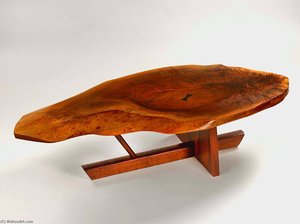
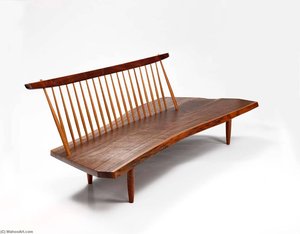
The work of George Nakashima is characterized by an organic modernism that celebrates the inherent imperfections of natural materials. He did not seek to dominate the wood, but rather to collaborate with it. His furniture—most notably the iconic Conoid Chair—serves as a testament to this symbiotic relationship. Through the use of the "butterfly joint," Nakashima would bridge cracks and fissures in raw slabs, turning what might be seen as flaws into breathtaking focal points of beauty. This technique allowed the natural history of the tree to remain visible, inviting the viewer to contemplate the passage of time and the life of the organism from which the piece was born.
His design philosophy extended beyond the mere creation of functional objects; he sought to create pieces that possessed a sense of "living" presence. This is evident in several of his most celebrated contributions:
- The Conoid Chair: A masterpiece of structural elegance, utilizing interlocking wooden elements to achieve a lightweight yet incredibly stable form.
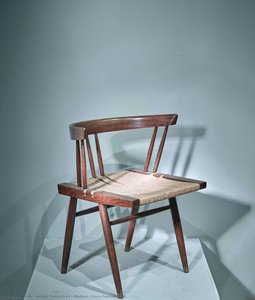
- Grass-Seated Chair: Developed during his time in India, this piece showcases his ability to blend technological precision with organic textures, using natural grass weaves to complement the wood.
- Butterfly Joint Tables: Large-scale works that transform raw, rugged slabs into sophisticated centerpieces of modern living.
A Lasting Architectural and Cultural Impression
Nakashima’s influence reached far beyond the confines of his workshop in Pennsylvania. His architectural collaborations, such as his work with Philip Johnson on the St George Church in Hungary, demonstrated his unique ability to synthesize Eastern and Western aesthetics into a singular, harmonious composition. He possessed a rare talent for integrating Byzantine iconography and Hungarian Baroque art within structures that felt fundamentally grounded in Japanese minimalism. This ability to harmonize disparate traditions made him a pivotal figure in the American Craft Movement.
Even as his fame grew, Nakashima remained dedicated to the intimate scale of the studio. His home, studio, and workshop in Bucks County, Pennsylvania, became a sanctuary for both creation and family life, eventually earning designation as a National Historic Landmark. Through the stewardship of his daughter, Mira Nakashima, his legacy continues to breathe through the continued production of his designs. George Nakashima left behind more than just furniture; he left a blueprint for how humanity might live in greater harmony with the natural world, reminding us that true beauty is found when we honor the history, the struggle, and the inherent character of all living things.