The Master of Everyday Life: The Legacy of Ignatius Josephus Van Regemorter
In the heart of the nineteenth century, amidst the shifting cultural tides of Europe, Ignatius Josephus Van Regemorter emerged as a profound observer of the human condition. Born in Antwerp in 1785, he was a child of a rich artistic lineage, descending from a family where the brush and the palette were as essential as bread. His father, Petrus Johannes Van Regemorter, was not merely a progenitor but a respected pedagogue and painter who provided the foundational stones upon which Ignatius built his illustrious career. This early immersion in the traditions of Flemish art instilled in him a reverence for detail and a deep-seated passion for visual storytelling that would define his life's work.
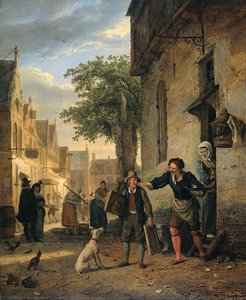
Van Regemorter’s artistic odyssey was far from stationary, as his pursuit of excellence led him through the vibrant cultural hubs of Paris, Antwerp, Brussels, and Ghent. These travels allowed him to absorb the diverse stylistic currents of the era, weaving together a unique aesthetic that bridged the gap between classical tradition and emerging realism. While he drew inspiration from the dramatic shadows of Rembrandt and the grand, fluid energy of Rubens, he chose not to pursue the lofty heights of mythological or historical grandeur. Instead, his heart belonged to the humble and the immediate—the quiet corners of a tavern, the rhythmic bustle of a fish market, and the intimate warmth of domestic interiors.
A Symphony of Light and Shadow
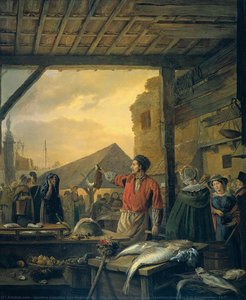
What truly distinguishes Van Regemorter’s oeuvre is his masterful command of chiaroscuro. He possessed an uncanny ability to manipulate light, using dramatic contrasts between brilliance and obscurity to breathe life into his subjects. In his hands, a simple scene of a marketplace becomes a stage for psychological depth; the way light falls upon a vendor's face or glints off a fresh catch in The Fish Market in Antwerp serves to elevate the mundane to the monumental. His compositions are never accidental; they are carefully orchestrated through pyramidal arrangements and balanced perspectives that guide the viewer’s eye through a narrative of light and shadow.
His technical prowess extended beyond the canvas into the delicate realms of engraving and lithography, showcasing a versatility that few of his contemporaries could match. Whether he was capturing the fleeting expression of a character in a genre scene or the sprawling serenity of a landscape, his work remained anchored by a meticulous attention to detail. This precision allowed him to capture the very essence of 19th-century Flemish life, preserving the textures of fabric, the sheen of metal, and the atmospheric weight of a crowded street for posterity.
Historical Significance and Enduring Spirit
The significance of Ignatius Josephus Van Regemorter lies in his role as a chronicler of the ordinary. At a time when many artists sought to immortalize kings and gods, he found divinity in the everyday. His works serve as a vital historical window into the social fabric of the Low Countries, documenting the rhythms of commerce, the intimacy of family life, and the shared experiences of the common people. Through his eyes, we see the world not as a series of grand events, but as a collection of meaningful, lived moments.
As he reached the twilight of his long life in 1873, Van Regemorter left behind a legacy that continues to resonate with those who find beauty in authenticity. His ability to imbue even the most transient scenes with lasting emotion ensures his place in the pantheon of Flemish masters. To study his work is to engage in a silent dialogue with the past, rediscovering the profound artistry hidden within the simple, beautiful realities of human existence.