The Enigmatic Vision of Johann Conrad Ochlich
Within the quiet corridors of early 19th-century German art history, few figures possess the hauntingly beautiful mystery of Johann Conrad Ochlich. Born around 1730 in Darmstadt, Germany, Ochlich remains a somewhat enigmatic presence, a painter whose life details are as veiled as the morning mist over a Rhine valley. Yet, despite the scarcity of biographical records, his artistic footprint is indelble. He emerged from a lineage deeply rooted in the creative arts; his father, Johann Conrad Dorner, served as a respected court painter, providing young Ochlich with an upbringing steeped in the nuances of light, shadow, and composition. This early immersion in a world of fine art likely laid the foundation for a career defined by an extraordinary ability to capture the soul of the German landscape.
The formative years of Ochlich’s development were undoubtedly shaped by the prestigious atmosphere of the Darmstadt court. It is widely believed that he refined his technical prowess under the mentorship of Philipp Hieronymus Brinckmann, the celebrated court painter of the era. This tutelage was transformative, instilling in Ochlich a profound mastery of Rococo aesthetics. From Brinckmann, he inherited a delicate approach to brushwork and a penchant for pastel hues that emphasized an idealized, almost dreamlike beauty. However, as his style matured, Ochlich began to transcend the purely decorative, moving toward a more rigorous and observational form of landscape painting that sought to document the pulse of German life with unprecedented clarity.
A Masterpiece of Urban Vitality
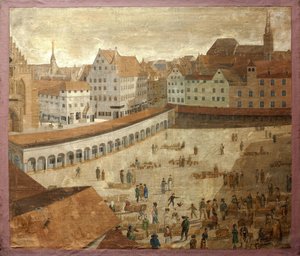
The pinnacle of Ochlich’s career is undoubtedly his monumental achievement, 'Panorama of the Market Square'. Completed in 1824, this work serves as a breathtaking temporal portal, transporting the modern viewer back to the vibrant heart of nineteenth-century Germany. While many of his contemporaries sought solace in the stillness of pastoral vistas, Ochlich turned his gaze toward the rhythmic energy of the urban environment. This particular piece was part of an ambitious series of eight monumental panels designed to provide an all-encompassing, panoramic view of Nuremberg, showcasing a level of ambition rarely seen in landscape painting of that period.
In this masterpiece, Ochlich achieves a cinematic quality through his meticulous attention to the social fabric of the era. The canvas is far from a static architectural study; it is a living, breathing tapestry of human interaction. Within the frame, one can observe:
- The dynamism of daily commerce: A bustling crowd of at least thirteen distinct individuals, ranging from focused merchants to casual passersby, creating a sense of spontaneous movement.
- The presence of life: The inclusion of animals, such as horses poised near the center and a resting dog, which grounds the grand architecture in the relatable realities of 19th-century existence.
- Architectural grandeur: The imposing weight of stone structures and prominent churches that anchor the composition, providing a sense of permanence against the fleeting moments of human activity.
Legacy and Artistic Significance
Technically, Ochlich’s work is a masterclass in the manipulation of light and perspective. He possessed an uncanny ability to render how sunlight interacts with weathered facades, creating atmospheric conditions that feel palpable to the viewer. By balancing the massive, imposing weight of German architecture with the delicate, transient nature of the figures inhabiting it, he created a harmonious tension that defines his unique contribution to the genre. His work does not merely depict a place; it captures an atmosphere, preserving the rhythmic pulse of a bygone age.
The historical significance of Johann Conrad Ochlich lies in his ability to bridge the gap between the decorative elegance of the Rococo period and the more observational, detailed realism that would come to define later landscape traditions. Though much of his personal history remains lost to time, his canvases remain as enduring witnesses to the architectural splendor and social vitality of the German landscape. Through his eyes, we do not just see the market squares of old; we feel the very breath of history.