The Luminous Legacy of Lippo Vanni
In the heart of the fourteenth century, as the golden light of the Italian Renaissance began to flicker across the Tuscan landscape, the city of Siena emerged as a sanctuary for profound artistic devotion. It was within this vibrant, medieval atmosphere that Lippo Vanni carved his name into the annals of art history. A master of both the delicate miniature and the expansive fresco, Vanni embodied the transition from the rigid elegance of the Gothic tradition to the burgeoning humanism that would soon redefine European aesthetics. Though the precise details of his early life remain shrouded in the mists of time, we know him as a craftsman whose hand breathed life into the sacred narratives of his era, leaving behind a trail of luminous works that continue to enchant the modern eye.
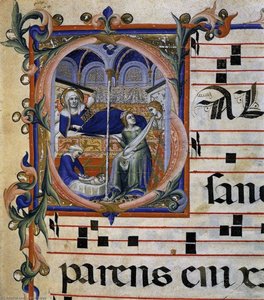
Vanni’s presence in the Sienese artistic community is documented through the meticulous records of the guilds and ecclesiastical commissions. His name first appeared within the guild system in 1355, yet his creative pulse was felt much earlier; by 1344, he was already demonstrating his extraordinary skill through miniature paintings for the Santa Maria della Scala. This early mastery of the miniature—a genre requiring unparalleled precision and a delicate touch—served as the foundation for his broader achievements. His ability to manipulate fine pigments on small scales allowed him to capture the intricate textures of silk, the subtle glow of divine light, and the profound emotional depth of religious figures, qualities that would later define his larger-scale fresco work.
A Tapestry of Devotion and History
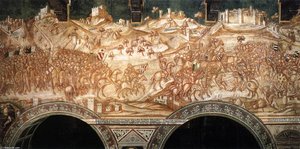
The breadth of Vanni’s oeuvre reflects a life deeply intertwined with the spiritual and civic identity of Siena. His artistry was not merely decorative but served as a vital medium for storytelling and communal memory. In the halls of power and the quiet cloisters of monasteries, his work acted as a bridge between the earthly and the divine. One of his most striking achievements is the fresco Victory of the Sienese Troops at Val di Chiana in 1363, housed within the Palazzo Pubblico. In this monumental work, Vanni moved away from the intimate scale of miniatures to capture the raw, kinetic energy of battle. Through a masterful use of earth tones punctuated by dramatic splashes of red, he brought the historical gravity of the conflict to life, showcasing an ability to render movement and architectural depth that resonated with the civic pride of his people.
Beyond the battlefield, Vanni’s hand is found in the most sacred corners of Tuscany. His religious compositions are characterized by a profound sense of Gothic elegance, where every fold of drapery and every tilt of a head conveys a specific theological truth. Notable examples include:
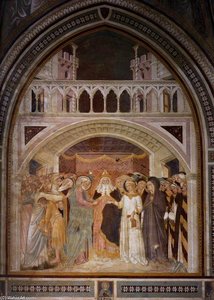
- The Betrothal of the Virgin: A masterpiece commissioned for the Santa Maria della Scala cathedral, showcasing his meticulous attention to detail and a palette that celebrates the richness of Sienese tradition.
- The Coronation of the Virgin: Executed in 1352 for the Biccherna, the Sienese Ministry of Finance, demonstrating how his sacred imagery permeated even the highest levels of civic administration.
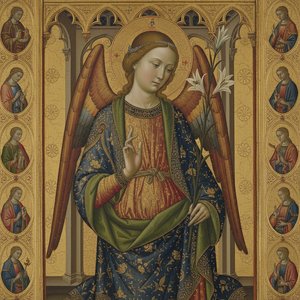
- The Annunciation: Painted for the cloisters of San Domenico, where portions of his delicate work still endure as a testament to his enduring legacy.
Artistic Evolution and Enduring Significance
As Vanni’s career progressed, his style became a sophisticated dialogue between the inherited Gothic splendor and the emerging naturalism of the mid-fourteenth century. He possessed a rare versatility, capable of executing the intimate, jewel-like precision required for illuminated manuscripts and the robust, narrative power necessary for large-scale wall paintings. This duality allowed him to influence a generation of Sienese painters, contributing to a stylistic continuity that made Siena a premier center of European art. His later years were marked by continued prestige, evidenced by his 1375 commission to paint the doors of the great crucifix in the Siena Cathedral—a task of immense honor that speaks to the high esteem in which he was held by the Church.
The historical significance of Lippo Vanni lies in his role as a custodian of the Sienese spirit. He did not merely replicate existing forms; he refined them, infusing the decorative beauty of the International Gothic style with a burgeoning sense of human presence and emotional resonance. Today, when we gaze upon his triptychs or his sweeping frescoes, we are not just looking at relics of the past, but witnessing the very moment when the medieval world began to look toward the light of the Renaissance. His work remains a vital chapter in the story of Italian art, reminding us of a time when every brushstroke was an act of both artistry and devotion.