The Painter of Desert Dreams
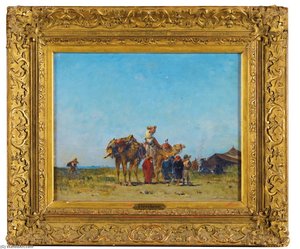
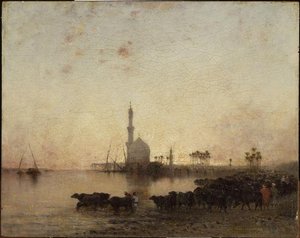
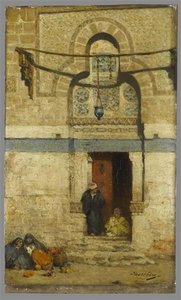
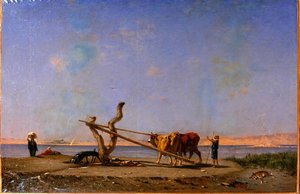
Narcisse Berchère (1819–1891) stands as a singular figure in the annals of French Orientalist painting, an artist whose canvases transported viewers to the sun-drenched landscapes and vibrant cultures of the Middle East and North Africa. Born in Étampes, Berchère possessed a remarkable sensitivity for capturing the subtle beauty and profound spirituality inherent in these regions—a perspective that distinguishes him as one of the most evocative interpreters of Islamic art themes. Unlike many of his contemporaries who focused on grand narratives of conquest or opulent palaces, Berchère sought the soul of the landscape, finding poetry in the vast, arid expanses and the rhythmic movement of desert life.
His artistic journey began with rigorous academic foundations in Paris. Under the guidance of masters such as Charles-Caïus Renoux at the École des Beaux-Arts and later within the studios of Jean-Charles-Joseph Rémond, Berchère developed a disciplined command of form and light. This classical training was deeply enriched by the influence of Alexandre Cabanel, whose mastery of chiaroscuro left an indelible mark on Berchère’s technique. However, it was the dramatic Romanticism of Eugène Delacroix that truly ignited his creative spirit. Delacroix’s fascination with exotic locales, particularly Morocco, provided a blueprint for Berchère to venture beyond European borders and embrace the challenge of portraying unfamiliar environments with both authenticity and emotional depth.
Journeys Through the Orient
The true essence of Berchère’s oeuvre was forged through his physical travels across much of the known world. Between 1849 and 1850, he explored Egypt, Asia Minor, and the Greek archipelago, experiences that would forever alter his visual vocabulary. His connection to the East was not merely observational but deeply immersive; in 1856, he returned to Egypt, famously crossing the Sinai desert alongside the painter Léon Belly. This expedition even brought him into the company of luminaries like Jean-Léon Gérôme and Auguste Bartholdi, placing him at the very heart of the 19th-century Orientalist movement.
One of his most significant historical contributions occurred when Ferdinand de Lesseps entrusted him with a monumental task: to document the various stages of the excavation of the Suez Canal. Through this series of paintings, Berchère acted as both an artist and a visual historian, capturing the transformative industrial labor that was reshaping the geography of the region. His correspondence during this period, particularly with the painter Eugène Fromentin, offers a rare glimpse into the intellectual and personal reflections of an artist witnessing history in the making.
Technique and Lasting Legacy
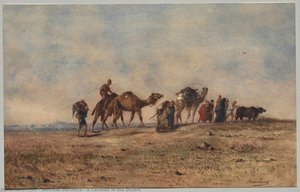
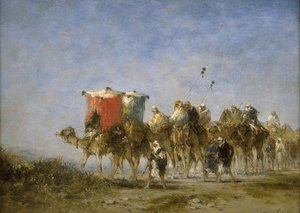
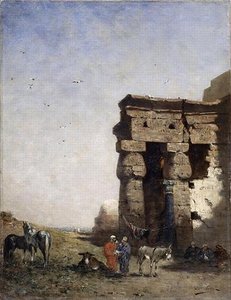
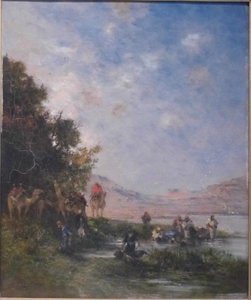
Berchère’s style is characterized by a delicate balance between impressionistic realism and meticulous observation. In works such as A Caravan in the Desert, he utilizes luminous washes of color—primarily earthy ochres and deep browns—to convey the palpable heat and dryness of the Egyptian landscape. He mastered the use of atmospheric perspective, where distant dunes and figures become pale and ethereal, creating a convincing sense of immense scale and depth. His brushwork, while capable of great detail, often retains an expressive looseness that captures the movement of wind-blown sand or the swaying gait of a camel.
The historical significance of Narcisse Berchère lies in his ability to move past the mere spectacle of the "exotic" to find a profound connection with his subjects. His work remains a vital window into a period of intense cultural exchange and colonial ambition, serving as a bridge between the European gaze and the enduring majesty of the Orient. Through his eyes, we do not merely see a landscape; we feel the heat of the sun, the silence of the dunes, and the timeless pulse of the desert.