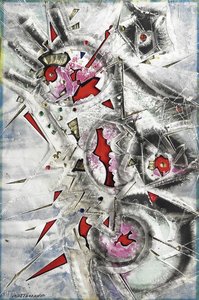
The Sculptor of Resistance and Fragmented Form
Umberto Mastroianni, a name synonymous with the raw, transformative power of postwar Italian sculpture, lived a life shaped by both profound political struggle and intense artistic exploration. Born in 1910 in Fontana Liri, within the province of Frosinone, his early years were shadowed by the turbulent onset of World War II. This was not merely a historical backdrop for Mastroianni; it was a lived reality that saw him actively participating in the Italian Resistance movement. The grit, resilience, and very much the struggle for freedom experienced during these partisan years would later find their way into his bronze and steel, earning him the poignant title of “poet of the Resistance” from the critic Giulio Carlo Argan. His work often serves as a monument to those fallen in war, channeling the energy of movement and the weight of memory through monumental volumes.
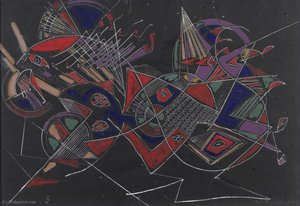
The artistic soul of Mastroianni was deeply rooted in the tension between structure and chaos. While his early sensibilities were touched by the fractured perspectives of Cubism and the psychological depths of Surrealism—drawing inspiration from the pioneering spirit of Picasso—he eventually moved toward a more visceral, abstract language. He navigated the complex space between geometric post-Cubism and the expressive, textured spontaneity of Art Informel. In his hands, matter was never static; it fermented, underwent transformation, and seemed to breathe. This approach allowed him to dismantle traditional sculptural conventions, prioritizing the conceptual weight of an idea over the mere pursuit of polished, classical perfection.
Materiality and the Dance of Light and Shadow
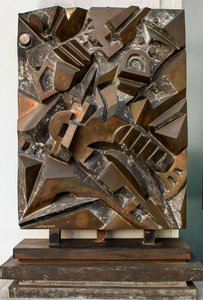
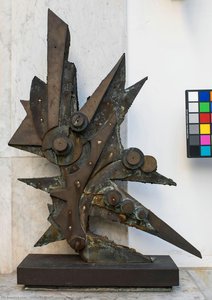
Mastroianni’s mastery lay in his profound relationship with bronze and the technical intricacies of lost wax casting. He did not seek to hide the process of creation but rather celebrated the irregularities of the surface. By emphasizing textural contrasts and surface imperfections, he created works that mirrored the complexities and scars of the human experience. His sculptures often feature an intentional interplay between solid and void, where light and shadow dance across rugged, uneven planes to create a sense of explosive energy.
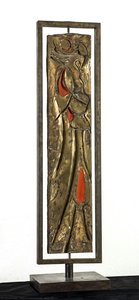
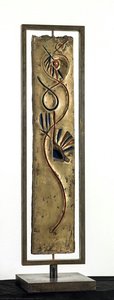
This mastery is perhaps most evident in his celebrated mature works, such as:
- Groviglio (1967): A dynamic exploration of fragmented identity, where interlocking forms create a complex, knot-like structure that challenges the viewer's perception of space.
- Stele n.1 and Stele n.2: Monumental bronze pieces that exemplify his ability to balance geometric precision with an almost organic, erupting energy, utilizing the alternation of light and shadow to give life to the metal.
Through these works, Mastroianni achieved a space-surface dimension that felt both grounded in heavy materiality and liberated by abstract movement. His ability to manipulate bronze so that it appeared to be in a state of constant flux remains one of his most enduring legacies.
Legacy and International Recognition
As his career progressed, Mastroianni’s influence expanded far beyond the borders of Italy. He became a pivotal figure in modern sculpture, recognized globally for his ability to capture the spirit of an era defined by reconstruction and rebirth. His contributions were formally honored in 1989 when he received the prestigious Praemium Imperiale for Sculpture, one of the highest accolades in the art world. This recognition cemented his status as a master who could translate the political and social tremors of the 20th century into a universal language of form.
Beyond his individual artistic triumphs, Mastroianni’s life was intertwined with the cultural fabric of Italy; he was the uncle of the legendary actor Marcello Mastroianni, though his own fame rested firmly on the strength of his sculptural vision. Today, his legacy is preserved not only in museums and public monuments but also through the Museo Civico Umberto Mastroianni, established in his honor. His work remains a testament to the idea that art can be both a personal expression of beauty and a powerful, enduring witness to the struggle for human dignity.