 Vorschau anzeigen
 Versenden
 Teilen
 Details anzeigen

 Herunterladen
 Ähnliche Objekte
 Röntgenaufnahme
 Diashow
Flower of Death
 Acrylic On Canvas
- WallArt
- National Romanticism
 1895
1895 14.0 x 16.0 cm
 Ateneum Kunstmuseum
 Weiterlesen
Handgefertigte Ölreproduktion
Handgemaltes Ölgemälde auf Leinwand in Ihrer Wunschgröße und mit Rahmen, auf Bestellung von unseren Künstlern angefertigt. ( Druck bestellen Bild kaufen)




P118B $10

P118H $10

P118W $10

P438Z $10

P508JH $12

P508YH $12

P805H $10

P805Z $10

P919BZ $10

P919G $10

P919XJ $10

P959ZH $10

P968JZ $12

W106C $8

W218G $10

W218JH $8

W218Y $10

W307PJ $10

W316G $10

W316PJ $8

W316Y $10

W398PJ $8

W4111J $10

W500HY $15

W500JH $15

W692G $12

W849H $8

W940BG $15

W953PJ $8




Wählen Sie aus unseren vordefinierten Formaten, die den ursprünglichen Proportionen des Kunstwerks entsprechen.

Sie können Ihre eigenen Maße eingeben, um einen bestimmten Rahmen oder Platz auszufüllen. Wenn die gewählte Größe nicht den Proportionen des Originalbildes entspricht, werden wir das Kunstwerk entweder beschneiden oder das Gemälde durch zusätzliche, handgemalte Elemente erweitern. Ein digitales Mockup wird Ihnen zur Genehmigung zugesandt, bevor die Produktion beginnt.
Bitte beachten Sie, dass die Bildschirmvorschau nicht die tatsächliche Beschneidung oder Erweiterung widerspiegelt. Nur das Mockup zeigt die endgültige Komposition exakt an.
Obwohl Sondermaße verfügbar sind, empfehlen wir, eine Größe aus der vordefinierten Liste zu wählen, um die ursprünglichen Proportionen beizubehalten.
Nach der Bestellung wird das ArtsDot.com-Team dem Kunden Anweisungen per E-Mail zusenden und eine Mockup-Vorschau bereitstellen.
Weltweiter Versand () in nur 3 bis 4 Wochen statt der üblichen 5 Wochen. (28 August). Keine Kompromisse bei der Qualität.

Kostenloser weltweiter Expressversand

Hochwertige Leinenleinwand

Umfassender Versicherungsschutz beim Versand

Zollgebühren-Rückerstattungsgarantie

Garantie für exakte Farbtreue

60 Tage Rückgaberecht (nur bei Mängeln)

100% Geld-zurück-Garantie

Mengenrabatt verfügbar
 Die Glasoption ist nur für Größen unter 110 cm verfügbar.

Flower of Death
Art der Reproduktion
Format der Reproduktion
-


Gesamtpreis
$ 263
A Portrait of Grief – The Genesis of ‘Flower of Death’
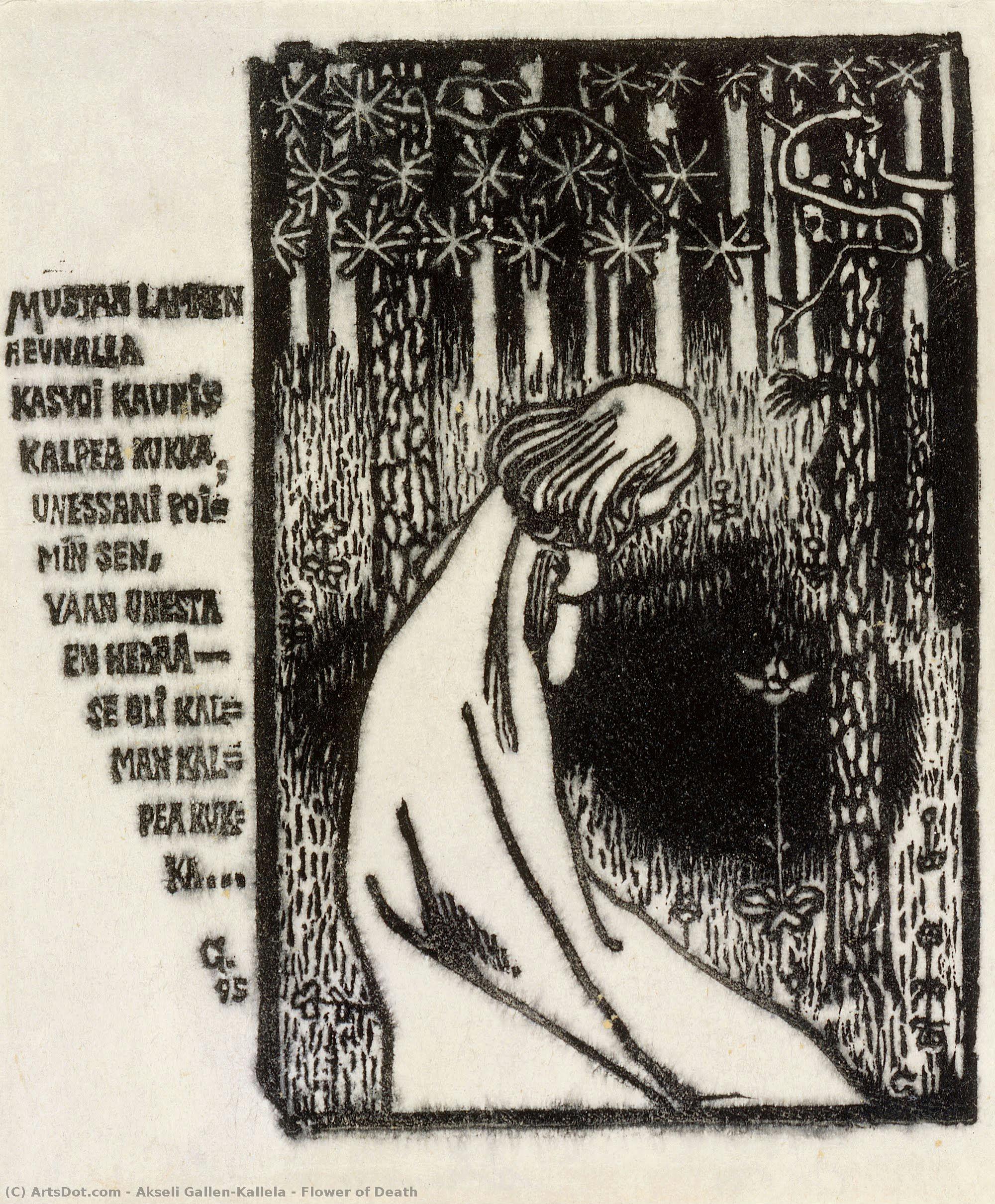
Akseli Gallen-Kallela's “Flower of Death” (1895) isn’t merely a painting; it’s a visceral embodiment of loss, meticulously crafted from the somber depths of personal tragedy. Born Axel Waldemar Gallén in Pori, Finland, Gallen-Kallela was already a rising star in the Finnish art scene when his young daughter, Marjatta, succumbed to diphtheria in March 1895. This devastating event served as the catalyst for what would become one of his most profoundly moving and enduring works – a poignant memorial rendered not in vibrant color, but in the restrained beauty of woodcut on pine. The genesis of this piece lies within a brief sojourn to Berlin, where Gallen-Kallela sought to refine his printmaking skills amidst the burgeoning popularity of Japanese woodblock prints and the evocative aesthetics of Art Nouveau. The trip was tragically cut short by Marjatta’s death, forcing him to confront grief directly through artistic expression.
Symbolism Woven into the Grain – A Language of Loss
The painting’s power resides not in overt drama, but in a carefully constructed tapestry of symbolism. The central figure, a woman seated before a skeletal tree, is shrouded in a veil, her face turned away from the viewer—a deliberate act of shielding herself from unbearable sorrow. This veiled presence speaks to the private nature of grief and the difficulty of confronting profound loss. The tree itself, rendered with coarse, uneven lines, represents mortality and decay, mirroring the fragility of life and the permanence of death. Crucially, the “flower” – a pale, almost spectral bloom – is not a symbol of beauty or joy, but rather a poignant reminder of Marjatta’s fleeting existence. The birds perched nearby—one near the top left corner, another to the right—add layers of interpretation; they could represent mourning doves, symbols of sorrow and remembrance, or perhaps even the departed soul taking flight.
Technique and Material – A Dialogue with Wood
Gallen-Kallela’s choice of medium is integral to the work's emotional impact. The woodcut technique—a subtractive process involving carving away areas of the wood to reveal the lighter grain beneath—creates a remarkable sense of texture and depth. The coarse, uneven lines contribute to the painting’s somber mood, while the subtle gradations of tone evoke a feeling of quiet melancholy. The use of pine wood, known for its soft, workable grain, allowed Gallen-Kallela to achieve both delicacy and strength in his execution. He skillfully manipulated the wood's natural imperfections, transforming them into expressive elements within the composition. The limited palette—primarily shades of gray and brown—further enhances the painting’s mood of quiet contemplation.
A National Icon – Gallen-Kallela and Finnish Identity
“Flower of Death” is more than just a personal memorial; it's a pivotal work in the development of Finnish national identity. Gallen-Kallela, deeply committed to celebrating his homeland’s folklore and mythology, used his art to explore themes of loss, remembrance, and the connection between humanity and nature—elements central to Finnish culture. His illustrations for the Kalevala, the epic poem that forms the foundation of Finnish literature, solidified his reputation as a national artist. “Flower of Death” can be seen as a precursor to this broader body of work, demonstrating his ability to imbue traditional subjects with profound emotional resonance. It’s a testament to Gallen-Kallela's role in shaping Finland’s artistic and cultural landscape, transforming personal grief into a powerful symbol of national mourning and remembrance.
Ähnliche Kunstwerke

Über den Künstler
Frühes Leben und Karriere
Akseli Gallen-Kallela, ein renommierter finnischer Maler, wurde am 26. April 1865 in Pori, Finnland, geboren. Seine frühen Jahre waren geprägt von einer schwedischsprachigen Familie, und sein Name war zunächst Axel Waldemar Gallén. Er finnisierte seinen Namen später 1907 in Akseli Gallen-Kallela.Künstlerische Beiträge
Gallen-Kallelas Werk ist am besten bekannt für seine Illustrationen des Kalevala, dem finnischen Nationalepos. Seine Beiträge zur finnischen Kunst gelten als ein entscheidender Aspekt der nationalen Identität des Landes. Zu seinen bemerkenswertesten Werken gehören:- Die Verteidigung der Sampo (1897), ein Gemälde, das seine Fähigkeit zeigt, die Essenz des Kalevala einzufangen.
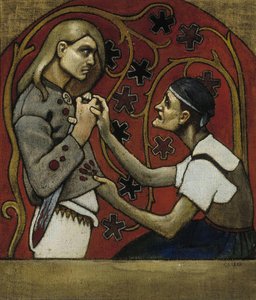
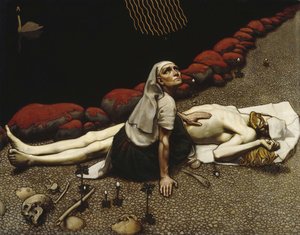
- Lemminkäinens Mutter (1893), eine ergreifende Darstellung einer Figur aus dem Kalevala, die Gallen-Kallelas Fähigkeit hervorhebt, Emotionen durch seine Kunst hervorzurufen.
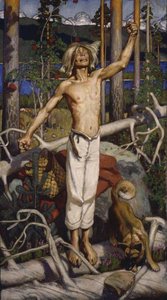
- Kullervos Fluch (1893), ein weiteres Kalevala-inspiriertes Werk, das Gallen-Kallelas Meisterschaft in der Vermittlung der Komplexität des Epos demonstriert.
Entwicklung und Einflüsse
Gallen-Kallela entwickelte seinen Stil im Laufe seiner Karriere weiter. Anfänglich beeinflusst vom Realismus und Impressionismus, wandte er sich zunehmend dem Nationalromantik zu, inspiriert von der finnischen Folklore und Natur. Er war ein Pionier in der Verwendung von Symbolik und vereinfachten Formen, die an das Jugendstil erinnern. Seine Reisen nach Frankreich und Deutschland trugen ebenfalls zur Entwicklung seines künstlerischen Ausdrucks bei. Wichtige Einflüsse waren unter anderem die Werke von Arnold Böcklin und Aubrey Beardsley. Er war auch ein Verfechter des finnischen Nationalismus und nutzte seine Kunst, um das Bewusstsein für die finnische Kultur zu schärfen.Museale Bedeutung und Vermächtnis
Gallen-Kallelas Werk ist in verschiedenen Museen zu finden, darunter:- Das Kunstmuseum Ateneum (Helsinki, Finnland), das mehrere seiner Gemälde wie Großer Schwarzspecht und Der Brudermord zeigt.
- Die Finnische Nationalgalerie, wo seine Werke Teil der Sammlung sind und seinen Einfluss auf die finnische Kunst demonstrieren.
Zusätzliche Informationen
- Erfahren Sie mehr über Gallen-Kallelas Werke auf Akseli Gallen-Kallela | ArtsDot.
- Entdecken Sie die finnische Nationalgalerie mit Gallen-Kallelas Werken unter Suomen Kansallisgalleria | ArtsDot.
- Lesen Sie mehr über das Kalevala und seinen Einfluss auf die finnische Kultur auf Wikipedia.
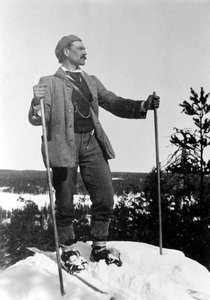
Akseli Gallen-Kallela
1865 - 1931 , Finnland
Kurzinfos
- Bemerkenswerte Werke:
- Die Verteidigung des Sampo
- Lemminkäisens Mutter
- Kullervos Fluch
- Geburtsdatum: 26. April 1865
- Geburtsort: Pori, Finnland
- Kunstbewegung: Nationalromantik
- Nationalität: Finnisch
- Sterbedatum: 1931
- Vollständiger Name: Akseli Gallen-Kallela
Ähnliche Artikel
Akseli Gallen-Kallela: Die Gestaltung finnischer Identität durch Nationalromantik und Symbolismus
Entdecken Sie Akseli Gallen-Kallelas wegweisende Kunst und ihren Einfluss auf die finnische Identität! Erfahren Sie mehr über Nationalromantik, Symbolismus & das Kalevala-Epos. Expertenwissen auf ArtsDot.
Blossoming Symbolism: A Historical Journey Through Flowers in Western Painting
Explore the rich history of flower symbolism in Western painting! Discover how artists from the Renaissance to Modernism used blossoms to convey meaning, emotion & beauty. Learn about iconic artworks and movements.
Blossoms of Time: A Historical Journey Through Flower Painting
Explore the captivating history of flower painting! Discover Dutch masters, symbolic meanings, & botanical art. Expert insights & high-quality reproductions at ArtsDot.
Albert Edelfelt: Ein Pionier des finnischen Realismus und die internationale impressionistische Bewegung
Entdecken Sie das faszinierende Werk von Albert Edelfelt, einem Pionier des finnischen Realismus und seiner Verbindung zum Impressionismus. Erfahren Sie mehr über sein Leben, seine Gemälde und seinen Einfluss auf die Kunstgeschichte – mit Expertenwissen von ArtsDot.
Blossoms of Time: A Historical & Aesthetic Exploration of Floral Painting Across Cultures
Explore the rich history of floral painting! Discover symbolism, techniques & masterpieces from Van Huysum to O'Keeffe. Expert insights for art lovers & collectors at ArtsDot.