

 Vorschau anzeigen
 Versenden
 Teilen
 Details anzeigen

 Herunterladen
 Ähnliche Objekte
 Röntgenaufnahme
 Diashow
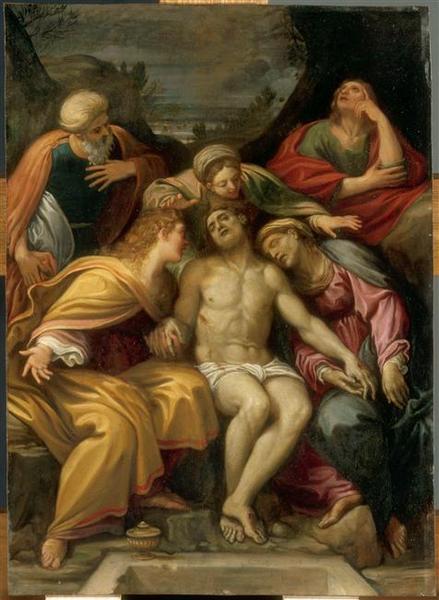
La déploration du Christ


 Weiterlesen
Erwerben Sie ein hochauflösendes, optimiertes digitales Bild, das der Online-Vorschau weit überlegen ist.
Jede Datei wird von unseren hauseigenen Spezialisten mit modernsten Werkzeugen und fachmännischer manueller Retusche sorgfältig vorbereitet. Wir stellen sicher, dass jedes Bild eine außergewöhnliche Klarheit, präzise Farbgenauigkeit und feinste Details aufweist.
Die endgültige Datei wird innerhalb von 72 Stunden per E-Mail zugestellt und ist für den sofortigen Einsatz in professionellen, redaktionellen und Druckumgebungen optimiert. Es handelt sich um dieselbe Qualität, der führende Designstudios, Verlage und Galerien vertrauen.
Digitales Bild
Laden Sie eine hochauflösende Datei für die persönliche Präsentation, den Druck und kreative Projekte herunter. ( Druck bestellen Handgemalte Reproduktion bestellen)
In jeder Bestellung digitaler Bilder enthalten
Professionelle digitale Bereitstellung, garantiert
Wenn Sie sich für ArtsDot.com entscheiden, erhalten Sie nicht nur ein Bild – Sie erhalten ein professionell aufbereitetes digitales Kunstwerk, das mit höchster Präzision erstellt und durch eine Zufriedenheitsgarantie abgesichert wird. Hier ist alles, was automatisch mit Ihrer Bestellung geliefert wird:

Schnelle E-Mail-Zustellung
Ihre hochauflösende digitale Bilddatei wird Ihnen innerhalb von 72 Stunden nach der Bestellung per E-Mail zugestellt – bereit zur sofortigen Verwendung.

KI-optimierte digitale Datei
Ihre Kunstwerke werden professionell mithilfe fortschrittlicher KI-Tools und manueller Bearbeitung optimiert, um maximale Detailtreue, Klarheit und Farbgenauigkeit zu gewährleisten.

Lebenslanger kostenloser Neudruckservice
Datei versehentlich gelöscht oder verloren? Keine Sorge – wir senden sie Ihnen jederzeit kostenlos erneut zu.

Keine Einfuhrgebühren – jemals
Genießen Sie Ihr Kunstwerk sofort ohne Zollgebühren, Einfuhrabgaben oder Versandkosten – digitale Downloads sind immer steuerfrei.

Garantierte Farbtreue
Wir garantieren, dass Ihr digitales Bild mithilfe professioneller Werkzeuge und Farbmanagement die Originalfarben so präzise wie möglich wiedergibt.

60-Tage-Zufriedenheitsgarantie
Sollten Sie mit Ihrem digitalen Bild nicht zufrieden sein, werden wir es überarbeiten oder Ihnen innerhalb von 60 Tagen 100% erstatten – ohne Wenn und Aber.

100% Geld-zurück-Garantie
Nicht zufrieden? Erhalten Sie innerhalb von 60 Tagen nach Erhalt Ihrer digitalen Datei eine vollständige Rückerstattung – ohne Angabe von Gründen.

Rabatte bei Großbestellungen
3 Bilder kaufen, 10% sparen – 5 Bilder kaufen, 15% sparen – Ab 10 Bildern 20% sparen. Ideal für kreative Projekte, Galerien und Agenturen.
Details zum Sammlerstück
Francesco Francia’s Lamentation: A Study in Sorrow and Divine Grace
The world of Renaissance art is replete with depictions of Christ's death and resurrection, yet few resonate with the profound sorrow and quiet dignity of Francesco Francia’s “The Lamentation over the Dead Christ,” painted around 1515-16. This intimate scene, housed within the National Gallery in London, transcends mere representation; it’s a carefully constructed meditation on loss, faith, and the enduring mystery of human suffering. Francia, a master of subtle detail and evocative emotion, doesn't offer a dramatic spectacle but rather invites the viewer into a deeply personal moment of grief surrounding the body of his divine subject.
The painting depicts Christ’s lifeless form laid outside a cave, awaiting burial. Around him cluster figures – Nicodemus or Saint Joseph of Arimathea, identified by his kneeling posture and clasped hands in prayer; Saint John the Evangelist, supporting the body with a gesture of profound sorrow; Mary, the Virgin Mother, her face etched with anguish; and Mary Magdalene, holding Christ’s feet. Francia masterfully captures the vulnerability of each figure, their bodies rendered with an almost sculptural precision, conveying both physical exhaustion and emotional weight. The figures are not idealized; they are recognizably human in their grief, their faces reflecting a raw, palpable sadness.
A Symphony of Color and Light: Technique and Style
Francia’s artistic approach is characterized by a remarkable restraint and an exquisite attention to detail. He employs a technique known as *sfumato*, subtly blurring the edges of forms and creating a hazy atmosphere that enhances the sense of melancholy. The color palette is dominated by muted earth tones – ochres, browns, and deep reds – reflecting the somber mood of the scene. These colors are applied in thin, translucent layers, building up depth and texture with remarkable finesse. Notice particularly how Francia uses light to sculpt the forms; it’s not a dramatic illumination but rather a gentle, diffused glow that emphasizes the contours of the figures and their expressions.
The composition itself is carefully balanced, utilizing a pyramidal structure – Christ at its base, the mourners forming the apex. This arrangement draws the eye to the central figure while simultaneously creating a sense of intimacy and connection between the figures. Francia’s mastery lies in his ability to convey complex emotions through subtle gestures and expressions, avoiding overt melodrama and instead relying on the viewer's own empathy to fill in the emotional gaps.
Symbolism and Spiritual Resonance
Beyond its immediate depiction of grief, “The Lamentation” is rich in symbolic meaning. The cave itself represents both earthly mortality and the promise of resurrection – a temporary resting place before Christ’s triumphant return. The wounds on Christ's forehead, visible through the translucent layers of paint, are a poignant reminder of his suffering and sacrifice. Each figure embodies a specific role within the Christian narrative: Nicodemus representing repentance, Saint John symbolizing faith and devotion, Mary embodying maternal sorrow, and Mary Magdalene representing forgiveness and redemption.
The painting’s emotional impact is profound. It's not simply a depiction of death but an exploration of grief, loss, and the enduring power of faith. Francia doesn’t offer easy answers or comforting platitudes; instead, he presents a raw and honest portrayal of human suffering in the face of divine mystery. The scene invites contemplation on themes of mortality, compassion, and the relationship between humanity and the divine.
A Timeless Masterpiece: Reproduction Possibilities
Francesco Francia’s “The Lamentation over the Dead Christ” remains a powerfully moving work of art centuries after its creation. ArtsDot offers high-quality reproductions that capture the essence of this masterpiece, allowing you to bring its beauty and emotional depth into your home or office. Whether you choose a standard size or commission a custom reproduction tailored to your specific needs, our skilled artisans ensure that every detail is faithfully reproduced, preserving the painting’s subtle nuances and evocative atmosphere. Consider this artwork for spaces where contemplation and reverence are valued – it's a timeless reminder of humanity's shared experience of sorrow and hope.
Ähnliche Kunstwerke
Biografie des Künstlers
Albani Francesco, auch bekannt als l'Albane, war ein herausragender italienischer Maler, geboren im Jahr 1578 und tätig bis zu seinem Tod im Jahre 1660. Er war eine Schlüsselfigur in der Entwicklung der barocken Malerei in Italien, besonders in Rom.
Frühes Leben und Ausbildung
Francesco Albani wurde in Bologna, Italien, in eine Künstlerfamilie hineingeboren. Sein Vater, Daniele Albani, war Maler, und sein Onkel, Giovanni Paolo Cavagna, ein renommierter Künstler. Francescos frühe Ausbildung fand im Atelier von Denzio Ferrari statt, wo er die Grundlagen der Malerei erlernte. Später zog er nach Rom, um unter der Anleitung von Guidobaldo Gandolfi zu studieren.Künstlerische Karriere
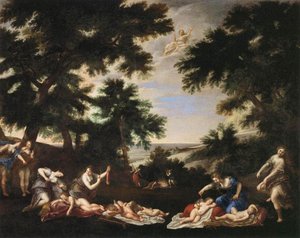
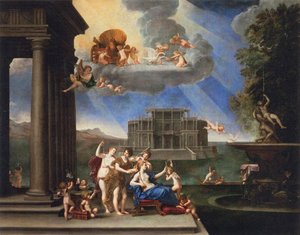
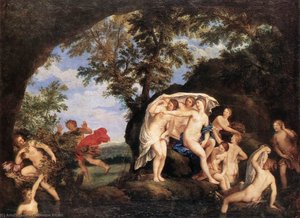
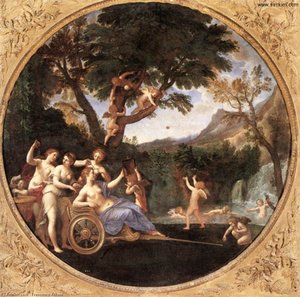
Albanis künstlerisches Schaffen zeichnete sich durch seinen einzigartigen Stil aus, der Elemente des Barock und der klassischen Kunst miteinander verschmolz. Er war bekannt für seine wunderschönen und zarten Darstellungen mythologischer und biblischer Szenen. Zu seinen berühmtesten Werken zählt Die Toilette der Venus, ein Gemälde, das sein Können darin unter Beweis stellt, die Schönheit der menschlichen Form einzufangen. Zu Albani's bemerkenswerten Werken gehören:- Die Taufe Christi, ein Gemälde, das seine Fähigkeit demonstriert, Emotion und Drama zu vermitteln.
- St. Sebastian, ein Werk, das seine Beherrschung von Licht und Schatten hervorhebt.
- Die Jungfrau und das Kind mit dem heiligen Johannes dem Täufer, ein Gemälde, das sein Können in der Erfassung der Nuancen menschlicher Ausdrucks vermittelt.
Einfluss und Vermächtnis
Albanis Einfluss auf die Entwicklung der barocken Malerei in Italien war signifikant. Er war einer der ersten Künstler, der die Verwendung von Chiaroscuro einführte, einer Technik, die den Kontrast zwischen Licht und Dunkel betont. Sein Werk wirkte auch auf die Entwicklung der Landschaftsmalerei, da er oft natürliche Szenen in seine Kompositionen einfließen ließ. Heute sind Albani's Gemälde in verschiedenen Museen zu finden, darunter das Musée du Louvre in Paris, wo seine Toilette der Venus ausgestellt ist. Sein Werk wurde auch auf ArtsDot.com präsentiert, wo Kunstliebhaber mehr über sein Leben und seine künstlerischen Errungenschaften erfahren können.Fazit
Francesco Albani war ein begabter Maler, der einen unvergesslichen Eindruck in die Welt der Kunst hinterließ. Sein einzigartiger Stil, der Elemente des Barock und der klassischen Kunst vereinte, inspiriert Künstler bis heute. Durch sein Werk können wir die Schönheit und das Drama der menschlichen Form sowie die Bedeutung von Licht und Schatten bei der Schaffung eines Gefühls von Tiefe und Emotion würdigen. Für weitere Informationen über Albani's Leben und Werk besuchen Sie ArtsDot.com oder sehen Sie sich seine Biografie auf Wikipedia an.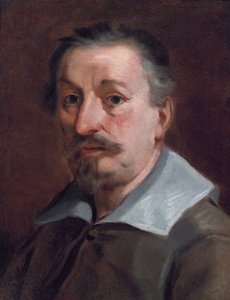
Francesco Albani (L'Albane)
1578 - 1660 , Italien

