 Vorschau anzeigen
 Versenden
 Teilen
 Details anzeigen

 Herunterladen
 Ähnliche Objekte
 Röntgenaufnahme
 Diashow
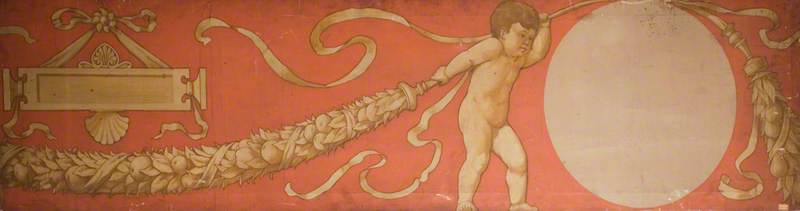
Putti Flanking a Medallion (design for a frieze in the Victoria and Albert Museum)
 1910
1910 56.0 x 230.0 cm
 Weiterlesen
Erwerben Sie ein hochauflösendes, optimiertes digitales Bild, das der Online-Vorschau weit überlegen ist.
Jede Datei wird von unseren hauseigenen Spezialisten mit modernsten Werkzeugen und fachmännischer manueller Retusche sorgfältig vorbereitet. Wir stellen sicher, dass jedes Bild eine außergewöhnliche Klarheit, präzise Farbgenauigkeit und feinste Details aufweist.
Die endgültige Datei wird innerhalb von 72 Stunden per E-Mail zugestellt und ist für den sofortigen Einsatz in professionellen, redaktionellen und Druckumgebungen optimiert. Es handelt sich um dieselbe Qualität, der führende Designstudios, Verlage und Galerien vertrauen.
Digitales Bild
Laden Sie eine hochauflösende Datei für die persönliche Präsentation, den Druck und kreative Projekte herunter. ( Druck bestellen Handgemalte Reproduktion bestellen)
In jeder Bestellung digitaler Bilder enthalten
Professionelle digitale Bereitstellung, garantiert
Wenn Sie sich für ArtsDot.com entscheiden, erhalten Sie nicht nur ein Bild – Sie erhalten ein professionell aufbereitetes digitales Kunstwerk, das mit höchster Präzision erstellt und durch eine Zufriedenheitsgarantie abgesichert wird. Hier ist alles, was automatisch mit Ihrer Bestellung geliefert wird:

Schnelle E-Mail-Zustellung
Ihre hochauflösende digitale Bilddatei wird Ihnen innerhalb von 72 Stunden nach der Bestellung per E-Mail zugestellt – bereit zur sofortigen Verwendung.

KI-optimierte digitale Datei
Ihre Kunstwerke werden professionell mithilfe fortschrittlicher KI-Tools und manueller Bearbeitung optimiert, um maximale Detailtreue, Klarheit und Farbgenauigkeit zu gewährleisten.

Lebenslanger kostenloser Neudruckservice
Datei versehentlich gelöscht oder verloren? Keine Sorge – wir senden sie Ihnen jederzeit kostenlos erneut zu.

Keine Einfuhrgebühren – jemals
Genießen Sie Ihr Kunstwerk sofort ohne Zollgebühren, Einfuhrabgaben oder Versandkosten – digitale Downloads sind immer steuerfrei.

Garantierte Farbtreue
Wir garantieren, dass Ihr digitales Bild mithilfe professioneller Werkzeuge und Farbmanagement die Originalfarben so präzise wie möglich wiedergibt.

60-Tage-Zufriedenheitsgarantie
Sollten Sie mit Ihrem digitalen Bild nicht zufrieden sein, werden wir es überarbeiten oder Ihnen innerhalb von 60 Tagen 100% erstatten – ohne Wenn und Aber.

100% Geld-zurück-Garantie
Nicht zufrieden? Erhalten Sie innerhalb von 60 Tagen nach Erhalt Ihrer digitalen Datei eine vollständige Rückerstattung – ohne Angabe von Gründen.

Rabatte bei Großbestellungen
3 Bilder kaufen, 10% sparen – 5 Bilder kaufen, 15% sparen – Ab 10 Bildern 20% sparen. Ideal für kreative Projekte, Galerien und Agenturen.
Ähnliche Kunstwerke







Biografie des Künstlers
A Life Dedicated to Beauty: The Art of Alexander Fisher
Alexander Fisher (born in 1867, died 1934) was a pivotal figure in the British Arts and Crafts movement, though his name remains surprisingly less known than contemporaries like William Morris or Charles Ashbee. This is perhaps due to the breadth of his talents – he excelled not only as a painter, particularly renowned for his exquisite depictions of roses, but also as an accomplished enamelist and highly respected silversmith. Fisher’s life was one devoted to the pursuit of beauty in all its forms, seamlessly blending classical influences with the aesthetic principles of the Arts and Crafts ethos. He wasn't merely replicating styles; he was synthesizing them into a uniquely personal vision that celebrated craftsmanship, naturalism, and refined elegance. His early training laid the foundation for this multifaceted career, beginning at the Birmingham School of Art under Henry Payne, where he developed a strong grounding in drawing and design. This formal education was followed by studies at the South Kensington Schools (later the Royal College of Art), exposing him to a wider range of artistic traditions and techniques. However, it was his subsequent apprenticeship with A.J. Collings, a leading silversmith, that truly shaped his path, instilling in him a deep appreciation for the meticulous processes involved in creating objects of lasting quality.From Silverware to Canvas: The Evolution of an Artistic Style
Fisher initially established himself as a skilled silversmith, producing pieces characterized by their graceful forms and delicate detailing. His work during this period often drew inspiration from 18th-century designs, reflecting a broader revival of interest in historical styles within the Arts and Crafts movement. However, he soon began to explore other artistic avenues, most notably painting. This transition wasn’t abrupt; rather, it was a natural extension of his existing sensibilities. The same attention to detail and refined aesthetic that informed his silverware found expression in his canvases. He became particularly celebrated for his paintings of roses – not the idealized, romanticized roses of earlier traditions, but meticulously observed studies capturing their subtle nuances of color, form, and texture. These weren’t simply botanical illustrations; they were imbued with a sense of quiet contemplation and poetic beauty. Simultaneously, Fisher embarked on a remarkable career in enamel work, becoming one of the leading exponents of *Limoges enameling* techniques in Britain. His enamel panels, often depicting floral motifs or classical scenes, showcased his mastery of color and his ability to create luminous, jewel-like surfaces. He frequently combined these different mediums – incorporating enamel into his silverwork or using painted designs as studies for larger enamel compositions.Influences and Artistic Philosophy
Fisher’s artistic development was shaped by a confluence of influences. The Pre-Raphaelites, with their emphasis on naturalism and detailed observation, undoubtedly played a role in his early work. He admired the clarity of form and vibrant color found in Italian Renaissance painting, particularly the works of Botticelli and Fra Angelico. However, he wasn’t simply imitating these masters; he was adapting their principles to suit his own aesthetic vision. The Arts and Crafts movement itself provided a crucial framework for his artistic philosophy. Fisher believed strongly in the importance of craftsmanship, rejecting mass-produced objects in favor of handmade items that celebrated skill and individuality. He also embraced the movement's emphasis on *naturalism*, seeking inspiration from the natural world and striving to depict it with accuracy and sensitivity. His work often reflects a sense of harmony between art and nature, suggesting a deep respect for the beauty and order inherent in the natural world. He saw his role as an artist not merely as creating beautiful objects, but as elevating everyday life through the quality and artistry of his creations.Major Achievements and Legacy
Throughout his career, Fisher exhibited widely, gaining recognition for his exceptional skill and refined aesthetic. He contributed to numerous Arts and Crafts exhibitions, showcasing his silverware, paintings, and enamel work. His pieces were highly sought after by collectors and connoisseurs, and he received commissions from prominent patrons of the arts. While he didn’t found a large workshop like some of his contemporaries, Fisher exerted a significant influence on other artists through his teaching and mentorship. He lectured at various art schools and encouraged students to embrace craftsmanship and naturalism in their own work. His enamel panels were particularly influential, inspiring a new generation of enamelists to explore the possibilities of this ancient medium. His paintings of roses remain highly prized for their delicate beauty and meticulous detail. Today, Fisher’s work is held in numerous public and private collections, including the Victoria and Albert Museum and the British Museum. His legacy lies not only in the exquisite objects he created but also in his unwavering commitment to craftsmanship, naturalism, and refined elegance – principles that continue to resonate with artists and designers today.Historical Significance
Alexander Fisher occupies a unique position within the history of the Arts and Crafts movement. He wasn’t solely focused on one particular craft; he excelled in multiple disciplines, demonstrating a remarkable versatility and artistic range. This breadth of talent allowed him to explore the interconnectedness between different art forms and to create works that seamlessly blended painting, enamel work, and silversmithing. His emphasis on classical influences set him apart from some of his more overtly medievalist contemporaries, suggesting a broader understanding of historical styles and their potential for contemporary expression.- He helped to elevate the status of enamel work within British art.
- His paintings of roses represent a significant contribution to botanical art.
- His silverwork embodies the aesthetic principles of the Arts and Crafts movement.