 Vorschau anzeigen
 Versenden
 Teilen
 Details anzeigen

 Herunterladen
 Ähnliche Objekte
 Röntgenaufnahme
 Diashow
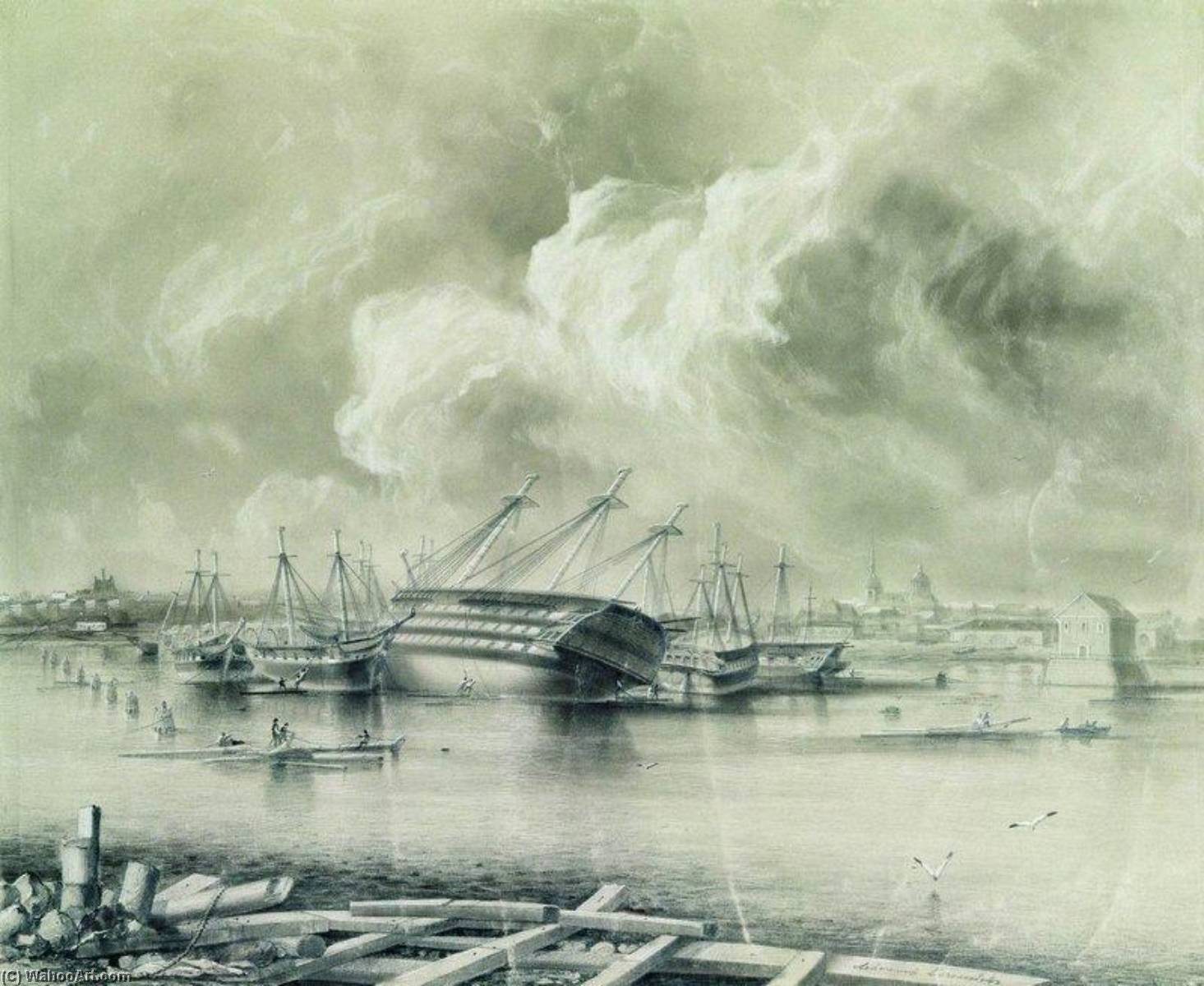
Kronstadt after the Flooding


 Weiterlesen
Giclée / Kunstdruck
Giclée- oder Leinwanddruck in Museumsqualität mit schneller Produktion und flexiblen Veredelungsoptionen. ( Handgemalte Reproduktion bestellen Bild kaufen)




P118B $10

P118H $10

P118W $10

P438Z $10

P508JH $12

P508YH $12

P805H $10

P805Z $10

P919BZ $10

P919G $10

P919XJ $10

P959ZH $10

P968JZ $12

W106C $8

W218G $10

W218JH $8

W218Y $10

W307PJ $10

W316G $10

W316PJ $8

W316Y $10

W398PJ $8

W4111J $10

W500HY $15

W500JH $15

W692G $12

W849H $8

W940BG $15

W953PJ $8




Wählen Sie aus unseren vordefinierten Formaten, die den ursprünglichen Proportionen des Kunstwerks entsprechen.

Sie können Ihre eigenen Maße eingeben, um ein bestimmtes Format oder einen speziellen Platz einzupassen. Wenn das von Ihnen gewählte Format nicht den Proportionen des Originalbildes entspricht, werden wir das Kunstwerk entweder beschneiden oder das Bild mit einem gespiegelten oder einfarbigen Rand erweitern. Ein digitaler Entwurf wird Ihnen zur Genehmigung zugesandt, bevor die Produktion beginnt.
Bitte beachten Sie, dass die Vorschau auf dem Bildschirm nicht den tatsächlichen Zuschnitt oder die Erweiterung widerspiegelt. Nur der Entwurf zeigt die endgültige Komposition präzise an.
Obwohl Sondermaße verfügbar sind, empfehlen wir die Auswahl eines Maßes aus der vordefinierten Liste, um die ursprünglichen Proportionen zu bewahren.
Weltweiter Versand () innerhalb von 2 Wochen statt der üblichen 4/5 Wochen. (29 August)

Kostenloser weltweiter Expressversand

Hochwertige Leinenleinwand

Umfassender Versicherungsschutz beim Versand

Zollgebühren-Rückerstattungsgarantie

Garantie für exakte Farbtreue

60 Tage Rückgaberecht (nur bei Mängeln)

100% Geld-zurück-Garantie

Mengenrabatt verfügbar
 Die Glasoption ist nur für Größen unter 110 cm verfügbar.

Kronstadt after the Flooding
Giclée / Kunstdruck
Format der Reproduktion
-


Gesamtpreis
$ 62
A Storm-Tossed Harbor: Bogoliubov’s “Kronstadt After the Flooding”
Alexei Petrovich Bogolyubov's "Kronstadt After the Flooding" isn’t merely a seascape; it’s a visceral embodiment of a pivotal moment in Russian history – the tumultuous Kronstadt Rebellion of 1921. Painted during a period of intense social and political upheaval, this dramatic canvas captures not just a physical event but also the simmering discontent and ultimately tragic fate of a revolutionary outpost. The painting, rendered with a masterful blend of Romantic idealism and meticulous realism, speaks volumes about the complexities of the early Soviet era and the artist’s profound connection to the sea.
Bogolyubov, born in 1824 into a family steeped in both military tradition and intellectual ferment – his father a retired colonel, his maternal grandfather the celebrated philosopher Alexander Radishchev – possessed an artistic sensibility deeply influenced by his naval service. This experience, coupled with his travels across Europe, particularly to Düsseldorf where he studied under Andreas Achenbach, shaped his distinctive style: a potent combination of atmospheric perspective, dynamic brushwork, and a keen eye for capturing the raw power of nature. “Kronstadt After the Flooding” exemplifies this perfectly, showcasing a dramatic interplay between light, shadow, and turbulent water.
The Scene Unfolds: Composition and Technique
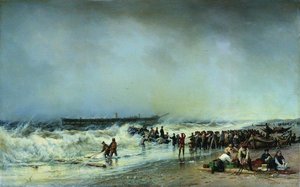
The composition immediately draws the viewer into the heart of the storm. A chaotic jumble of thirteen boats – ranging from small fishing skiffs to larger merchant vessels – are tossed about on a churning sea under a bruised, ominous sky. The palette is dominated by cool blues, greys, and greens, punctuated by flashes of white foam and the dark silhouettes of distant buildings. Bogolyubov’s technique is characterized by loose, expressive brushstrokes that convey both the violence of the storm and the vulnerability of the ships caught in its grip. He skillfully utilizes a layering effect, building up color gradually to create a sense of depth and movement. The artist's attention to detail—the individual waves, the splintered wood on the boats, the desperate figures clinging to the rigging—adds an incredible level of realism to the scene.
Notably, the painting’s perspective is deliberately skewed, creating a feeling of instability and disorientation mirroring the chaos of the event it depicts. The horizon line is low, emphasizing the vastness of the sea and the insignificance of human endeavors against the forces of nature. This compositional choice reinforces the painting's thematic core: the struggle between humanity and the overwhelming power of the elements.
Symbolism and Historical Context
“Kronstadt After the Flooding” is inextricably linked to the Kronstadt Rebellion, a brief but significant uprising by sailors and workers at the naval fortress on Kotlin Island. These revolutionaries, who had initially supported the Bolsheviks during the Russian Civil War, grew disillusioned with the increasingly authoritarian nature of the Soviet regime and demanded greater political freedom. The rebellion was brutally suppressed in March 1921, resulting in a wave of executions and arrests.
The painting itself serves as a poignant visual record of this event. The flooded harbor, ravaged by the storm, symbolizes the destruction wrought by the Bolsheviks’ crackdown on dissent. The scattered figures on the boats represent the shattered hopes and dreams of the rebels. It's important to note that Bogolyubov was commissioned to paint several works depicting events related to the Kronstadt uprising, reflecting the government's desire to both document and control the narrative surrounding this controversial episode.
Emotional Resonance and Legacy
Beyond its historical significance, “Kronstadt After the Flooding” possesses a profound emotional resonance. The painting evokes feelings of anxiety, vulnerability, and ultimately, tragedy. The turbulent sea and stormy sky create a sense of foreboding, while the desperate figures on the boats convey a poignant sense of loss. It’s a powerful reminder of the human cost of political upheaval and the enduring struggle for freedom.
Today, this artwork stands as a testament to Bogolyubov's artistic skill and his ability to capture the drama and complexity of Russian history. Reproductions offer a window into a turbulent era, inviting viewers to contemplate the legacy of the Kronstadt Rebellion and the enduring power of art to bear witness to both triumph and tragedy.
Ähnliche Kunstwerke
Über den Künstler
Frühes Leben und Ausbildung
Alexei Petrowitsch Bogoliubow wurde am 16. März 1824 in dem pomeranischen Dorf Nowgorod Gouvernia geboren. Sein Vater, Pjotr Gawrilowitsch Bogoliubow, war ein im Ruhestand befindlicher Oberstleutnant, und sein mütterlicher Großvater, Alexander Radischtschow, war ein bekannter Philosoph und Sozialkritiker. Im Jahr 1841 absolvierte Alexei die Militärschule und diente in der russischen Marine, wobei er viele Länder bereiste. Ab 1849 besuchte er Kurse an der Akademie für Künste St. Petersburg, wo er unter Maxim Worobjew studierte.Karriere und Einflüsse
Bogoliubow wurde stark von Iwan Aiwazowski, einem russischen Marine-Maler, beeinflusst. Im Jahr 1853 schloss er die Akademie mit einer großen Goldmedaille ab. Er trat vom Militärdienst zurück und wurde zum Künstler am Stab des Marineministeriums ernannt. Von 1854 bis 1860 reiste er durch Europa und arbeitete sehr produktiv. In Rom traf er Alexander Iwanow, der ihn davon überzeugte, sich stärker auf das Zeichnen zu konzentrieren. In Düsseldorf besuchte er Kurse bei Andreas Achenbach. In Paris bewunderte er die Künstler der Barbizon-Schule, darunter Camille Corot und Charles-François Daubigny.Wichtige Werke und Ausstellungen
Bogoliubows Gemälde zeichnen sich durch ihren Realismus und Romantik aus. Er ist bekannt für seine zahlreichen Landschaftsbilder und Meeresansichten, insbesondere seine Marinekampfszenen. Einige seiner bemerkenswerten Werke finden Sie auf ArtsDot.com. Er stellte seine Arbeiten in der Akademie für Künste aus und erhielt den Titel Professor. Im Jahr 1871 wurde er in die Akademie für Künste gewählt.Vermächtnis und spätere Jahre
Bogoliubow näherte sich der Wanderer-Kunstbewegung, nahm an allen ihren Ausstellungen teil. Er wurde Mitglied ihres Vorstands, hatte aber Bedenken hinsichtlich ihrer sozialen Ideen. Im Jahr 1873 trat er in Solidarität mit seinen Mitstreitern aus der Akademie zurück. Nach 1873 lebte Bogoliubow hauptsächlich in Paris aufgrund seiner Herzkrankheit. Sein Haus war wie eine russische Kolonie, mit häufigen Besuchern darunter Iwan Turgenew, Ilja Repin und Wassili Polenow. Für weitere Informationen über Bogoliubows Leben und Werk besuchen Sie seine Seite auf ArtsDot.com oder seine Wikipedia-Seite.- Alexei Petrowitsch Bogoliubow war ein russischer Landschafts- und Meeresmaler.
- Er wurde am 16. März 1824 in dem pomeranischen Dorf Nowgorod Gouvernia geboren.
- Sein Vater war Pjotr Gawrilowitsch Bogoliubow, ein im Ruhestand befindlicher Oberstleutnant.
- Sein mütterlicher Großvater war Alexander Radischtschow, ein bekannter Philosoph und Sozialkritiker.
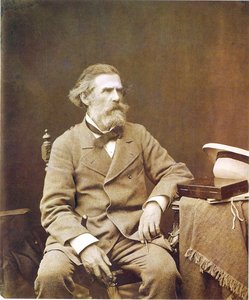
Alexei Petrowitsch Bogoljubow
1824 - 1896 , Russland
Kurzinfos
- Beeinflusste Künstler:
- Iwan Aiwazowski
- Camille Corot
- Charles-François Daubigny
- Bemerkenswerte Werke:
- Meeresansichten
- Schlachtgemälde
- Einfluss Auf Künstler: ['Wanderer Bewegung']
- Geburtsdatum: 16. März 1824
- Geburtsort: Pomeranie, Russland
- Künstlerische Richtung: Realismus, Romantik
- Nationalität: Russisch
- Todatum: 1896
- Vollständiger Name: Alexei Petrowitsch Bogoliubow
Ähnliche Artikel
The Allure of the Horizon: A Comprehensive Exploration of Seascape Art Through History & Emotion
Explore the captivating world of seascape art! Discover its history, key artists & movements – from Dutch Masters to Impressionism. Expert insights for collectors and enthusiasts at ArtsDot.
Ivan Bilibin: A Synthesis of Folklore, Modernism & National Identity in Russian Illustration
Explore the enchanting world of Ivan Bilibin, a master Russian illustrator who synthesized folklore, Art Nouveau & national identity. Discover his iconic fairy tale illustrations and legacy with ArtsDot.
Victor Vasnetsov: Myth, Nationalism & the Revival of Russian Fairy Tale Painting
Explore the captivating world of Victor Vasnetsov, a co-founder of Russian folklorist painting. Discover his iconic works, influence on national identity, and lasting legacy in this expert guide.
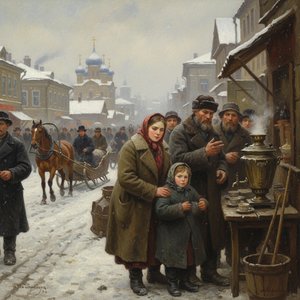
Vladimir Makovsky: Realism, Social Commentary & Russian Life in Late 19th-Century Painting
Explore the captivating world of Vladimir Makovsky, a leading Russian realist painter. Discover his insightful depictions of 19th-century life, social commentary & legacy with ArtsDot.
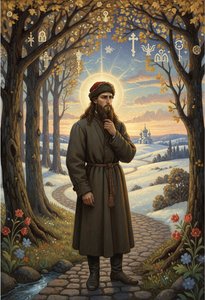
Mikhail Nesterow: Spirituelle Suche und symbolische Landschaften des russischen Symbolismus
Entdecken Sie Mikhail Nesterows faszinierende Werke des russischen Symbolismus! Analysen religiöser Motive, philosophische Einflüsse & sein Vermächtnis. Expertenwissen auf ArtsDot.