

 Vorschau anzeigen
 Versenden
 Teilen
 Details anzeigen

 Herunterladen
 Ähnliche Objekte
 Röntgenaufnahme
 Diashow
 Stats
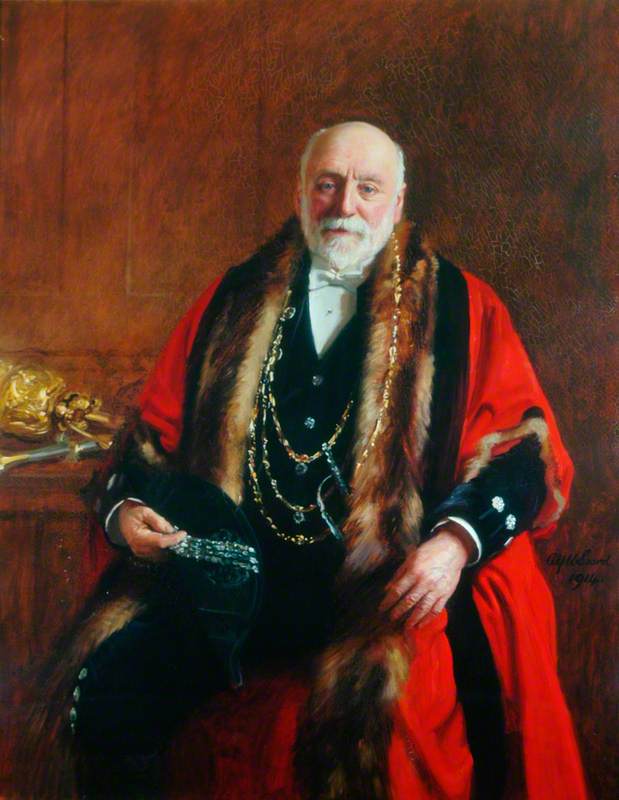
StatsAlderman Sir Joseph Sykes Rymer, Lord Mayor
 1914
1914 140.0 x 110.0 cm
 York Guildhall
 Weiterlesen
Erwerben Sie ein hochauflösendes, optimiertes digitales Bild, das der Online-Vorschau weit überlegen ist.
Jede Datei wird von unseren hauseigenen Spezialisten mit modernsten Werkzeugen und fachmännischer manueller Retusche sorgfältig vorbereitet. Wir stellen sicher, dass jedes Bild eine außergewöhnliche Klarheit, präzise Farbgenauigkeit und feinste Details aufweist.
Die endgültige Datei wird innerhalb von 72 Stunden per E-Mail zugestellt und ist für den sofortigen Einsatz in professionellen, redaktionellen und Druckumgebungen optimiert. Es handelt sich um dieselbe Qualität, der führende Designstudios, Verlage und Galerien vertrauen.
Digitales Bild
Laden Sie eine hochauflösende Datei für die persönliche Präsentation, den Druck und kreative Projekte herunter. ( Switch to Print Handgemalte Reproduktion bestellen)
In jeder Bestellung digitaler Bilder enthalten
Professionelle digitale Bereitstellung, garantiert
Wenn Sie sich für ArtsDot.com entscheiden, erhalten Sie nicht nur ein Bild – Sie erhalten ein professionell aufbereitetes digitales Kunstwerk, das mit höchster Präzision erstellt und durch eine Zufriedenheitsgarantie abgesichert wird. Hier ist alles, was automatisch mit Ihrer Bestellung geliefert wird:

Schnelle E-Mail-Zustellung
Ihre hochauflösende digitale Bilddatei wird Ihnen innerhalb von 72 Stunden nach der Bestellung per E-Mail zugestellt – bereit zur sofortigen Verwendung.

KI-optimierte digitale Datei
Ihre Kunstwerke werden professionell mithilfe fortschrittlicher KI-Tools und manueller Bearbeitung optimiert, um maximale Detailtreue, Klarheit und Farbgenauigkeit zu gewährleisten.

Lebenslanger kostenloser Neudruckservice
Datei versehentlich gelöscht oder verloren? Keine Sorge – wir senden sie Ihnen jederzeit kostenlos erneut zu.

Keine Einfuhrgebühren – jemals
Genießen Sie Ihr Kunstwerk sofort ohne Zollgebühren, Einfuhrabgaben oder Versandkosten – digitale Downloads sind immer steuerfrei.

Garantierte Farbtreue
Wir garantieren, dass Ihr digitales Bild mithilfe professioneller Werkzeuge und Farbmanagement die Originalfarben so präzise wie möglich wiedergibt.

100-Tage-Zufriedenheitsgarantie
Wenn Sie mit Ihrem digitalen Bild nicht zufrieden sind, werden wir es überarbeiten oder 100% innerhalb von 100 Tagen erstatten – ohne Wenn und Aber.

100% Geld-zurück-Garantie
Nicht zufrieden? Erhalten Sie innerhalb von 100 Tagen nach Erhalt Ihrer digitalen Datei eine vollständige Rückerstattung – ohne Wenn und Aber.

Rabatte bei Großbestellungen
3 Bilder kaufen, 10% sparen – 5 Bilder kaufen, 15% sparen – Ab 10 Bildern 20% sparen. Ideal für kreative Projekte, Galerien und Agenturen.
Ähnliche Kunstwerke










Biografie des Künstlers
Alford Usher Soord: A Master of Atmospheric Portraiture and the Echoes of ‘The Lost Sheep’
Alford Usher Soord (1868-1915) remains a quietly compelling figure in British art, largely due to his enduring masterpiece, “The Lost Sheep.” Born in Sunderland but raised primarily in York, Soord's artistic journey was shaped by a blend of formal training and a deeply personal vision. His life, though tragically cut short at the age of 47, produced a body of work characterized by atmospheric landscapes, evocative portraits, and a remarkable sensitivity to light and mood – elements that coalesce powerfully within his most famous painting.
Soord’s early artistic development was rooted in traditional training. He began studying part-time at the York School of Art, absorbing techniques from John Windass, before transitioning to the Herkomer School of Painting at Bushey, Hertfordshire – a prestigious institution founded by Sir Hubert von Herkomer. This school fostered a rigorous approach to painting, emphasizing observation and direct representation. However, Soord’s artistic spirit wasn't confined to mere imitation; he quickly developed his own distinctive style, marked by a subtle yet profound use of color and an ability to capture fleeting moments of emotion.
His career unfolded across several decades, punctuated by consistent contributions to the Royal Academy exhibitions. From 1893 through to 1910, Soord’s paintings graced the walls of this esteemed institution, showcasing a range of subjects – from dramatic landscapes like “Falls on the Conway” and “Wastwater, Cumberland,” to intimate portraits such as “Portrait of a Lady” and “Portrait of Edward Wilson.” Beyond the Royal Academy, he also exhibited at the Royal Birmingham Society of Artists, the Fine Art Society, Glasgow Institute of the Fine Arts, Walker Gallery in Liverpool, and even the Paris Salon. This diverse exposure demonstrated his versatility and established him within the broader British art scene.
The Enduring Power of ‘The Lost Sheep’
While Soord produced a considerable body of work across various genres, it is undoubtedly “The Lost Sheep” (1913) that secures his place in art history. This iconic painting, depicting a shepherd precariously balanced over a steep cliff face attempting to rescue a stranded lamb, transcends mere narrative illustration. It’s a potent allegory for human vulnerability and the lengths to which we will go to protect those in need. The composition is masterfully constructed – the dramatic lighting, the swirling mist, and the precarious positioning of figures all contribute to an overwhelming sense of tension and impending danger.
The painting's immediate popularity was phenomenal; over 300,000 reproductions were sold within a few years of its initial exhibition at the Royal Academy. This unprecedented success speaks volumes about the painting’s ability to resonate with viewers on an emotional level. It’s a testament to Soord’s skill in conveying complex themes through simple yet powerful imagery. The story behind the painting, as recounted by John A Dalles, adds another layer of intrigue: Wilson, the subject of the portrait, was a polar explorer and physician who sought respite from his demanding career, providing Soord with an unusual opportunity to capture him in a moment of quiet contemplation.
Beyond Portraits: Landscapes and a Subtle Palette
While “The Lost Sheep” dominates much of the conversation surrounding Soord’s work, it's important to acknowledge his contributions to landscape painting. His depictions of the Northumbrian coastline – particularly Wastwater in Cumberland – reveal a keen eye for detail and an ability to capture the raw beauty of the natural world. His landscapes are characterized by muted colors and atmospheric effects, creating a sense of depth and tranquility.
Soord’s palette was notably restrained, favoring subtle gradations of color rather than bold contrasts. He expertly employed light and shadow to create mood and atmosphere, imbuing his paintings with a quiet intensity. This understated approach is particularly evident in his portraits, where he captured the essence of his subjects through carefully observed details and nuanced expressions.
Legacy and Recognition
Alford Usher Soord’s legacy extends beyond “The Lost Sheep.” His work continues to be exhibited at museums across the United Kingdom, including the Bushey Museum and Art Gallery, where a collection of his paintings resides. The British Museum also holds several examples of his oeuvre. His influence can be seen in the works of later artists who embraced atmospheric realism and psychological depth. Soord’s ability to evoke emotion through carefully crafted imagery ensures that he remains a significant figure in the history of British art, a master of capturing the fleeting beauty of life's most poignant moments.
Further research can be found at Art UK and My Open Museum.
Kurzinfos
- Artistic Movement Or Style: Portraiture, Landscapes
- Artists Or Movements Influenced By This Artist: ['Royal Academy']
- Artists Who Influenced This Artist: ['Herkomer']
- Date Of Birth: September 1, 1868
- Date Of Death: August 9, 1915
- Full Name: Alford Usher Soord
- Nationality: British
- Notable Artworks:
- Mrs. Wilson
- The Lost Sheep
- Place Of Birth: Sunderland, England