

 Vorschau anzeigen
 Versenden
 Teilen
 Details anzeigen

 Herunterladen
 Ähnliche Objekte
 Röntgenaufnahme
 Diashow
 Stats
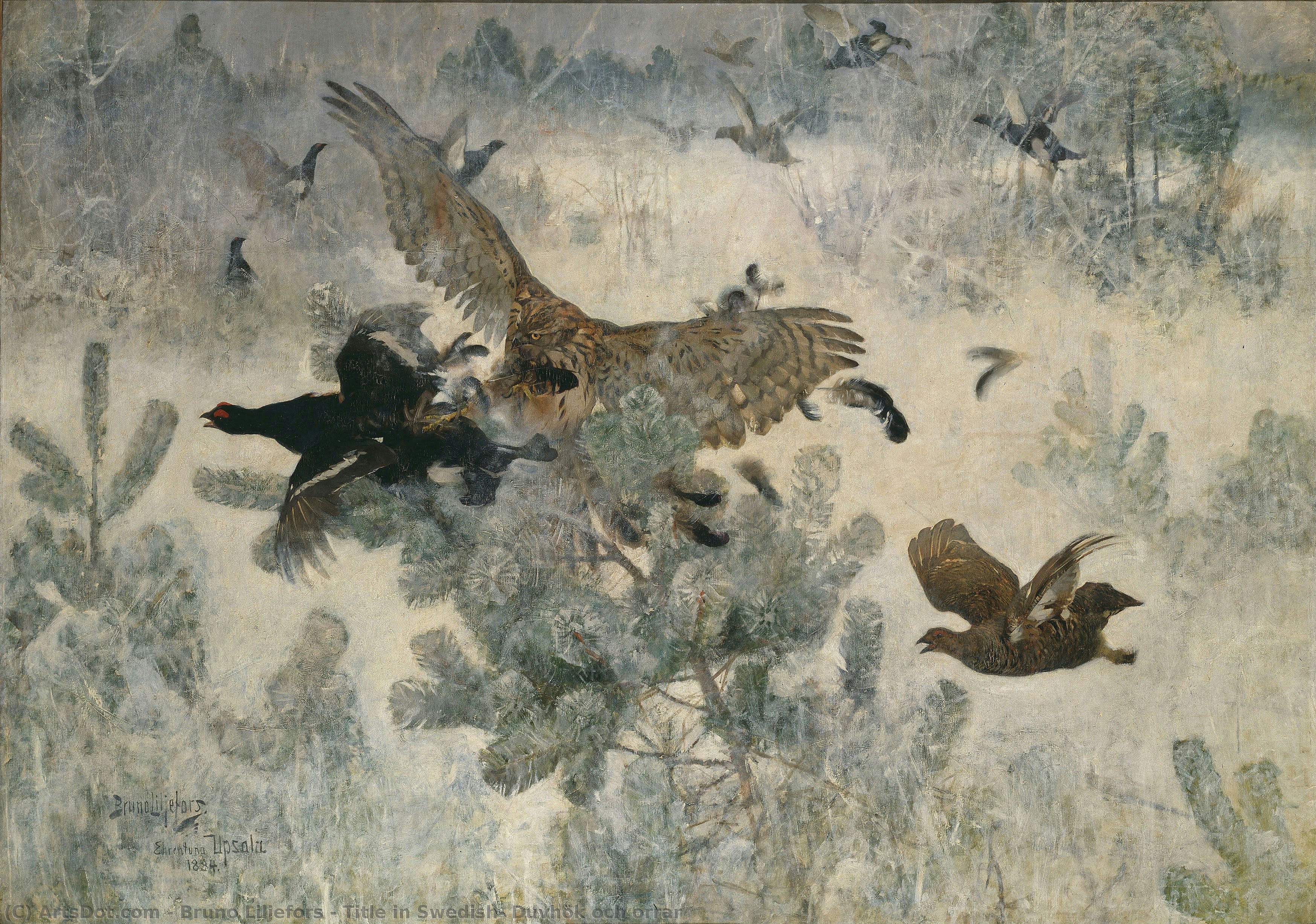
StatsTitle in Swedish: Duvhök och orrar
 Acrylic On Canvas
- WallArt
- Impressionistic Techniques
 1884
1884 2030.0 x 1430.0 cm
 Nationalmuseum
 Weiterlesen
Giclée / Kunstdruck
Giclée- oder Leinwanddruck in Museumsqualität mit schneller Produktion und flexiblen Veredelungsoptionen. ( Handgemalte Reproduktion bestellen Switch to Digital Image)




P118B $10

P118H $10

P118W $10

P438Z $10

P508JH $12

P508YH $12

P805H $10

P805Z $10

P919BZ $10

P919G $10

P919XJ $10

P959ZH $10

P968JZ $12

W106C $8

W218G $10

W218JH $8

W218Y $10

W307PJ $10

W316G $10

W316PJ $8

W316Y $10

W398PJ $8

W4111J $10

W500HY $15

W500JH $15

W692G $12

W849H $8

W940BG $15

W953PJ $8




Wählen Sie aus unseren vordefinierten Formaten, die den ursprünglichen Proportionen des Kunstwerks entsprechen.

Sie können Ihre eigenen Maße eingeben, um ein bestimmtes Format oder einen speziellen Platz einzupassen. Wenn das von Ihnen gewählte Format nicht den Proportionen des Originalbildes entspricht, werden wir das Kunstwerk entweder beschneiden oder das Bild mit einem gespiegelten oder einfarbigen Rand erweitern. Ein digitaler Entwurf wird Ihnen zur Genehmigung zugesandt, bevor die Produktion beginnt.
Bitte beachten Sie, dass die Vorschau auf dem Bildschirm nicht den tatsächlichen Zuschnitt oder die Erweiterung widerspiegelt. Nur der Entwurf zeigt die endgültige Komposition präzise an.
Obwohl Sondermaße verfügbar sind, empfehlen wir die Auswahl eines Maßes aus der vordefinierten Liste, um die ursprünglichen Proportionen zu bewahren.
Weltweiter Versand () innerhalb von 2 Wochen statt der üblichen 4/5 Wochen. (8 September)

Kostenloser weltweiter Expressversand

Hochwertige Leinenleinwand

Umfassender Versicherungsschutz beim Versand

Zollgebühren-Rückerstattungsgarantie

Garantie für exakte Farbtreue

100-Tage-Rückgaberecht (nur bei Mängeln)

100% Geld-zurück-Garantie

Mengenrabatt verfügbar
 Die Glasoption ist nur für Größen unter 110 cm verfügbar.

Title in Swedish: Duvhök och orrar
Giclée / Kunstdruck
Format der Reproduktion
-


Gesamtpreis
$ 62
A Symphony of Winter’s Grip: Exploring Bruno Liljefors' Duvhök och Orrar
Bruno Liljefors’ “Duvhök och Orrar” – translated as “Hawk and Owls” – isn’t merely a painting; it’s a distillation of the Swedish winter landscape, imbued with an arresting immediacy that speaks to both scientific observation and profound artistic emotion. Completed in 1884, this monumental canvas embodies Liljefors' signature style: a breathtakingly realistic portrayal of wildlife interwoven with Impressionistic brushstrokes that capture the ephemeral beauty of fleeting moments. It resides within the Uppsala Kunsthalle’s collection, securing its place as one of Sweden’s most treasured artistic achievements.The Scene Unfolds: Observation and Artistic Capture
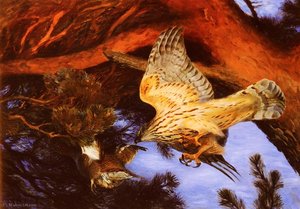
The painting depicts a snowy field teeming with black grouse – *Tetrao tetrax* – their plumage rendered in meticulous detail against the stark white expanse. Dominating the composition is a goshawk (*Accipiter gentilis*) poised mid-strike, its powerful wings outstretched as it pursues a juvenile hawk. Liljefors’ genius lies not just in accurately depicting these birds but in conveying the palpable tension of their encounter – the drama of survival played out against the backdrop of winter's unforgiving cold. He meticulously recreated this scene outdoors, applying grey-white paint thinly with a half-dry brush to achieve an atmospheric effect that perfectly embodies the swirling snow and biting wind characteristic of Ärentuna, north of Uppsala where Liljefors spent his winters.Technique and Impressionistic Vision
Liljefors’ technique was revolutionary for its time. Rejecting academic conventions, he embraced Impressionism's focus on capturing light and color as perceived by the eye – a bold departure from traditional artistic representations. Yet, unlike many Impressionists who prioritized fleeting impressions, Liljefors combined this approach with painstaking anatomical accuracy. He painstakingly studied specimens of hawks and grouse, meticulously sketching them before applying his vibrant palette to canvas. The resulting texture is remarkable; visible brushstrokes create a sense of movement and dynamism, mirroring the frantic activity of the birds themselves. This layering of technique – observation coupled with Impressionistic artistry – elevates “Duvhök och Orrar” beyond mere depiction into an immersive experience for the viewer.Historical Context: Liljefors' Pursuit of Naturalism
Liljefors’ artistic endeavors were driven by a fervent belief in the importance of portraying nature truthfully. He was deeply influenced by Darwinian theory, recognizing the interconnectedness of all living organisms and striving to capture their essence with uncompromising realism. The painting reflects the broader intellectual currents of its era – a burgeoning interest in scientific inquiry alongside an appreciation for the sublime beauty of the natural world. It stands as testament to Liljefors’ conviction that art could illuminate the wonders of existence and inspire awe.Symbolism: More Than Just Birds
Beyond its stunning visual impact, “Duvhök och Orrar” carries symbolic weight. The hawk represents power and dominance, while the juvenile hawk symbolizes vulnerability and innocence – a poignant juxtaposition reflecting the cyclical nature of life and death within the ecosystem. The snow itself serves as a metaphor for hardship and resilience, mirroring Liljefors’ own unwavering dedication to his craft despite facing considerable challenges during his lifetime. Ultimately, the painting invites contemplation on themes of predation, survival, and the enduring beauty of the natural world.Emotional Resonance: A Masterpiece That Still Captivates
“Duvhök och Orrar” transcends mere artistic skill; it evokes a profound emotional response. The painting’s dynamism captures the thrill of observation, transporting the viewer to the frozen landscape of Ärentuna and immersing them in the drama of the avian world. It speaks to our primal fascination with wildlife and reminds us of the fragility of existence within the grand scheme of nature. Liljefors' ability to convey both scientific precision and emotional depth solidified his legacy as one of Sweden’s greatest artists—a painter who dared to confront the sublime beauty and inherent brutality of the natural world, resulting in a timeless masterpiece that continues to inspire admiration and contemplation today.Ähnliche Kunstwerke

Über den Künstler
Frühe Jahre und Ausbildung
- Geburt und Familie: Carl Larsson wurde am 28. Mai 1853 in Falun, Schweden, geboren. Seine Eltern waren Johan Larsson, ein Minenarbeiter, und Carolina f. Fahlström. Er hatte zwei ältere Geschwister.
- Kindheit in Falun: Carl verbrachte seine Kindheit in der malerischen Umgebung von Falun, die durch ihre Holzhäuser mit roten Dächern und die umliegende Berglandschaft geprägt war. Diese frühen Eindrücke beeinflussten später sein künstlerisches Schaffen.
- Ausbildung: Nach dem Besuch der örtlichen Schule absolvierte Carl eine Lehre als Gravierer in Falun. Anschließend zog er nach Stockholm, um seine künstlerische Ausbildung zu vertiefen.
- Akademie und Privatunterricht: In Stockholm besuchte Carl die Königliche Akademie der Bildenden Künste sowie Privatunterricht bei verschiedenen Künstlern, darunter Johan Fredrik Sjöström und August Blanche. Er konzentrierte sich auf das Studium der Porträtmalerei und des Landschaftsmalereis.
Künstlerische Entwicklung und Durchbrüche
- Frühe Werke: In seinen frühen Werken zeigte Carl Larsson Einflüsse der realistischen Malerei des 19. Jahrhunderts. Er malte Porträts, Landschaften und Genre-Szenen.
- Reisen nach Paris: Zwischen 1878 und 1880 reiste Carl Larsson mehrmals nach Paris, wo er sich mit anderen Künstlern austauschte und neue Inspirationen fand. Er lernte die impressionistischen Maltechniken kennen.
- Durchbruch mit "Zigeunerfamilie": 1881 erzielte Carl Larsson seinen ersten großen Erfolg mit dem Gemälde "Zigeunerfamilie", das auf der Ausstellung der Akademie gezeigt wurde. Das Werk erregte Aufsehen und brachte ihm Anerkennung ein.
- Einflüsse des Impressionismus: Nach seiner Rückkehr nach Schweden begann Carl Larsson, impressionistische Elemente in seine Malerei zu integrieren. Er arbeitete mit helleren Farben und lockeren Pinselstrichen.
Das Bofors-Ideal und die Darstellung des Familienlebens
- Heirat mit Karin Bergöö-Larsson: 1880 heiratete Carl Larsson Karin Bergöö, eine talentierte Künstlerin und Illustratorin. Die beiden lebten in einer engen Partnerschaft und inspirierten sich gegenseitig.
- Umzug nach Bofors: 1893 zogen Carl und Karin Larsson mit ihren Kindern auf das Gut Bofors, wo sie ein neues Zuhause schufen. Das Haus wurde zu einem Ort der Kreativität und des Familienlebens.
- Darstellung des Familienlebens in Bildern: In seinen Gemälden und Illustrationen stellte Carl Larsson das Leben seiner Familie auf dem Gut Bofors dar. Er malte Szenen aus dem Alltag, Porträts seiner Kinder und Landschaften von Bofors.
- Das "Bofors-Ideal": Die Darstellung des Familienlebens in Carls Bildern trug zur Entstehung eines idealisierten Bildes vom schwedischen Bürgertum bei. Das "Bofors-Ideal" wurde zum Inbegriff von Geborgenheit, Glück und Kreativität.
Spätere Jahre und Vermächtnis
- Weitere Ausstellungen und Ehrungen: Im Laufe seiner Karriere zeigte Carl Larsson seine Werke auf zahlreichen Ausstellungen in Schweden und im Ausland. Er erhielt zahlreiche Ehrungen für sein künstlerisches Schaffen.
- Künstlerische Reise nach Italien: 1904 reiste Carl Larsson mit seiner Familie nach Italien, wo er sich von der Kunst des Landes inspirieren ließ. Er malte Landschaften und Porträts italienischer Bürger.
- Tod und Begräbnis: Carl Larsson starb am 22. Januar 1919 in Bofors. Er wurde auf dem Friedhof von Falun begraben.
- Vermächtnis als schwedischer Nationalkünstler: Carl Larsson gilt als einer der bedeutendsten schwedischen Nationalkünstler des 19. und 20. Jahrhunderts. Seine Werke sind in zahlreichen Museen und Sammlungen zu sehen.
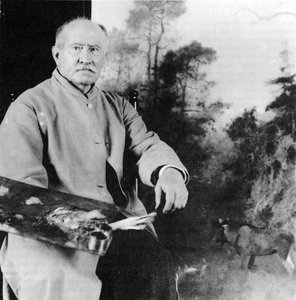
Bruno Liljefors
1860 - 1939 , Schweden
Kurzinfos
- Beeinflusste Künstler:
- Claude Monet
- Pierre-Auguste Renoir
- Beeinflusste Künstler/Stile:
- Schwedische Malerei
- Innenarchitektur
- Bemerkenswerte Werke:
- Midsummer Celebration
- Karin Sealing Letters
- Christmas Morning at Home
- Sunlit Springtime
- Geburtsdatum: 23 September 1855
- Geburtsort: Backsta, Schweden
- Künstlerische Richtung: Impressionismus
- Nationalität: Schwedisch
- Todestag: 28 Januar 1919
- Vollständiger Name: Carl Larsson
Ähnliche Artikel
Impressionismus Meisterwerke: Die Top 10 Kunstwerke für Ihr Zuhause | ArtsDot
Entdecken Sie die Top 10 Meisterwerke des Impressionismus! Von Monet bis Renoir – erfahren Sie die Geschichten hinter berühmten Gemälden, Techniken & Farben. Hochwertige Kunstdrucke auf ArtsDot.com.
Feathered Visions: A Historical & Artistic Exploration of Birds in Painting
Explore the rich history of birds in painting! Discover symbolism, artistic movements & master artists like Audubon. High-quality reproductions available at ArtsDot.

Paul Cézanne: Die 25 Meisterwerke des Impressionismus | ArtsDot
Entdecken Sie die 25 Meisterwerke von Paul Cézanne! Tauchen Sie ein in die Welt des Impressionismus und Postimpressionismus. Erfahren Sie mehr über seine Stillleben, Landschaften & berühmten Gemälde – jetzt hochwertige Kunstdrucke auf ArtsDot.com.
The Pursuit of Power & Prestige: Hunting Scenes in Western Art
Explore the rich history of hunting scenes in Western art, from royal pursuits to powerful allegories. Discover masterpieces & expert insights for discerning collectors. ArtsDot offers museum-quality reproductions.
Impressionismus und Postimpressionismus: Eine vergleichende Analyse
Entdecken Sie die Welt des Impressionismus und Postimpressionismus! Expertenwissen über Künstler wie Monet, Van Gogh & Cézanne. Jetzt lesen!