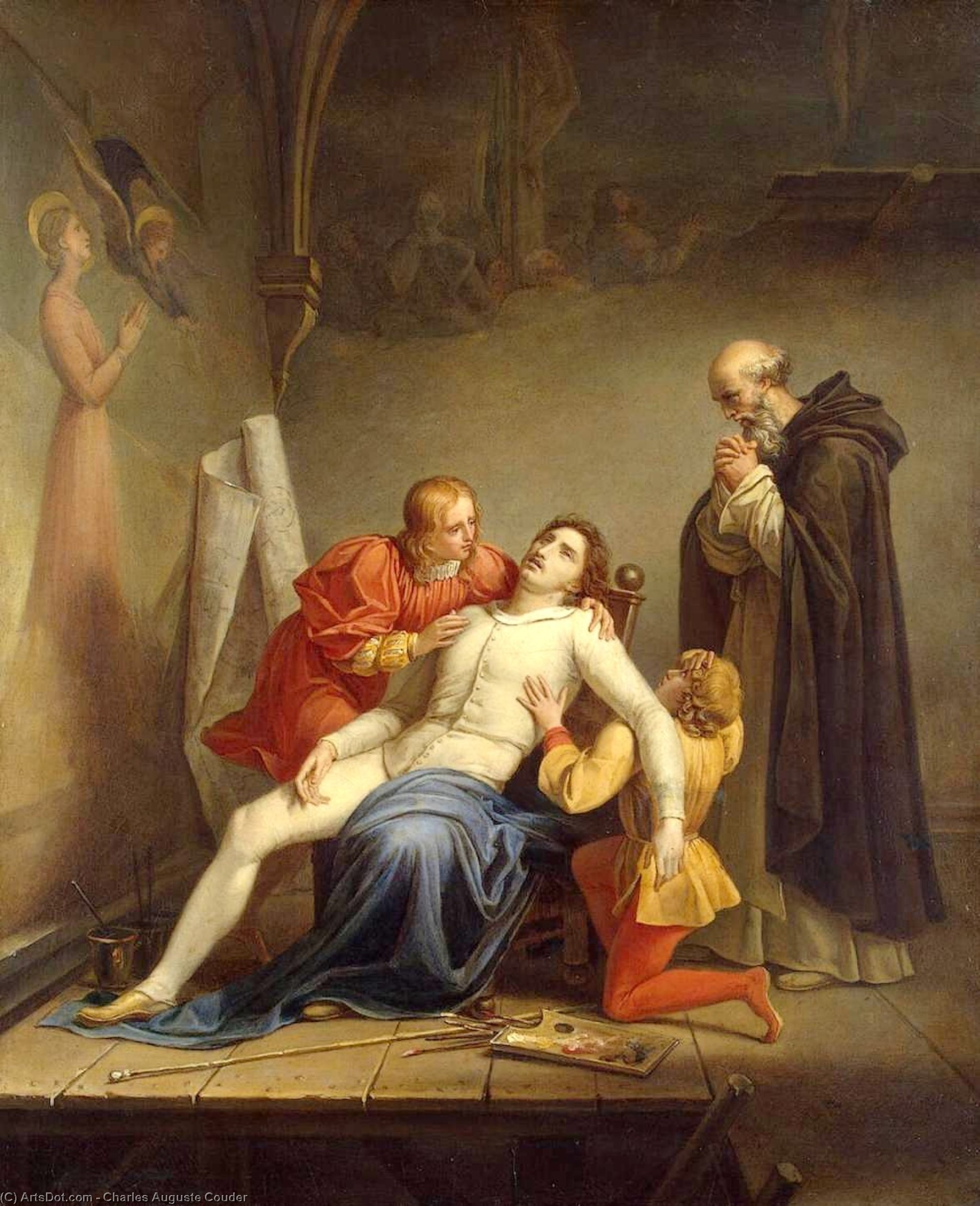
Explore Charles Couder’s ‘Death of Masaccio,’ a dramatic Neoclassical painting depicting Saint Denis’ martyrdom. Admire its rich detail, strong composition & poignant emotion.
Louis-Charles-Auguste Couder (1789-1873): Französischer Maler bekannt für historische Szenen, Schlachten wie die Belagerung von Yorktown & fesselnde Porträts. Ausgebildet von David & Regnault.
Entdecken Sie die Kunstschätze des weltberühmten Eremitage Museums in St. Petersburg! Renaissance bis Moderne – ein kulturelles Erlebnis erwartet Sie.
A Neoclassical Reverie on Martyrdom: Exploring Couder’s ‘Death of Masaccio’
Louis-Charles-Auguste Couder's “Death of Masaccio” stands as a testament to the enduring influence of classical ideals within 19th-century French art. Executed in 1817, this canvas reproduction captures a poignant scene from religious history—the martyrdom of Saint Denis—rendered with meticulous detail and imbued with an emotional depth that speaks volumes about its era. More than just a depiction of biblical narrative, it’s a carefully constructed meditation on sacrifice and faith, reflecting the artistic sensibilities of a period grappling with revolutionary fervor and imperial ambition.
Composition & Technique: Order Amidst Suffering
The painting's visual impact is immediately striking due to its tightly organized composition. Couder employs a pyramidal structure, anchoring the central figure—the prone body of Saint Denis—with supporting figures who convey unwavering devotion. A prominent diagonal line originating from the fallen saint directs the viewer’s gaze across the canvas, fostering a sense of immediacy and immersing them in the dramatic unfolding of events. The artist skillfully utilizes perspective to flatten the space, prioritizing narrative clarity over illusionistic depth – a hallmark of Neoclassical style. Oil paint on canvas ensures smooth surfaces and rich colors, complemented by precise lines delineating architectural elements and drapery, mirroring the precision demanded by David’s tutelage. Texture is deliberately subdued, emphasizing form and conveying solemnity rather than distracting from the central subject matter.
Symbolism & Context: Echoes of Michelangelo
Couder's artistic vision transcends mere representation; it incorporates potent symbolic elements that enrich its narrative significance. The inclusion of Saint Denis’ corpse serves as a focal point for contemplation on mortality and spiritual suffering, mirroring themes prevalent in Renaissance art—particularly those explored by Michelangelo Buonarroti. Tools of torture – notably the skinning knife – underscore the brutality of martyrdom while simultaneously highlighting the artist's palette and the presence of onlookers representing witnesses to this sacred ordeal. The backdrop features a stylized depiction of Calvary, referencing Jesus Christ’s crucifixion and establishing a parallel between Saint Denis’ sacrifice and divine redemption. This deliberate juxtaposition underscores Couder’s intention to elevate the scene beyond a simple historical record into a profound statement about faith and human endurance.
A Reflection of Romantic Sentiment
Despite its adherence to classical conventions—balanced composition, sharp lines, subdued textures—“Death of Masaccio” possesses an undeniable emotional resonance that anticipates the burgeoning Romantic movement. The dramatic lighting – emanating from an unseen source above – casts deep shadows emphasizing Saint Denis’ anguish and conveying a palpable sense of sorrow. Couder's masterful rendering captures not only the physical posture of the martyr but also his inner turmoil, mirroring the Romantic preoccupation with subjective experience and emotional intensity. This subtle infusion of feeling distinguishes Couder’s work from the more austere aesthetic of its time, cementing its place as an exemplar of Neoclassical art infused with humanist compassion.
Concluding Remarks: An Artistic Legacy
Louis-Charles-Auguste Couder's “Death of Masaccio” remains a captivating artwork—a beautifully executed reproduction that embodies the spirit of its era and honors the legacy of artistic giants like David and Regnault. Its meticulous attention to detail, combined with its thoughtful exploration of religious symbolism and emotional depth, continues to inspire admiration among art historians and collectors alike.