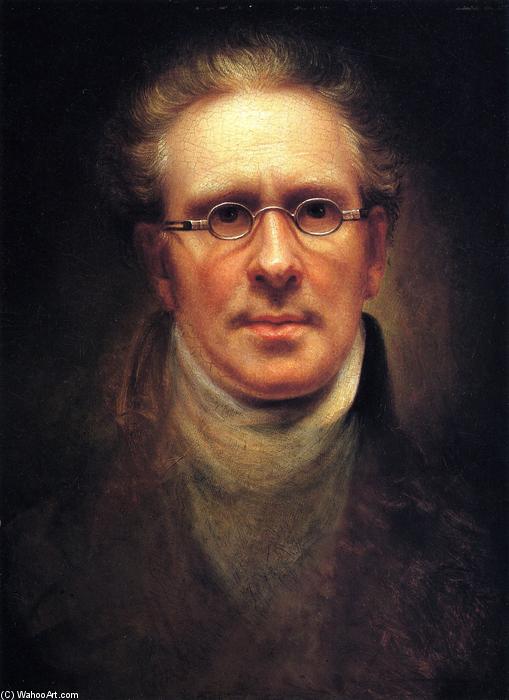
A Window into the Soul: Rembrandt Peale’s Self-Portrait
Rembrandt Peale's 1828 “Self-Portrait” isn’t merely a likeness; it’s a carefully constructed meditation on identity, artistry, and the burgeoning American spirit of the early 19th century. Housed within the Detroit Institute of Arts, this oil painting offers a remarkably intimate glimpse into the mind of a pivotal figure in American art history – a man grappling with his legacy, his craft, and the evolving role of the artist within a rapidly changing nation.
The portrait immediately draws the eye to Peale’s face: a study in weathered wisdom, framed by a neatly trimmed white beard and a pair of spectacles perched upon his nose. His expression is not one of grand pronouncements or theatrical display, but rather a quiet contemplation – a subtle hint of melancholy mingled with an undeniable sense of self-assuredness. The lighting, masterfully rendered, casts a warm glow across his features, highlighting the lines etched by time and experience, suggesting a life richly lived and deeply considered. Notice how Peale’s gaze meets the viewer's directly, creating a powerful connection that transcends centuries.
Neoclassical Precision Meets American Character
Peale’s style firmly anchors this portrait within the Neoclassical tradition, a movement that sought to revive the ideals and aesthetics of ancient Greece and Rome. The composition is meticulously balanced, with the artist positioned centrally against a dark, neutral background – a deliberate choice that directs all attention onto his figure. The brushwork is smooth and controlled, reflecting Peale’s technical skill and dedication to realism. However, there's an underlying sense of informality, a departure from the rigid formality often associated with Neoclassical portraiture. Peale isn’t striving for idealized perfection; he presents himself as a man – flawed, thoughtful, and undeniably human.
Crucially, this self-portrait emerged during a period of significant transformation in America. The early 1820s witnessed the rise of national identity, fueled by westward expansion and a desire to forge a distinct American culture. Peale himself was deeply involved in this cultural project, serving as founder and curator of the Philadelphia Museum (later the Franklin Institute), and later establishing his own museum in Baltimore. His art played a vital role in shaping public perceptions of history, science, and national pride. This self-portrait can be seen as an embodiment of that ambition – a conscious effort to document and celebrate the American experience.
Symbolism and Subtle Details
Beyond the immediate likeness, the portrait is laden with subtle symbolic details. The spectacles, for instance, represent not just Peale’s eyesight but also his intellectual curiosity and commitment to observation – qualities essential to both an artist and a scientist. The tie, neatly knotted around his neck, speaks to his professional standing and adherence to societal norms. But perhaps the most intriguing element is the inclusion of a geranium in a terracotta pot—a detail that has sparked considerable scholarly debate. Some interpret it as a symbol of domesticity and family life, reflecting Peale’s role as a husband and father. Others suggest it represents an early experiment with botanical illustration, aligning with Peale's broader interests in natural history.
The painting’s provenance—its journey through the hands of his family, including Rubens Peale, his brother, a fellow artist—adds another layer of significance. It speaks to the enduring legacy of the Peale family and their contribution to American art and culture. It's a testament to the power of portraiture to capture not just appearances but also the essence of an individual’s life and spirit.
Bringing the Portrait Home
ArtsDot offers meticulously crafted hand-painted reproductions of Rembrandt Peale’s “Self-Portrait,” allowing you to bring this iconic work into your own space. Each reproduction is created by skilled artisans using traditional techniques, ensuring that every detail – from the subtle nuances of Peale's expression to the rich texture of the oil paint – is faithfully preserved. Whether displayed in a formal study or a vibrant living room, this stunning artwork will serve as a timeless reminder of the enduring power of art and the complexities of the human spirit.