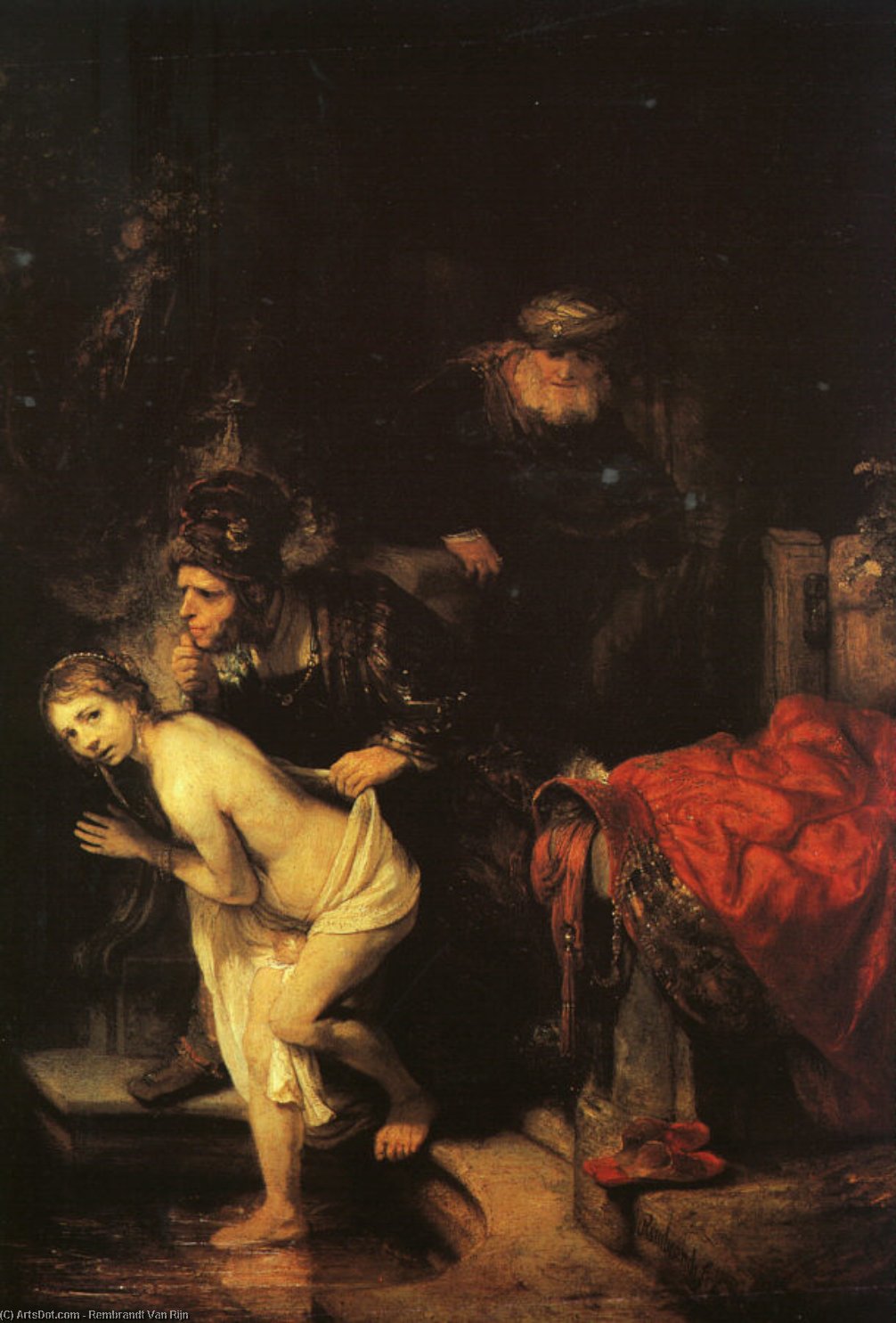
A Scene of Biblical Drama: Unveiling Rembrandt’s *Susanna and the Elders* (Detail)
This captivating detail from Rembrandt van Rijn's *Susanna and the Elders* plunges us into a moment of intense psychological drama, characteristic of the artist’s masterful storytelling. The scene depicts a pivotal moment from the Book of Daniel – Susanna surprised while bathing by two lascivious elders. However, rather than focusing on the act itself, Rembrandt concentrates on the aftermath, or perhaps the *anticipation* of violation, rendering it with profound emotional depth and unsettling realism. This is not merely an illustration of a biblical tale; it’s a study in human vulnerability, moral conflict, and the weight of judgment.
- Rembrandt's Baroque Mastery: Light, Shadow & Technique
- Historical & Symbolic Resonance
- Emotional Impact & Interior Design Considerations
Rembrandt's Baroque Mastery: Light, Shadow & Technique
The fragment exemplifies Rembrandt’s signature Baroque style, most notably his unparalleled command of *chiaroscuro* – the dramatic interplay of light and shadow. Notice how the light doesn’t simply illuminate; it sculpts the figures, highlighting their expressions and emphasizing the tension within the composition. The impasto technique—thickly applied paint—adds a tactile quality to the work, enhancing its realism and drawing the viewer into the scene's immediacy.
Rembrandt wasn’t merely painting *what* he saw, but *how* it felt. His meticulous brushwork and anatomical precision are hallmarks of his artistic genius, demonstrating a deep understanding of the human form and emotional expression. The use of warm earth tones further contributes to the scene's intimacy and gravity.
Historical & Symbolic Resonance
Painted during the Dutch Golden Age (though the exact date remains unknown), *Susanna and the Elders* reflects the period’s fascination with biblical narratives and moral themes. The story of Susanna served as a cautionary tale about temptation, false accusation, and the importance of unwavering faith.
The elders represent unchecked power and lust, while Susanna embodies innocence and virtue. Rembrandt's interpretation moves beyond simple morality, however. He focuses on the psychological toll of the situation – the fear in Susanna’s eyes, the stern resolve of the elder, and the implied distress of a potential witness (likely her mother). The painting invites contemplation on themes of privacy, vulnerability, and the abuse of authority—themes that remain powerfully relevant today.
Emotional Impact & Interior Design Considerations
This detail from *Susanna and the Elders* is not simply a beautiful image; it’s an emotionally resonant work of art capable of sparking conversation and introspection. Its dark, dramatic palette and intense subject matter make it a striking focal point for any interior.
- Consider pairing this reproduction with neutral wall colors to allow the artwork's richness to shine.
- The painting’s Baroque style complements both traditional and contemporary settings, adding a touch of historical sophistication.
- Its intimate scale makes it suitable for smaller spaces like studies or libraries, creating an atmosphere of quiet contemplation.
A high-quality reproduction captures the nuances of Rembrandt’s technique, bringing the power and beauty of this masterpiece into your home.
Additional Research:
This captivating detail from Rembrandt van Rijn's *Susanna and the Elders* plunges us into a moment of intense psychological drama, characteristic of the artist’s masterful storytelling. The scene depicts a pivotal moment from the Book of Daniel – Susanna surprised while bathing by two lascivious elders. However, rather than focusing on the act itself, Rembrandt concentrates on the aftermath, or perhaps the *anticipation* of violation, rendering it with profound emotional depth and unsettling realism. This is not merely an illustration of a biblical tale; it’s a study in human vulnerability, moral conflict, and the weight of judgment.
- Rembrandt Harmenszoon van Rijn
- Biography: Rembrandt Harmenszoon van Rijn, a name synonymous with the Dutch Golden Age and the mastery of light and shadow, was born in Leiden, Netherlands, on July 15, 1606. His arrival coincided with a period of unprecedented prosperity and artistic flourishing for the young republic, a climate that would profoundly shape his life and work. The son of a miller and Neeltgen Willemsdochter van Zuytbrouck, from a family of bakers, Rembrandt received an education at Leiden’s Latin School, providing him with a foundation in classical learning that would later subtly inform his artistic narratives. His early artistic inclinations led to apprenticeships – first with Jacob van Swanenburg in Leiden around 1620, and then, crucially, a six-month period of study under Pieter Lastman in Amsterdam beginning in 1624. It was Lastman’s dramatic use of light and shadow, his dynamic compositions filled with historical and mythological subjects—a stylistic hallmark that would define Rembrandt's oeuvre—that ignited his passion for artistic expression.
- Willem van de Velde the Elder
- Tintoretto: Tintoretto (Jacopo Robusti, 1518–1594) was a Venetian Baroque painter renowned for his detailed pen paintings and depictions of naval battles. Explore his innovative technique & iconic works like 'The Battle of Texel'.
- Susanna - Rembrandt van Rijn Suzanna - Mauritshuis
- Rembrandt
Photo Description:
--Overall Impression-- The artwork is a dramatic oil painting depicting a scene of intense emotion and possibly suffering. It’s a vertical composition dominated by dark tones with strong contrasts between light and shadow. The subject matter appears to be a biblical or mythological scene, featuring a young woman being subjected to a painful procedure – likely circumcision – by an older man who seems stern and resolute. A third figure, presumably her mother, watches with evident distress. The painting utilizes chiaroscuro lighting extensively, creating a sense of drama and highlighting the figures’ faces and bodies. The composition is tightly focused on the central action, drawing the viewer's eye directly to the suffering woman. Lines are used to define the forms of the figures and create a sense of movement, particularly in the drapery and the young woman’s posture. Shapes are predominantly organic – human forms, draped fabrics – with sharp lines defining edges and creating contrast. The texture is rich and impasto-like, characteristic of Rembrandt's technique, adding depth and realism to the scene. Perspective is somewhat flattened, prioritizing emotional impact over strict spatial accuracy. Depth is created through variations in lighting and shadow, as well as the layering of figures within the space. Symbolically, the painting evokes themes of pain, sacrifice, religious duty, and maternal concern. The style is undeniably Rembrandt’s signature Baroque style, known for its dramatic use of light and shadow, emotional intensity, and realistic depiction of human subjects. His meticulous brushwork and anatomical precision are hallmarks of his artistic genius, demonstrating a deep understanding of the human form and emotional expression. The use of warm earth tones further contributes to the scene's intimacy and gravity.