 Vorschau anzeigen
 Versenden
 Teilen
 Details anzeigen

 Herunterladen
 Ähnliche Objekte
 Röntgenaufnahme
 Diashow
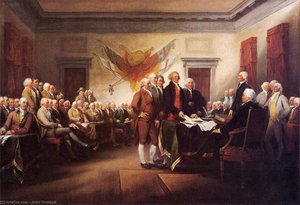
The Declaration of Indepenence


 Weiterlesen
Handgefertigte Ölreproduktion
Handgemaltes Ölgemälde auf Leinwand in Ihrer Wunschgröße und mit Rahmen, auf Bestellung von unseren Künstlern angefertigt. ( Druck bestellen Bild kaufen)




P118B $10

P118H $10

P118W $10

P438Z $10

P508JH $12

P508YH $12

P805H $10

P805Z $10

P919BZ $10

P919G $10

P919XJ $10

P959ZH $10

P968JZ $12

W106C $8

W218G $10

W218JH $8

W218Y $10

W307PJ $10

W316G $10

W316PJ $8

W316Y $10

W398PJ $8

W4111J $10

W500HY $15

W500JH $15

W692G $12

W849H $8

W940BG $15

W953PJ $8




Wählen Sie aus unseren vordefinierten Formaten, die den ursprünglichen Proportionen des Kunstwerks entsprechen.

Sie können Ihre eigenen Maße eingeben, um einen bestimmten Rahmen oder Platz auszufüllen. Wenn die gewählte Größe nicht den Proportionen des Originalbildes entspricht, werden wir das Kunstwerk entweder beschneiden oder das Gemälde durch zusätzliche, handgemalte Elemente erweitern. Ein digitales Mockup wird Ihnen zur Genehmigung zugesandt, bevor die Produktion beginnt.
Bitte beachten Sie, dass die Bildschirmvorschau nicht die tatsächliche Beschneidung oder Erweiterung widerspiegelt. Nur das Mockup zeigt die endgültige Komposition exakt an.
Obwohl Sondermaße verfügbar sind, empfehlen wir, eine Größe aus der vordefinierten Liste zu wählen, um die ursprünglichen Proportionen beizubehalten.
Nach der Bestellung wird das ArtsDot.com-Team dem Kunden Anweisungen per E-Mail zusenden und eine Mockup-Vorschau bereitstellen.
Weltweiter Versand () in nur 3 bis 4 Wochen statt der üblichen 5 Wochen. (24 August). Keine Kompromisse bei der Qualität.

Kostenloser weltweiter Expressversand

Hochwertige Leinenleinwand

Umfassender Versicherungsschutz beim Versand

Zollgebühren-Rückerstattungsgarantie

Garantie für exakte Farbtreue

60 Tage Rückgaberecht (nur bei Mängeln)

100% Geld-zurück-Garantie

Mengenrabatt verfügbar
 Die Glasoption ist nur für Größen unter 110 cm verfügbar.

The Declaration of Indepenence
Art der Reproduktion
Format der Reproduktion
-


Gesamtpreis
$ 263
Beschreibung des Kunstwerks
A Moment Frozen in American History
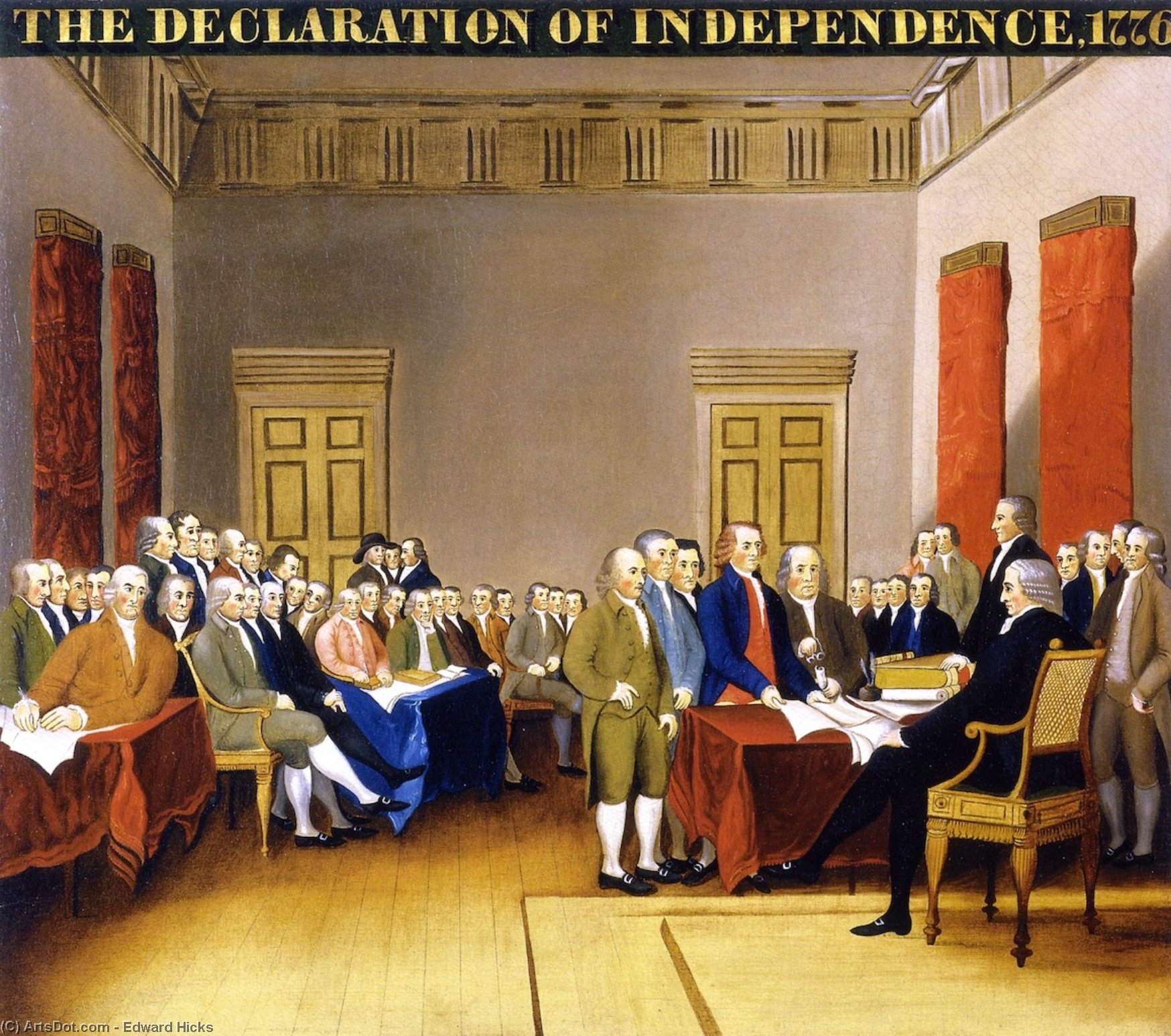
In the grand tapestry of American iconography, few moments resonate with as much profound gravity as the signing of the Declaration of Independence. Edward Hicks, a master of the American folk art tradition, captures this seismic shift in human governance within his 1840 masterpiece, The Declaration of Independence. This oil on canvas work does not merely document a political event; it breathes life into the very spirit of 1776. As one gazes upon the scene, the viewer is transported into a large, solemn chamber where the air seems thick with the weight of destiny. Hicks meticulously arranges a gathering of at least thirteen figures, including the legendary architects of American liberty—George Washington, John Adams, Thomas Jefferson, and Benjamin Franklin. Through his brush, we witness not just a meeting of men, but a convergence of ideals, as they gather around tables and chairs in a formal, historic tableau that feels both intimate and monumental.
The composition is a masterclass in the folk art style, characterized by a unique clarity and an unwavering attention to narrative detail. Unlike the sweeping, dramatic flourishes of European academic painting, Hicks employs a more direct and honest approach. His technique relies on a deliberate use of color and a structured composition that guides the eye through the room, from the seated delegates to the standing observers. There is a rhythmic quality to the placement of the figures, creating a sense of communal purpose. The artist’s background as a Quaker minister subtly informs his hand; there is a certain "inner light" reflected in the clarity of the scene, where every face and gesture contributes to a larger story of unity and sacrifice. For the collector, this painting offers more than just visual beauty; it provides a window into the foundational soul of a nation.
The Artistry of the Folk Tradition
To appreciate The Declaration of Independence is to understand the profound skill of Edward Hicks. Though often categorized as self-taught, Hicks’s mastery of decorative painting—honed during his early years apprenticing with coach makers—is evident in the precise rendering of the room's elements. The textures of the wooden furniture, the arrangement of the dining table, and the formal attire of the delegates are all executed with a meticulousness that honors the historical gravity of the subject. His style avoids unnecessary ornamentation, opting instead for a truthful representation that emphasizes the human element of history. This lack of pretension makes the work incredibly accessible, allowing the emotional weight of the event to take center stage.
For interior designers and art enthusiasts looking to curate a space of distinction, a high-quality reproduction of this work serves as a powerful focal point. The painting carries an inherent dignity that complements both classic and contemporary settings, offering a sense of heritage and intellectual depth. Whether placed in a study, a library, or a formal living area, the piece invites conversation and contemplation. It is an evocative addition to any collection, bridging the gap between historical reverence and aesthetic elegance. Owning a piece of this magnitude—even as a handmade oil painting reproduction—allows one to surround themselves with the enduring legacy of American courage and the timeless beauty of Hicks’s visionary folk art.
Ähnliche Kunstwerke
![Indian Tobacco Shop Sign [rückwärts, Indianer Rechtsblickend] — Winslow Homer, American Folk Realism](/media/artworks/images-thumb/74/22/7422432cafc295265ef3b7f7fa62d35d.jpg)

Über den Künstler
Frühes Leben und Hintergrund
- Geboren: 4. April 1780 in Attleboro (heute Langhorne), Bucks County, Pennsylvania
- Gestorben: 23. August 1849
- Seine Eltern waren Anglikaner, aber er wurde von Matron Elizabeth Twining, einer Quäkerin, aufgezogen. Dies führte ihn schon in jungen Jahren an die quakerischen Glaubensvorstellungen heran.
- Im Alter von dreizehn Jahren begann er eine Lehre bei den Karrenbauern William und Henry Tomlinson und lernte dort Karrenmaltechniken.
- Er verließ die Firma im Jahr 1800, um als unabhängiger Haus- und Karrenmaler zu arbeiten.
Quäkerisches Wirken und künstlerische Entwicklung
- Er wurde 1803 in die Religious Society of Friends aufgenommen und begann regelmäßig an Quäkerversammlungen teilzunehmen.
- Er heiratete Sarah Worstall, ebenfalls eine Quäkerin, und wurde im ganzen Philadelphia ein reisender Prediger.
- Um seine Familie zu unterstützen, erweiterte er seine Malerei um Haushaltsgegenstände, landwirtschaftliche Geräte und Wirtshausschilder.
- Er gab 1815 aufgrund finanzieller Schwierigkeiten kurzzeitig die Zierdekorationsmalerei auf, nahm sie aber 1816 wieder auf.
Künstlerischer Stil und Hauptwerke
- Autodidakt: Hicks war weitgehend autodidaktisch tätig und entwickelte einen einzigartigen Folk-Art-Stil.
- Quäkerische Einflüsse: Seine Arbeit spiegelte die quäkerischen Glaubensvorstellungen vom "Inneren Licht" wider, wobei er persönliche spirituelle Erfahrungen betonte. Dies zeigt sich in seinen einfachen Kompositionen und seinem Fokus auf die Natur.
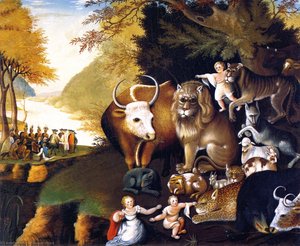
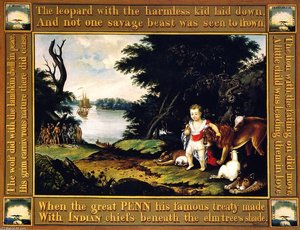
- Die Friedensreich-Serie: Seine berühmteste Serie umfasst 62 Versionen und stellt eine Vision der Harmonie zwischen Mensch und Tier dar, die Frieden und Koexistenz symbolisiert.
- Bemerkenswerte Gemälde:
- Friedensreich (31) – Beherbergt in der Yale University Art Gallery
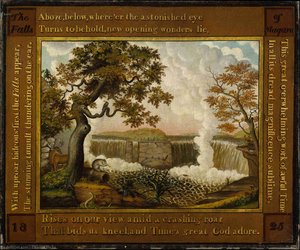
- Niagarafälle – Beherbergt im Abby Aldrich Rockefeller Folk Art Center
- George Washington mit seiner Armee, die den Delaware überquert – Ebenfalls beherbergt im Abby Aldrich Rockefeller Folk Art Center
- Friedensreich (34) - Stellt in einem ruhigen Ölgemälde Noahs Arche dar.
- Grab von William Penn in Jordans, England - Eine Darstellung ländlicher englischer Szenerie, die das quäkerische Erbe zeigt.
Vermächtnis und historische Bedeutung
- Folk-Art-Ikone: Edward Hicks gilt als bedeutende Figur der amerikanischen Folk Art, bekannt für seinen unverwechselbaren Stil und seine wiederkehrenden Themen.
- Darstellung quäkerischer Werte: Seine Gemälde geben wertvolle Einblicke in die Glaubensvorstellungen und Werte der Religious Society of Friends im 19. Jahrhundert.
- Einzigartige künstlerische Vision: Hicks verband religiösen Glauben mit künstlerischem Ausdruck und schuf ein Werk, das sowohl optisch ansprechend als auch spirituell bedeutsam ist.
- Fortwährende Wertschätzung: Seine Werke werden in wichtigen Museen ausgestellt und werden weiterhin für ihre historische und künstlerische Bedeutung studiert und geschätzt.
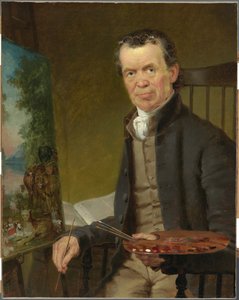
Edward Hicks
1780 - 1849 , Vereinigte Staaten von Amerika
Kurzinfos
- Artistic Movement Or Style: Volkskunst
- Date Of Birth: 4. April 1780
- Date Of Death: 23. August 1849
- Full Name: Edward Hicks
- Nationality: Amerikanisch
- Notable Artworks:
- Peaceable Kingdom (31)
- Falls of Niagara
- George Washington Crossing Delaware
- Peaceable Kingdom (34)
- Grave of William Penn
- Place Of Birth (City And Country): Attleboro, USA
Ähnliche Artikel
Edward Hopper: Die 25 Meisterwerke des amerikanischen Realismus | ArtsDot
Entdecken Sie die 25 Meisterwerke von Edward Hopper! Tauchen Sie ein in amerikanische Kunst, Realismus & Isolation. Hochwertige Reproduktionen & Inspiration für Ihr Zuhause bei ArtsDot.com.
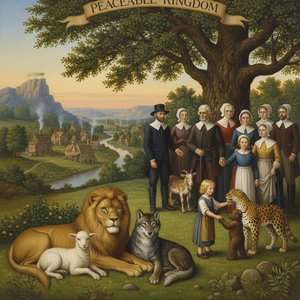
Edward Hicks’ ‘Peaceable Kingdom’: American Folk Art & the Shaping of a National Identity
Explore the profound symbolism & historical context of Edward Hicks’ ‘Peaceable Kingdom.’ Discover how this iconic American folk art masterpiece reflects Quaker values and shaped a nation's identity. Learn more at ArtsDot.
Amerikanischer Realismus: Die 10 Meisterwerke, die eine Ära prägten | ArtsDot
Entdecken Sie die 10 Meisterwerke des Amerikanischen Realismus! Von Edward Hopper bis Winslow Homer – erleben Sie die Geschichten, Techniken & zeitlose Schönheit. Hochwertige Kunstdrucke auf ArtsDot.com.
Grant Wood und der amerikanische Regionalismus: Identität, Mythos und die ländliche Landschaft
Entdecken Sie Grant Wood und den amerikanischen Regionalismus! Erfahren Sie mehr über 'American Gothic', Woods Leben, Einflüsse und sein Vermächtnis in der Kunstgeschichte. Expertenwissen & hochwertige Reproduktionen.
Shadow Catcher: Edward S. Curtis & the Ethnographic Portraiture of a Vanishing West
Explore the life & work of Edward S. Curtis, the 'Shadow Catcher,' and his groundbreaking photographic documentation of Native American cultures. Discover iconic images from *The North American Indian* and a critical look at his lasting legacy.