

 Vorschau anzeigen
 Versenden
 Teilen
 Details anzeigen

 Herunterladen
 Ähnliche Objekte
 Röntgenaufnahme
 Diashow
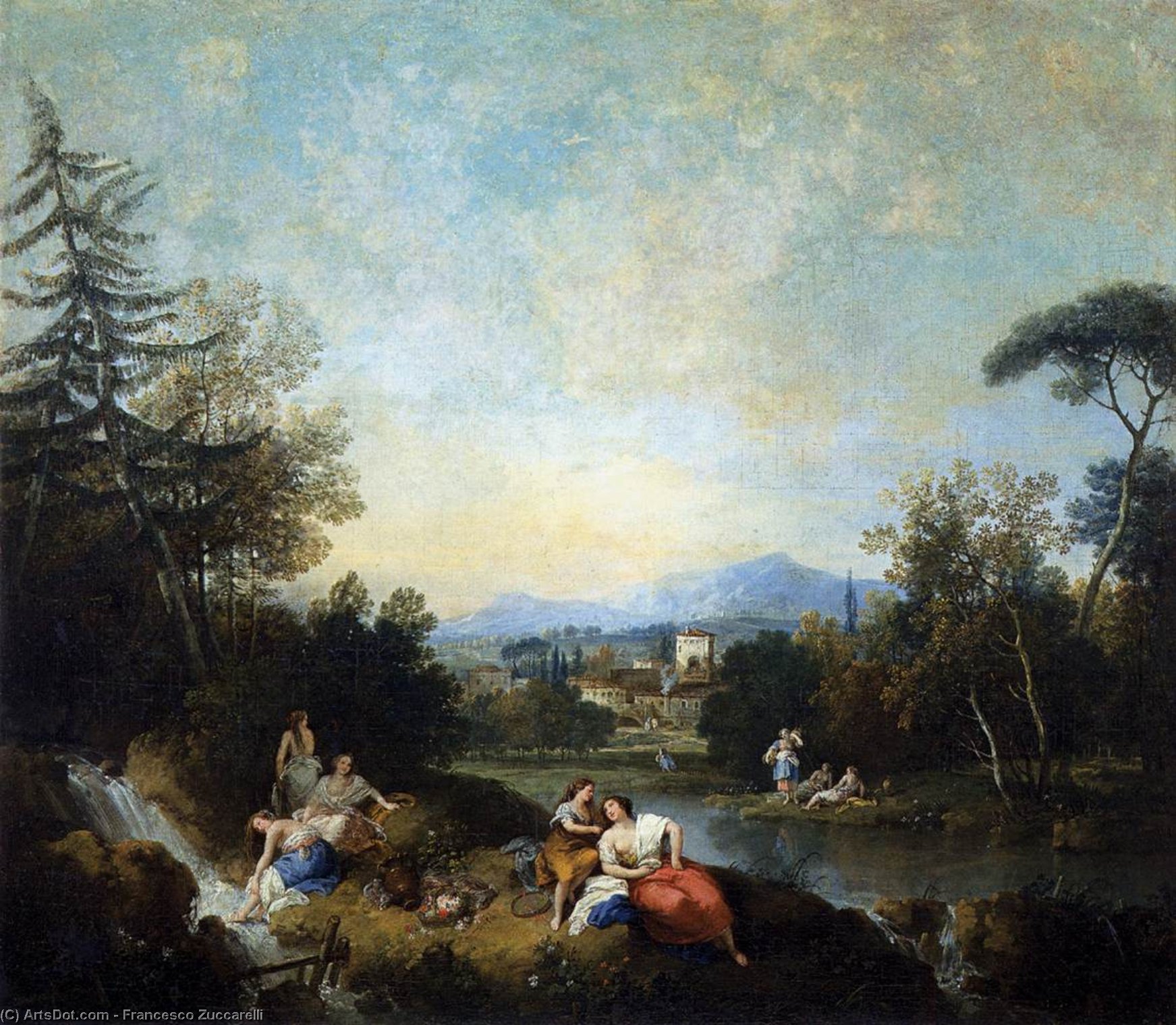
Landscape with Girls at the River
 Oil On Canvas
- WallArt
- Baroque
 1760
1760 118.0 x 137.0 cm
 Gallerie dell’Accademia
 Weiterlesen
Erwerben Sie ein hochauflösendes, optimiertes digitales Bild, das der Online-Vorschau weit überlegen ist.
Jede Datei wird von unseren hauseigenen Spezialisten mit modernsten Werkzeugen und fachmännischer manueller Retusche sorgfältig vorbereitet. Wir stellen sicher, dass jedes Bild eine außergewöhnliche Klarheit, präzise Farbgenauigkeit und feinste Details aufweist.
Die endgültige Datei wird innerhalb von 72 Stunden per E-Mail zugestellt und ist für den sofortigen Einsatz in professionellen, redaktionellen und Druckumgebungen optimiert. Es handelt sich um dieselbe Qualität, der führende Designstudios, Verlage und Galerien vertrauen.
Digitales Bild
Laden Sie eine hochauflösende Datei für die persönliche Präsentation, den Druck und kreative Projekte herunter. ( Druck bestellen Handgemalte Reproduktion bestellen)
In jeder Bestellung digitaler Bilder enthalten
Professionelle digitale Bereitstellung, garantiert
Wenn Sie sich für ArtsDot.com entscheiden, erhalten Sie nicht nur ein Bild – Sie erhalten ein professionell aufbereitetes digitales Kunstwerk, das mit höchster Präzision erstellt und durch eine Zufriedenheitsgarantie abgesichert wird. Hier ist alles, was automatisch mit Ihrer Bestellung geliefert wird:

Schnelle E-Mail-Zustellung
Ihre hochauflösende digitale Bilddatei wird Ihnen innerhalb von 72 Stunden nach der Bestellung per E-Mail zugestellt – bereit zur sofortigen Verwendung.

KI-optimierte digitale Datei
Ihre Kunstwerke werden professionell mithilfe fortschrittlicher KI-Tools und manueller Bearbeitung optimiert, um maximale Detailtreue, Klarheit und Farbgenauigkeit zu gewährleisten.

Lebenslanger kostenloser Neudruckservice
Datei versehentlich gelöscht oder verloren? Keine Sorge – wir senden sie Ihnen jederzeit kostenlos erneut zu.

Keine Einfuhrgebühren – jemals
Genießen Sie Ihr Kunstwerk sofort ohne Zollgebühren, Einfuhrabgaben oder Versandkosten – digitale Downloads sind immer steuerfrei.

Garantierte Farbtreue
Wir garantieren, dass Ihr digitales Bild mithilfe professioneller Werkzeuge und Farbmanagement die Originalfarben so präzise wie möglich wiedergibt.

60-Tage-Zufriedenheitsgarantie
Sollten Sie mit Ihrem digitalen Bild nicht zufrieden sein, werden wir es überarbeiten oder Ihnen innerhalb von 60 Tagen 100% erstatten – ohne Wenn und Aber.

100% Geld-zurück-Garantie
Nicht zufrieden? Erhalten Sie innerhalb von 60 Tagen nach Erhalt Ihrer digitalen Datei eine vollständige Rückerstattung – ohne Angabe von Gründen.

Rabatte bei Großbestellungen
3 Bilder kaufen, 10% sparen – 5 Bilder kaufen, 15% sparen – Ab 10 Bildern 20% sparen. Ideal für kreative Projekte, Galerien und Agenturen.
Details zum Sammlerstück
A Serene Vision of Pastoral Idyl – Francesco Zuccarelli’s “Landscape with Girls at the River”
Francesco Zuccarelli's "Landscape with Girls at the River," painted in 1760, is more than just a picturesque scene; it’s a carefully constructed meditation on beauty, leisure, and the harmonious relationship between humanity and nature. Emerging from the vibrant artistic milieu of Venice during the late Baroque and Rococo periods, Zuccarelli established himself as one of the foremost landscape painters of his time, renowned for his ability to evoke an almost dreamlike quality within his compositions. This particular work exemplifies his signature style – a blend of classical restraint and exuberant detail, creating a world both familiar and subtly enchanting.
The painting depicts a group of young women enjoying themselves by a gently flowing riverbank, surrounded by rolling hills and distant mountains bathed in the soft light of an afternoon. The scene is imbued with a sense of tranquility and contentment, inviting the viewer to step into this idyllic world. Zuccarelli masterfully employs atmospheric perspective – the subtle blurring of details and colors in the distance – to create a convincing illusion of depth, drawing our eyes seamlessly from the foreground’s cascading waterfall and rugged rocks towards the hazy horizon. The artist's use of muted greens, blues, and browns establishes a harmonious palette that reinforces the painting’s overall sense of serenity, while strategically placed patches of brighter color—the vibrant hues of wildflowers and the shimmering reflections on the water—add points of visual interest.
The Artist and His Venetian Roots
Francesco Zuccarelli's artistic journey began in Rome, where he apprenticed under Giovanni Maria Morandi and Pietro Nelli. This early training instilled in him a deep appreciation for classical principles and a meticulous attention to detail. However, it was his relocation to Venice in 1732 that truly defined his career. Venice, with its rich artistic heritage and unique landscape, provided Zuccarelli with the perfect environment to develop his distinctive style. He quickly gained recognition for his ability to capture the beauty of the Venetian countryside – a region characterized by gentle hills, meandering rivers, and picturesque villages – in a way that was both realistic and idealized.
Zuccarelli’s artistic development was further influenced by Paolo Anesi, a Roman painter who specialized in landscape studies. Anesi's focus on tonal values and the use of light and shadow to create depth and atmosphere profoundly impacted Zuccarelli’s approach to painting. This influence is particularly evident in “Landscape with Girls at the River,” where the artist skillfully employs subtle gradations of color to convey a sense of volume and distance, while simultaneously capturing the play of light on water and foliage.
Symbolism and the Arcadian Ideal
The "Landscape with Girls at the River" is deeply rooted in the concept of the “Arcadian” – an idealized vision of rural life that became increasingly popular during the 18th century. The Arcadian ideal represented a retreat from the complexities and anxieties of urban society, offering a sanctuary of peace, beauty, and simplicity. Zuccarelli’s painting perfectly embodies this sentiment, presenting a scene of idyllic leisure where young women are engaged in innocent pursuits by the riverbank.
The presence of the waterfall symbolizes renewal and transformation, while the flowing river represents the passage of time and the continuity of life. The distant mountains, shrouded in mist, evoke a sense of mystery and grandeur, reminding us of the vastness and power of nature. Furthermore, the figures themselves are not merely decorative elements; they represent humanity’s connection to the natural world – a harmonious coexistence that is both aesthetically pleasing and spiritually enriching.
Technique and Materials
“Landscape with Girls at the River” was executed in oil paints on canvas, utilizing a technique characterized by meticulous brushwork and a deep understanding of color theory. Zuccarelli’s attention to detail is remarkable – from the individual blades of grass to the ripples on the water's surface—every element contributes to the painting’s overall sense of realism and immediacy. The artist’s use of layering techniques creates a rich, textured surface that invites close examination.
The canvas itself measures 118 x 137 cm, providing ample space for Zuccarelli to fully realize his vision. The painting's dimensions contribute to its impact, allowing the viewer to appreciate the scale and grandeur of the landscape. The use of a warm, diffused light source further enhances the painting’s atmosphere, creating a sense of warmth and intimacy.
A Legacy of Pastoral Beauty
Francesco Zuccarelli’s “Landscape with Girls at the River” stands as a testament to his artistic skill and his profound understanding of the human condition. It is a timeless masterpiece that continues to captivate viewers with its serene beauty, evocative symbolism, and masterful technique. Reproductions of this painting offer an opportunity to bring this idyllic vision into any space, creating a focal point that celebrates the enduring power of nature and the pleasures of simple living.
Ähnliche Kunstwerke
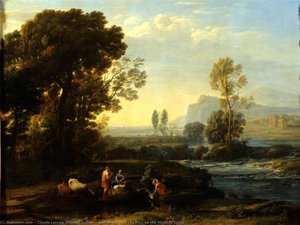
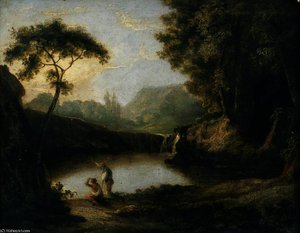
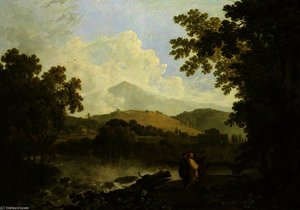
Biografie des Künstlers
Francesco Zuccarelli: Ein Leben zwischen Barock und Rokoko
- Geboren: 15. August 1702 in Pitigliano, Italien
- Gestorben: 30. Dezember 1788 in Florenz, Italien
- Hauptwirkungsort: Venedig, England
- Bekannt für: Landschaftsmalerei, Rokoko- und Barockstil
Frühe Jahre und Ausbildung (1702-1732)
- Zuccarelli wurde in Pitigliano, Süd-Toskana, geboren. Sein Vater besaß Weinberge und einen Laden für Küchenutensilien.
- Mit etwa elf oder zwölf Jahren begann er seine Lehre in Rom bei den Porträtmalern Giovanni Maria Morandi und Pietro Nelli. Dort lernte er die Grundlagen des Designs und absorbierte die Lektionen des römischen Klassizismus.
- Zwischen 1725 und 1727 schuf er seine erste Auftragsarbeit in Pitigliano: ein Paar Altarbilder für eine Kapelle.
- Unter der Schirmherrschaft von Francesco Maria Niccolò Gabburri widmete er sich von 1728 bis 1731 hauptsächlich dem Radieren und fertigte mindestens 43 Drucke an, darunter Serien, die die verfallenen Fresken von Giovanni da San Giovanni und Andrea del Sarto dokumentierten.
- Während seiner Zeit in Florenz begann er, Landschaftsskizzen anzufertigen, was seinen späteren Stil beeinflusste.
- Paolo Anesi, ein römischer Landschaftsmaler und Radierer, gilt als sein wichtigster Mentor in der Landschaftsmalerei.
Die Venezianische Periode und Erfolg (1732-1768)
- 1732 zog Zuccarelli nach Venedig, wo er eine Marktlücke im Bereich der Landschaftsmalerei fand, die durch den Tod von Marco Ricci entstanden war.
- Er kombinierte religiöse und mythologische Themen mit Landschaften und entwickelte einen eigenen Stil, inspiriert von Claude Lorrain und der römischen Schule.
- Seine frühen Gemälde zeigten Einflüsse von Alessandro Magnasco und später von Marco Ricci. Er brachte eine sanftere Palette und höhere Lichtwerte in die venezianische Farbgebung ein.
- Er erlangte schnell Erfolg und Patronage von Persönlichkeiten wie Marshal Schulenburg, Joseph Smith (sein langjähriger Förderer) und Francesco Algarotti.
- 1735 heiratete er Giustina Agata Simonetti und hatte vier Kinder, von denen zwei im Kindesalter starben.
- Zusammen mit Antonio Visentini schuf er eine Serie mit neupalladianischer Architektur (Burlington House, 1746).
- Ein bemerkenswertes Projekt war ein Satz von 52 Spielkarten mit biblischen Themen (Altes Testament), die 1748 in Venedig veröffentlicht wurden.
- Eine Reihe von sieben Leinwänden, die Rebecca mit Jakob und Esau darstellen, befindet sich heute im Windsor Castle.
England und Anerkennung (1768-1788)
- 1768 wurde Zuccarelli zu einem Gründungsmitglied der Royal Academy of Arts in London ernannt.
- Er verbrachte zwei längere Zeiträume in England, wo seine Werke großen Anklang fanden.
- Seine Landschaftsbilder wurden von George III geschätzt.
- Nach seiner Rückkehr nach Italien wurde er zum Präsidenten der venezianischen Akademie gewählt.
- Obwohl er zu Lebzeiten berühmt war, sank sein Ruf im frühen 19. Jahrhundert mit dem Aufkommen des Naturalismus in der Landschaftsmalerei.
- Turner kritisierte ihn zwar mild, erkannte aber die Schönheit seiner Figuren an.
- Michael Levey argumentierte, dass Zuccarellis Erfolg auf der dekorativen Natur seiner Werke beruhte.
Bedeutung und Vermächtnis
- Zuccarelli gilt als einer der bedeutendsten Landschaftsmaler des venezianischen 18. Jahrhunderts.
- Seine Werke beeinflussten die englische Landschaftsmalerei maßgeblich.
- Seit den 1990er Jahren gibt es ein erneutes Interesse an seinem Werk durch italienische Gelehrte, was zu Ausstellungen und Publikationen geführt hat.
- Er schuf nicht nur Gemälde, sondern auch Radierungen, Zeichnungen, Entwürfe für Wandteppiche und sogar Spielkarten.
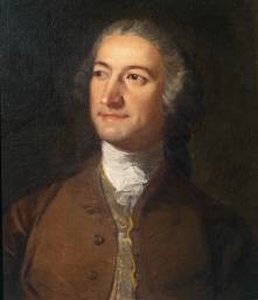
Francesco Zuccarelli
1702 - 1788 , Italien
Kurzinfos
- Beeinflusste Künstler:
- Paolo Anesi
- Alessandro Magnasco
- Marco Ricci
- Bemerkenswerte Werke:
- Bacchanal
- Landschaft mit Figuren
- Kapricio mit San Giorgio
- Pastorale Kapriccio
- Geburtsdatum: 15. August 1702
- Geburtsort: Pitigliano, Italien
- Künstlerische Bewegung: Rococo, Barock
- Nationalität: Italienisch
- Sterbedatum: 30. Dezember 1788
- Vollständiger Name: Francesco Zuccarelli

